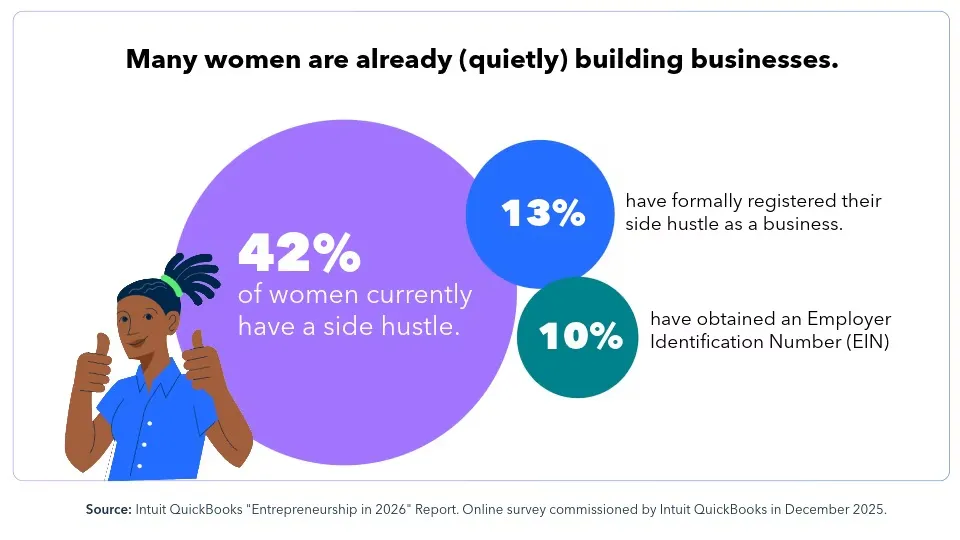
A quarter of women say they plan to start a business in 2026, and more than half say they are considering launching one in the near future, according to recent research into women's entrepreneurship trends. Yet despite this surge in ambition, the capital available to turn those plans into scaled companies remains stubbornly concentrated elsewhere — a gap that continues to define the global conversation around gender and venture funding.
According to recent research from QuickBooks' Women Entrepreneurs study, 25 percent of women plan to start a business in 2026, while 58 percent say they either plan to or would consider launching a venture in the near term. The findings point to a generation of women entering entrepreneurship with greater confidence, better access to low-cost digital tools, and a stronger sense that founding a business is a realistic career path rather than an exceptional outlier ambition. That confidence, however, continues to collide with a persistent and well-documented capital gap. According to Carta's 2024 Annual Equity Report, companies founded exclusively by women received just 5.3 percent of the capital invested through priced equity rounds that year — a figure that, while reflecting a specific dataset and time period, is broadly consistent with the pattern documented across multiple years and geographies: women-founded companies raise substantially less venture capital than their representation among founders would suggest. The gap is particularly pronounced in the transition from early-stage to growth-stage funding. Many women founders report success in raising pre-seed and seed capital, often through founder networks, angel investors, and increasingly, dedicated grant programmes — but face a steeper climb when seeking the larger, later-stage cheques required to scale beyond an initial product-market fit. This pattern has led many observers to describe the core challenge facing women founders not as an absence of promising early-stage companies, but as a systemic thinning of support precisely at the inflection point where capital-efficient growth becomes possible.
In response to this dynamic, a growing ecosystem of dedicated funding mechanisms has emerged specifically to support women entrepreneurs. In Europe, for instance, the Women TechEU programme has become a notable route for early-stage deep-tech teams led by women, offering targeted non-dilutive funding designed to help founders reach the technical and commercial proof points that later-stage investors require. Similar targeted grant and accelerator programmes have proliferated across markets including the United States and India, reflecting a broader recognition among policymakers and institutional investors that closing the funding gap requires more than encouraging more women to start companies — it requires restructuring the pathways through which capital flows once those companies are founded. India's own experience offers a useful, if still evolving, case study. Data compiled by startup-intelligence platforms has previously shown that women-led startups accounted for a meaningful and growing share of the country's unicorn cohort, with cumulative funding to women-led startups rising substantially over the preceding decade, even as that growth started from a comparatively low base. The trajectory illustrates both genuine progress and the scale of the gap that remains: even multi-year, multi-fold increases in absolute funding to women-led companies have, in many markets, still left women founders capturing a small single-digit percentage of total venture capital deployed. Beyond formal capital, the current generation of women entrepreneurs is also notable for how it is building. Industry observers point to a marked shift toward lean, service-first and community-driven business models — leveraging AI tools, no-code platforms and peer founder networks to test demand and generate early revenue before seeking institutional capital at all. This approach, while partly a response to capital constraints, also reflects a broader entrepreneurial philosophy gaining traction across genders: proving a paying customer base before scaling, rather than raising capital to search for one.