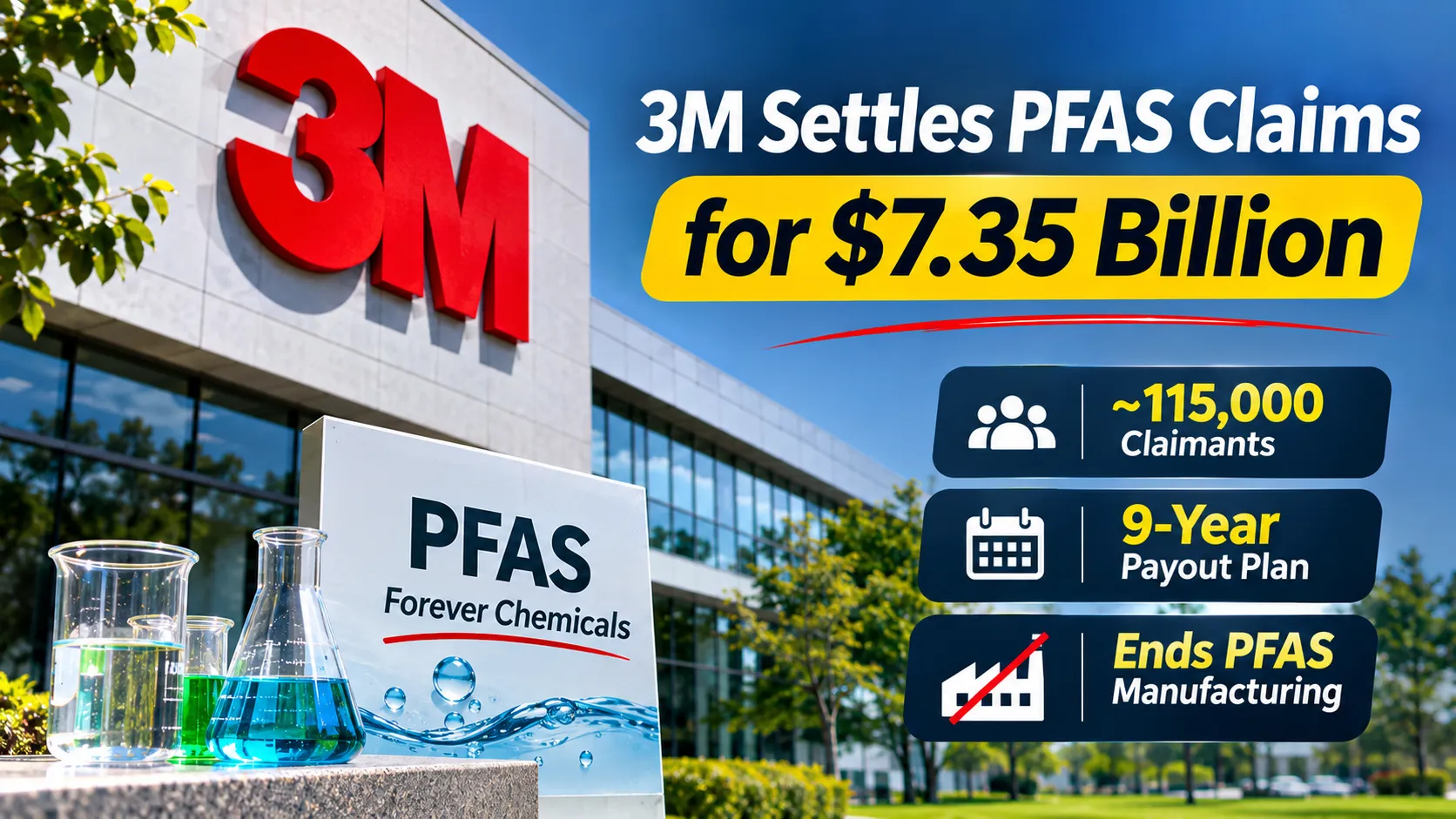
3M, the American industrial conglomerate behind products from Post-it notes to N95 masks, has committed nearly $7.35 billion over nine years to settle personal-injury claims linked to PFAS, the so-called "forever chemicals". It is one of the largest mass-tort resolutions in corporate history.
The company said on Tuesday, November 3, that the settlement addresses about 99% of current personal-injury claims both inside and outside the Aqueous Film-Forming Foam Multi-District Litigation (AFFF MDL). That is the consolidated case in a federal court in South Carolina covering firefighting foams containing PFAS. About 115,000 to 120,000 plaintiffs are eligible to participate.
"This settlement is a significant milestone for 3M and substantially reduces litigation uncertainty," chief executive William Brown said in a statement.
The terms
Payments will be spread over nine years and weighted towards the later period. 3M will make a $50 million payment in 2026 and no payments in 2027, with approximately 20% of the total due in the final two years. The company said the schedule is designed to align with its remaining payment obligations under other legacy settlements.
The present value of the payments is $5.8 billion, which 3M will record as a pre-tax charge in the fourth quarter. The company said the charge is a special item and will not affect its previously issued 2026 earnings guidance. All remaining and future personal-injury claims, both inside and outside the MDL, will be handled through several settlement mechanisms, 3M said.
According to Investing.com, the agreement allows 3M to terminate the settlement if plaintiff participation falls below a set threshold, a standard feature of mass-tort deals. Such clauses are designed to ensure the company achieves meaningful finality.
Investors welcomed the clarity. 3M shares rose 1.7% in late trading in New York, according to Bloomberg. The stock had gained 11% this year through Tuesday's close, in line with the S&P 500.
What are PFAS?
PFAS, short for per- and polyfluoroalkyl substances, are a large family of thousands of synthetic chemicals. They have been widely used since the mid-20th century because they resist heat, water, grease and stains. They have been used in non-stick cookware, waterproof clothing, food packaging, stain-resistant carpets and, critically for this case, firefighting foams used to extinguish fuel fires at airports, military bases and industrial sites.
The same chemical stability that makes PFAS useful also makes them persistent. They break down extremely slowly in the environment and can accumulate in the human body over time, earning the nickname "forever chemicals". Studies have linked exposure to certain PFAS to health problems including liver damage, immune-system effects, developmental issues and some cancers.
The contamination is widespread. A US Geological Survey study has estimated that nearly half of the tap water in the United States contains forever chemicals considered potentially harmful to human health.
A long history of litigation
The latest deal is the next chapter in years of legal battles. Plaintiffs, many of them firefighters and military personnel exposed to firefighting foam, along with residents near manufacturing sites, accused 3M of knowing about the risks posed by PFAS and failing to adequately warn users.
In 2023, 3M reached a separate settlement with a large group of US public water systems to resolve claims over drinking-water contamination. That deal was initially valued at $10.3 billion, with payouts that could reach $12.5 billion over 13 years depending on further contamination found. 3M has also settled claims with individual US states, including an agreement with New Jersey worth up to $450 million.
Other chemical makers face similar litigation. DuPont, its spin-off Chemours, and Corteva agreed to a $1.19 billion settlement with water providers in 2023 and continue to face PFAS-related lawsuits.
As with its earlier settlements, 3M has said its agreements do not constitute an admission of liability.
3M's exit from PFAS
The settlement coincides with the completion of a strategic shift. In December 2022, 3M announced it would stop manufacturing all PFAS globally by the end of 2025. On Tuesday, the company said it had successfully completed that plan. It has also deployed advanced water-treatment technology at sites where it previously produced the chemicals and has said it will continue remediation efforts.
For 3M, which has spent several years restructuring, including the spin-off of its healthcare business as Solventum, resolving the bulk of its PFAS liabilities is a major step towards removing a cloud that has weighed on its valuation and credit profile.
Reaction from plaintiffs' lawyers
Lawyers representing plaintiffs welcomed the agreement. Fred Thompson of Motley Rice, liaison counsel in the MDL, and David Hoyle, a member of the settlement negotiation team, said in a statement that the deal was "welcome news" for the thousands of victims who have sought answers and accountability for nearly a decade.
For firefighters and military personnel, who make up a large share of claimants, the deal could finally bring compensation after years of litigation. Individual payouts will depend on the settlement's allocation process and the circumstances of each claim. The payment timing is likely to draw attention: with only $50 million due in 2026 and nothing in 2027, most of the money will flow in the later years of the nine-year schedule.
Why it matters globally, including for India
The 3M settlement is a landmark in the global reckoning with PFAS, and its implications extend well beyond the United States.
Regulators worldwide are tightening controls on PFAS. The US Environmental Protection Agency has set national drinking-water limits for several PFAS compounds, and the European Union is considering broad restrictions on the entire chemical class. Companies across supply chains, from textiles to electronics, are being pushed to find alternatives.
For India, where regulation and monitoring of PFAS remain at an early stage, the case offers lessons. Indian researchers have detected PFAS in several water bodies, and the country's growing chemicals, textiles and electronics industries use or export products that may contain them. As global buyers demand PFAS-free supply chains, Indian exporters may face both compliance costs and opportunities to supply safer alternatives.
The broader lesson for business leaders is about long-tail risk. Chemicals that were once considered safe and commercially valuable can generate liabilities that last for decades. 3M's $7.35 billion commitment, on top of its earlier settlements, is a costly reminder that environmental and health impacts can ultimately land on the balance sheet.