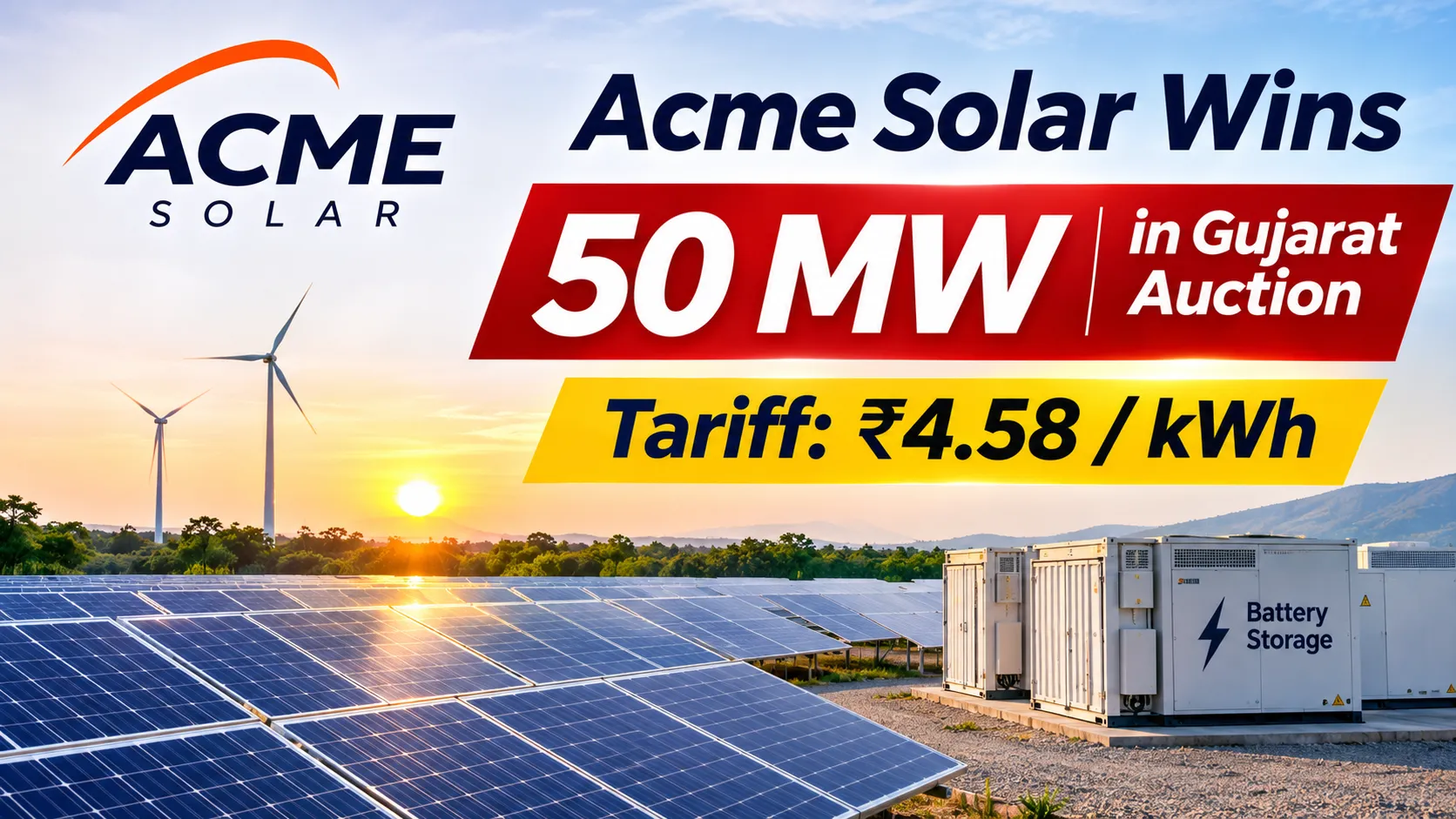
Acme Solar Holdings, one of India's larger independent renewable energy producers, has won 50 MW of capacity in an electronic reverse auction conducted by Gujarat Urja Vikas Nigam Ltd (GUVNL), the state's power procurement utility. The company secured the capacity at a discovered tariff of ₹4.58 per kilowatt-hour, according to a disclosure on November 22.
The capacity is modest compared with the gigawatt-scale projects that dominate headlines in India's renewable energy sector. But the tariff level is notable. At ₹4.58 per unit, the price is well above the record low tariffs of under ₹2.50 per unit seen for plain solar projects in recent years. This suggests the auction was for a more complex product than simple daytime solar power.
Why the tariff matters
India's renewable energy auctions have evolved significantly over the past decade. Early auctions were for plain solar or wind capacity, which generates power only when the sun shines or the wind blows. Intense competition and falling equipment costs drove tariffs to very low levels.
However, plain solar power creates challenges for grid operators. It produces large amounts of electricity in the middle of the day and none at night, when demand often peaks. As solar capacity grows, utilities increasingly need power that is available when consumers need it.
In response, Indian utilities have begun procuring "firm and dispatchable renewable energy" (FDRE), round-the-clock power and hybrid projects that combine solar, wind and battery storage. These products are designed to supply power during peak hours or around the clock, making renewable energy more useful to the grid.
Such projects cost more to build, because they require storage and more generating capacity, so tariffs are higher. A tariff of ₹4.58 per unit is consistent with this kind of firmer supply. GUVNL did not publicly detail the auction's specifications in the disclosure, but the price points to a product designed to deliver more than plain daytime solar.
Acme Solar's growth
Acme Solar Holdings has been one of India's prominent renewable energy developers, with a portfolio spanning solar, wind, hybrid and storage projects across several states. The company listed on Indian stock exchanges in November 2024.
Acme has been an active participant in auctions for complex renewable projects, including FDRE and round-the-clock power. It has also pursued green hydrogen and green ammonia projects, positioning itself for the next stage of India's energy transition.
Gujarat's role in the energy transition
Gujarat is one of India's leading states for renewable energy. It has abundant solar and wind resources, large areas of land suitable for projects and strong transmission infrastructure. The state is home to some of the world's largest renewable energy parks, including the massive Khavda renewable energy park in Kutch.
GUVNL has regularly conducted auctions to procure renewable energy for the state's distribution companies. Its auctions are closely watched by the industry as indicators of pricing trends.
Gujarat is also a major industrial state, with high electricity demand from manufacturing, chemicals, refining and other industries. Reliable, affordable clean power is important for the state's industrial competitiveness and for companies seeking to reduce their carbon footprints.
The storage revolution
The rise of battery storage has been one of the most important developments in India's power sector. Battery costs have fallen sharply in recent years, making it feasible to store solar power generated during the day and release it in the evening.
The government has supported storage through viability gap funding schemes and requirements for storage in new renewable projects. Battery storage tenders have drawn strong interest from developers, and tariffs for storage have fallen significantly.
Combining solar with storage allows developers to offer power during evening peak hours, which is when the grid is most stressed. That makes renewable energy more valuable to utilities and helps reduce reliance on coal-fired power during peak periods.
Market context
India has set an ambitious target of 500 GW of non-fossil fuel capacity by 2030. It has made significant progress, adding record amounts of solar capacity in recent years. However, challenges remain, including transmission bottlenecks, delays in signing power purchase agreements and financial stress at some state distribution companies.
One concern in recent years has been the gap between capacity auctioned and capacity actually contracted. Some projects won in auctions have faced delays because distribution companies were slow to sign power sale agreements. Auctions run directly by state utilities such as GUVNL can reduce this risk because the buyer is clearly identified.
Investor perspective
For investors, firm renewable energy projects offer an attractive combination of long-term contracted revenues and alignment with India's energy transition goals. Higher tariffs can support better returns, although the projects are also more complex and capital-intensive.
Execution risks include equipment supply, land acquisition, grid connection and the performance of battery systems over time. Developers must also manage financing costs, which are sensitive to interest rates.
Acme Solar's ability to win capacity in competitive auctions while maintaining healthy returns will be closely watched by investors following its listing.
Why small wins add up
A single 50 MW award might seem minor, but India's renewable energy expansion is built from many such projects. Developers continuously bid in auctions across states and central agencies, building portfolios that collectively add tens of gigawatts each year.
For The Impactful Global Indian's readers, the auction result illustrates a key shift in India's clean energy market: from simply adding cheap solar capacity to delivering reliable, dispatchable clean power. That shift is essential if renewable energy is to replace coal as the backbone of India's electricity system.
The price discovered in Gujarat suggests that utilities are willing to pay more for firmer renewable supply. As storage costs continue to fall, tariffs for such projects may decline further, making round-the-clock clean power increasingly competitive with conventional generation.
What to watch
Key indicators in the months ahead will include further FDRE and storage auctions, trends in discovered tariffs, and the speed at which awarded projects are contracted and built. Policy support for storage, transmission expansion and the financial health of distribution companies will also shape the sector's trajectory.
For Acme Solar, the immediate task will be to sign the power purchase agreement with GUVNL and move the project into execution. Each such step adds to the gradual transformation of India's power grid towards cleaner and more reliable electricity.