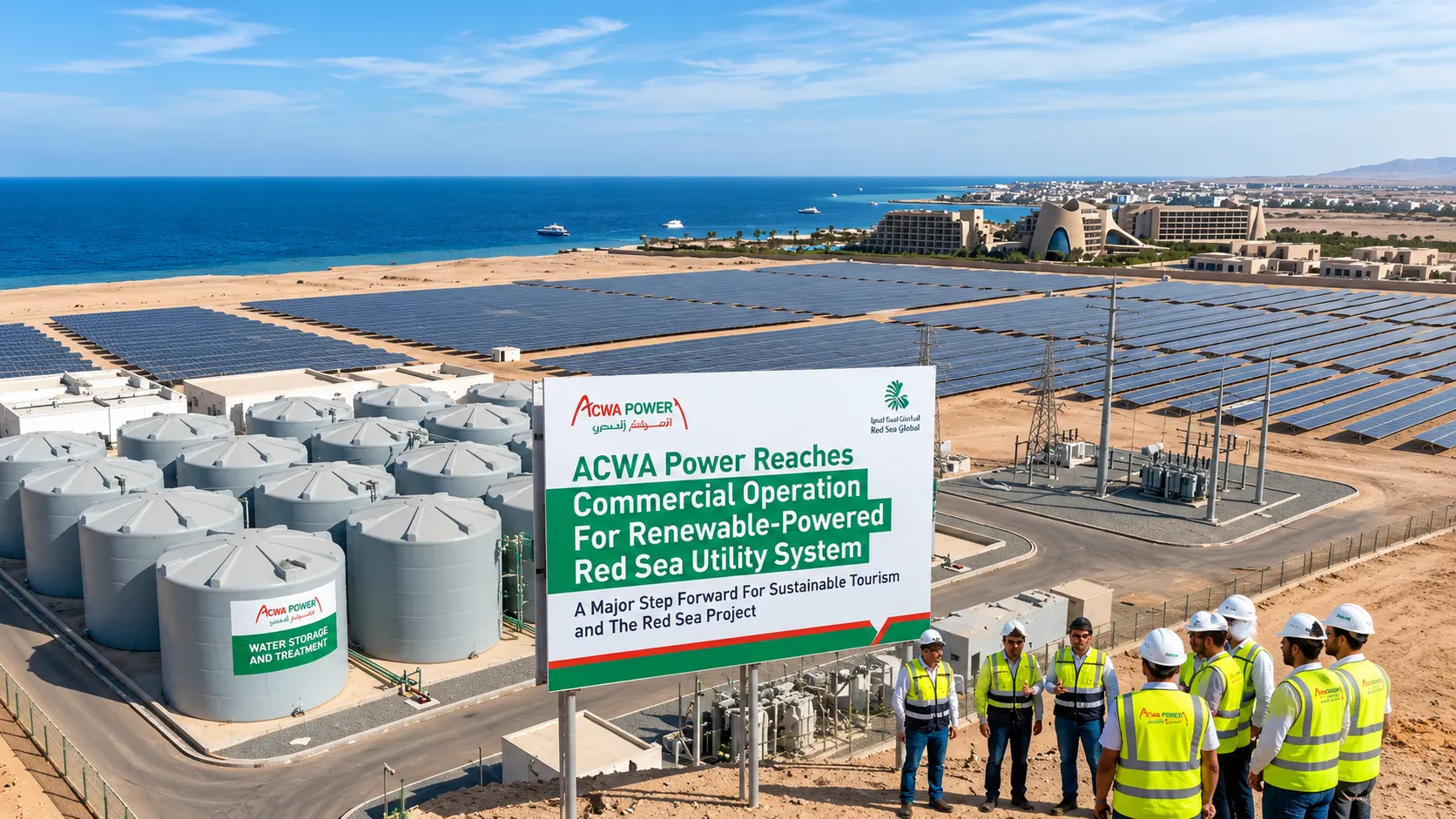
ACWA Power and its consortium partners have reached commercial operation at an integrated off-grid renewable utilities system serving the Red Sea destination in Saudi Arabia, according to a report published September 7, 2026. The system combines 340 megawatts alternating current of solar photovoltaic generation with 1,227 megawatt-hours of battery storage capacity, designed to power the large-scale tourism development entirely from renewable sources without reliance on a conventional grid connection.
The Red Sea project has been positioned by Saudi authorities as a flagship demonstration of the kingdom's broader Vision 2030 economic diversification strategy, which has placed significant emphasis on high-end, sustainability-branded tourism development alongside the country's traditional oil-and-gas economic base. Powering an entire destination-scale development off-grid, using solar generation paired with battery storage sized to provide power through periods of low solar output, represents one of the more ambitious integrated renewable-energy deployments globally, requiring storage capacity substantially larger than most utility-scale solar-plus-storage projects currently in operation.
At full capacity, the system is expected to avoid a significant volume of carbon emissions annually compared with conventional grid or diesel-generator power supply, reinforcing the project's positioning as a sustainability showcase rather than simply a power-infrastructure investment. For ACWA Power, one of the Gulf region's largest developers of power generation and water desalination infrastructure, the project adds to a growing portfolio of large-scale renewable and green-hydrogen developments across Saudi Arabia and the broader Middle East and North Africa region, as the company positions itself as a key infrastructure partner for the kingdom's economic diversification ambitions.
The project's success in reaching commercial operation will likely be closely studied by other large-scale tourism and real-estate developments globally weighing similar off-grid renewable-power strategies, particularly in regions with high solar irradiance but limited existing grid infrastructure. As battery-storage costs continue to decline, integrated solar-plus-storage systems of this scale may increasingly become a viable alternative to conventional grid extension for large, isolated developments — a shift with implications well beyond the Red Sea project itself.