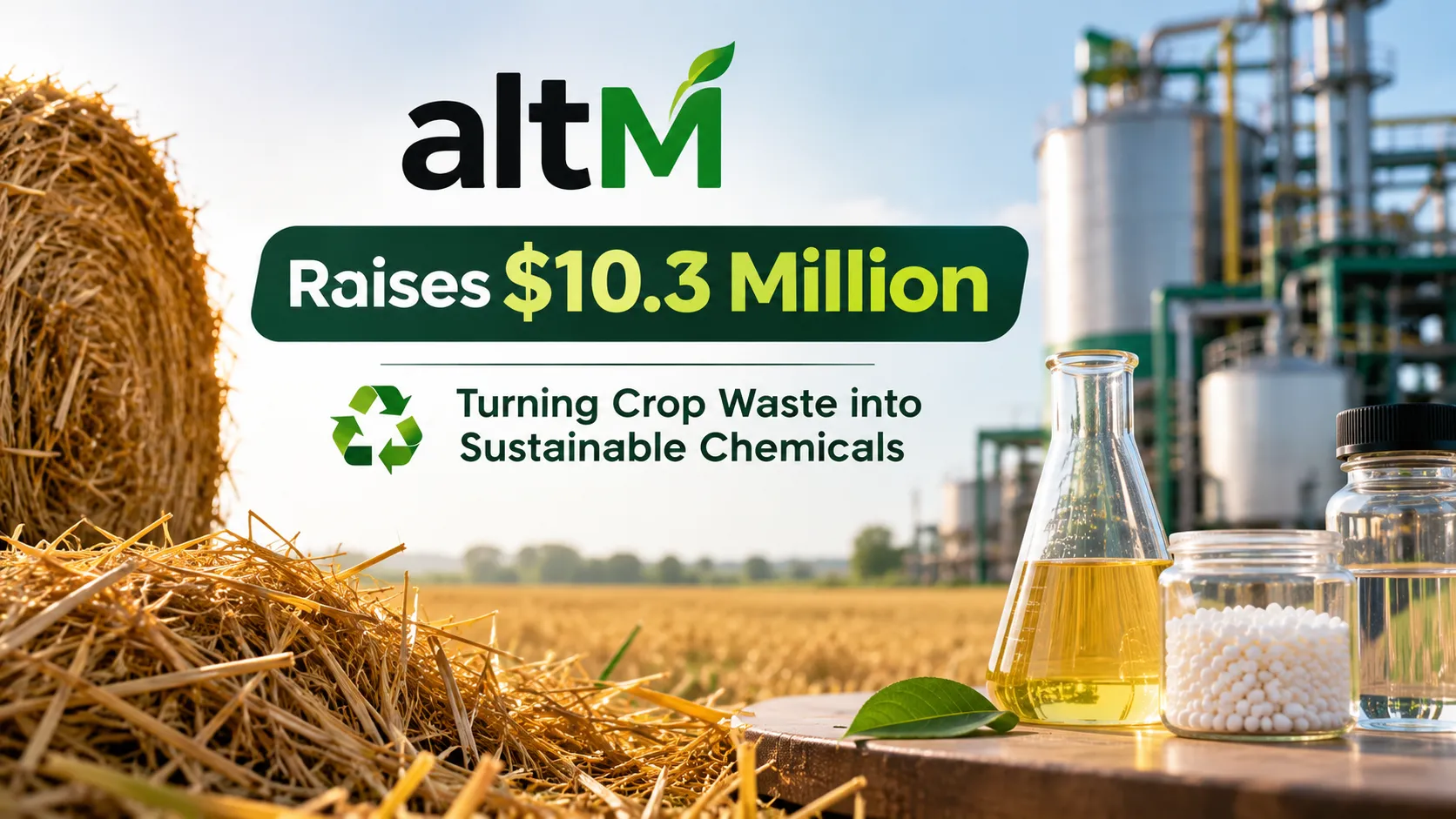
altM, a Bengaluru-based startup that turns agricultural waste into specialty chemicals and biomaterials, has raised $10.3 million (about ₹97.5 crore) in a Series A funding round. The investment will help it move its technology from pilot production to commercial scale.
The round was led by new investors Rainmatter, the climate and impact investment arm associated with stockbroking firm Zerodha, and Mela Ventures. Existing investors Omnivore, Theia Ventures, Aureolis and Spectrum Impact also took part.
The funding is one of the larger early-stage rounds this year for an Indian company working on industrial decarbonisation and the circular economy. Its backers are betting that crop residue, which India produces in enormous quantities, can become a valuable raw material for manufacturing rather than a source of pollution.
Turning residue into a resource
altM was founded in 2022 by Apoorv Garg, who serves as chief executive, and Yugal Raj Jain, a former Tesla engineer. The company has developed a process to break down agricultural residue, such as stalks, husks and straw left over after harvest, into its basic components. These are then converted into specialty chemicals and biomaterials that can replace petroleum-based ingredients in a range of industrial products.
Plant residues are made up mainly of cellulose, hemicellulose and lignin. Each of these can be turned into useful materials, but separating and processing them efficiently and at scale has long been a technical challenge. Many earlier attempts to build biorefineries struggled with high costs, inconsistent feedstock and products that could not compete on price with petrochemicals.
altM says its approach is designed to produce higher-value specialty materials, rather than commodity fuels or bulk chemicals. Higher-value products can support better margins, which in turn makes it more feasible to build a sustainable business around agricultural waste.
From pilot to commercial scale
The new capital will be used to expand production beyond the pilot stage. The company has set a target of processing around 10,000 tonnes a year within five years.
Scaling up is the most difficult phase for deep-technology companies in chemicals and materials. A process that works in a laboratory or small pilot plant often runs into new problems at larger volumes, from equipment design and energy use to quality control and the logistics of collecting raw materials.
altM's investors appear to be backing the founders' ability to navigate this transition. The startup previously raised a $3.5 million seed round in 2023, led by Omnivore, an agrifood and rural-focused venture fund.
Why investors see a hard but valuable problem
Investors in the round have acknowledged the difficulty of the challenge. Krishnakumar N of Mela Ventures described the company's work as tackling one of the hardest problems in industrial chemistry, which is converting variable, low-value biomass into consistent, high-value products.
Rainmatter's involvement is notable. Zerodha's founders have used Rainmatter to support climate, sustainability and health-focused ventures, often with a long-term view that differs from that of conventional venture capital. Its participation signals confidence in the startup's technology and in the broader opportunity in bio-based materials.
Mela Ventures, a Chennai-based fund focused on deep technology and industrial innovation, brings experience in backing companies that are building physical products and processes rather than software alone.
A pollution problem with economic potential
India is one of the world's largest agricultural producers, and its farms generate hundreds of millions of tonnes of crop residue each year. A significant share of this residue has little economic value to farmers, and in some regions it is burned in the fields to clear land quickly for the next crop.
Stubble burning in north India, particularly in Punjab and Haryana, has become one of the most visible environmental problems in the country. Each autumn, smoke from burning paddy straw contributes to severe air pollution across the Indo-Gangetic plain, including in Delhi.
Governments have tried a range of measures to reduce burning, from fines and subsidies for machinery to incentives for using residue in power plants and biofuels. Companies such as altM offer another potential solution, which is creating enough demand for residue that farmers can sell it rather than burn it.
The circular economy opportunity
altM's work sits within a broader global push to replace fossil-based materials with renewable alternatives. Chemical companies and consumer brands are under growing pressure from regulators, investors and customers to reduce their carbon footprints and dependence on petroleum.
Bio-based specialty chemicals can be used in applications ranging from personal care and coatings to packaging and textiles. If they can match the performance and price of petroleum-derived ingredients, they offer manufacturers a way to cut emissions without changing their products significantly.
For India, the opportunity is twofold. The country has abundant agricultural residue as a raw material, and it has a large and growing chemical industry that could adopt bio-based inputs. Building a domestic bio-based materials sector could create rural income, reduce pollution and strengthen India's position in global supply chains for sustainable materials.
The founders' backgrounds
Garg and Jain bring a combination of business and engineering experience to the company. Jain's background at Tesla, a company known for its focus on manufacturing scale and process engineering, is relevant to altM's central challenge of moving from pilot to commercial production.
The founding team's ability to attract a mix of agriculture-focused, climate-focused and deep-technology investors suggests that the company is seen as sitting at the intersection of several growth themes.
Challenges ahead
Despite the investor enthusiasm, altM faces significant challenges. Collecting crop residue at scale is complex, because farms in India are typically small and fragmented. Building reliable supply chains that pay farmers fairly and deliver consistent feedstock will be essential.
The company will also need to prove that its products can compete with petroleum-based alternatives on cost and performance. Oil prices, which fell sharply this week, can affect the relative competitiveness of bio-based materials. When oil is cheap, petrochemical inputs become more attractive for manufacturers.
Building a commercial plant also requires substantial capital. The Series A will support the next stage of growth, but reaching the company's target of 10,000 tonnes a year is likely to require further funding.
A signal for Indian climate technology
altM's round adds to a growing list of Indian climate technology startups that have attracted funding in 2026, despite a generally cautious venture capital environment. Investors are increasingly looking for companies that tackle industrial emissions, waste and materials, areas where India's scale gives local startups an advantage.
For The Impactful Global Indian's readers, altM represents a model of impact-driven entrepreneurship. It is turning one of India's most persistent environmental problems into the basis for a new industrial business.
If the company succeeds in scaling its technology, it could help reduce stubble burning, create new income streams for farmers and provide manufacturers with a renewable alternative to petrochemicals. The next few years will show whether its process can deliver at commercial scale.


