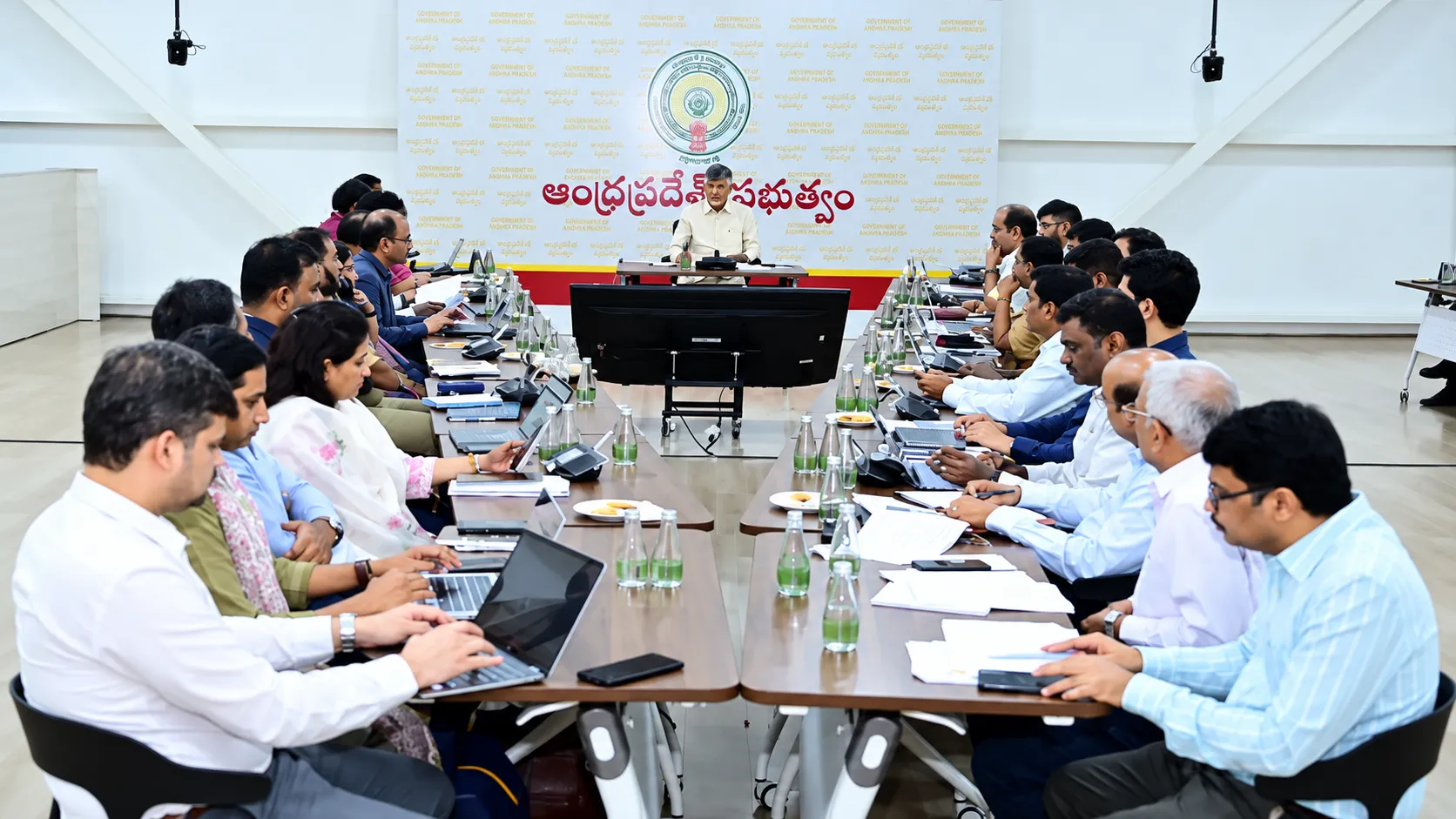
Andhra Pradesh has set out to turn the members of its vast self-help group network into a generation of business owners. At a review meeting on 5 October 2026, Chief Minister N Chandrababu Naidu set a target of creating five lakh women entrepreneurs and directed state officials to ensure that products made by women's collectives reach national and global markets.
Naidu instructed officials of the Society for Elimination of Rural Poverty (SERP) and the Mission for Elimination of Poverty in Municipal Areas (MEPMA), the state agencies that oversee rural and urban self-help groups, to extend full support to the initiative and to seek assistance from corporate organisations. Women interested in self-employment, he said, should also be encouraged to start franchise businesses. Special camps will be organised at district level to help meet the target.
The Chief Minister said no other system in the country is as extensive as Andhra Pradesh's self-help group network. The new push aims to use that network not only as a channel for credit and savings, its traditional role, but as a pipeline of enterprises.
Building on a long history
Andhra Pradesh's women's collectives have deep roots. The state was an early adopter of the Development of Women and Children in Rural Areas (DWCRA) programme, and Naidu himself championed women's self-help groups during his first tenure as chief minister in the 1990s. Over the decades, those groups have grown into one of India's largest community-based financial networks, mobilising savings, extending small loans and creating livelihoods for millions of women.
The state's financial architecture for women is significant. Stree Nidhi, a credit cooperative set up to serve self-help group members, has disbursed ₹4,800 crore in loans to 4.73 lakh women, according to figures shared at the review. Women in self-help groups already produce more than 23,000 products across food, handicrafts and textiles.
The challenge, as officials acknowledge, is that much of that production remains small-scale, sold locally at fairs and exhibitions, with limited branding, inconsistent packaging and weak access to modern retail or online channels. Turning producers into entrepreneurs requires closing those gaps.
Swayam AP: one brand for thousands of products
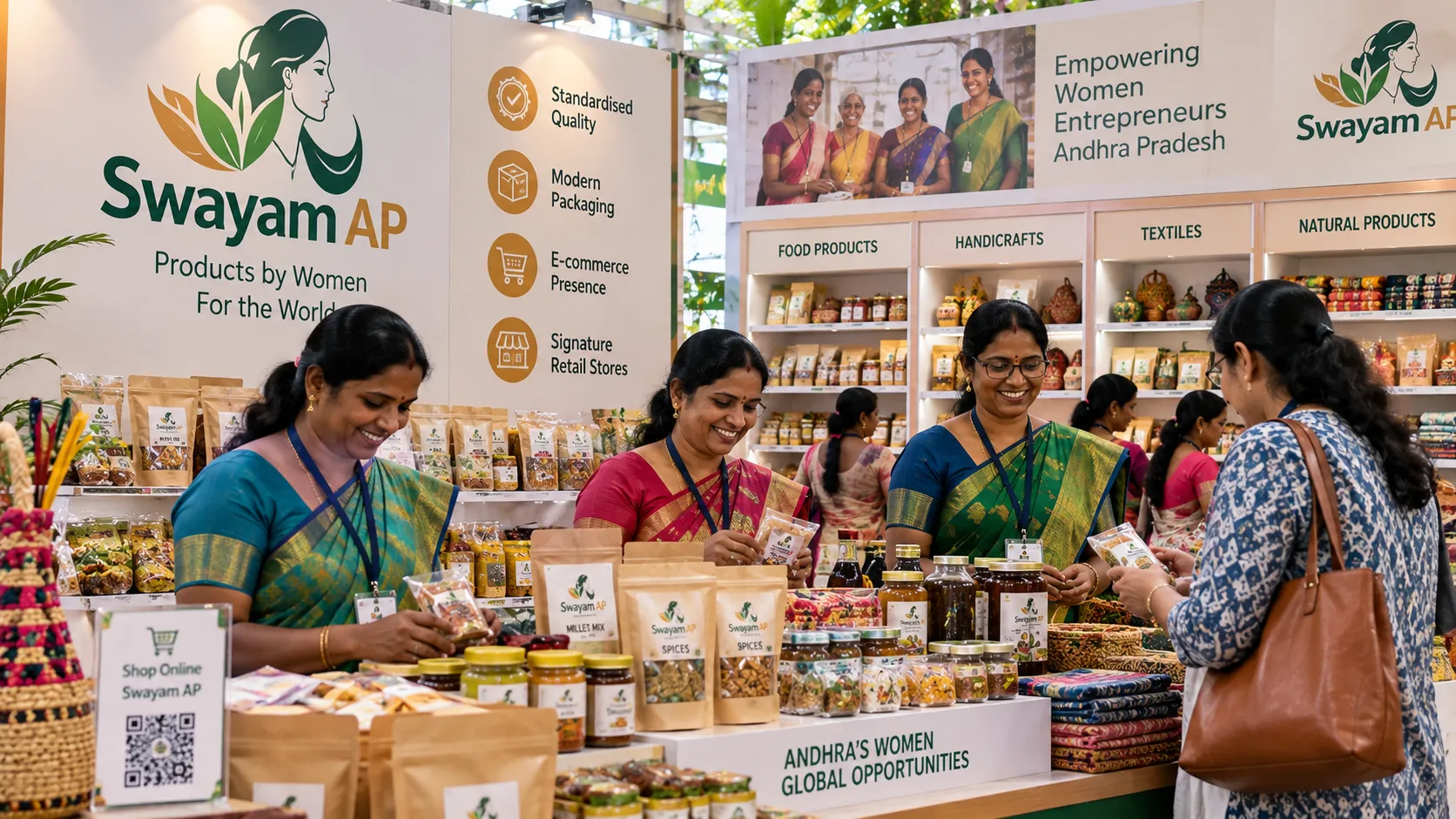
Central to the state's strategy is Swayam AP, a unified brand that will bring together the products made by DWCRA women under common standards. The plan calls for standardised quality, modern packaging, a presence on ecommerce platforms and signature retail stores. The approach mirrors a lesson learned by successful consumer brands: buyers are more willing to trust and pay for products that carry a recognisable name and consistent quality.
A single umbrella brand also offers economies of scale that individual groups cannot achieve alone. Shared certification, design, logistics and marketing can lower costs and make it feasible to supply larger retailers, institutional buyers and international customers.
Five areas of focus
State officials outlined five areas of focus for the programme. The first is a support system that connects village producers to global markets. The second involves identifying viable business opportunities suited to local skills and resources. The third concerns financial resources, with the state pointing to a pool of ₹68,585 crore available to support the effort. The fourth is capacity building through leading institutions, and the fifth involves connecting experienced entrepreneurs with newcomers as mentors.
Incubation partnerships with the Indian Institute of Management Visakhapatnam and Centurion University are intended to provide training in business planning, finance, marketing and digital skills. The franchise model, which Naidu specifically encouraged, offers a lower-risk path into entrepreneurship, allowing women to run outlets of established brands with proven products and systems rather than building a business from scratch.
A national showcase in Vijayawada
The state will soon have a high-profile platform to showcase the work of its women entrepreneurs. The National Saras Mela 2026, a fair for products made by self-help groups from across India, is scheduled to run in Vijayawada from 15 to 31 October. Organisers expect around 600 stalls and roughly one lakh visitors a day, and President Droupadi Murmu is set to inaugurate the event, according to state officials.
Such fairs have long been an important sales channel for self-help groups, but the state's ambition goes beyond them. The goal is to use these events as launch pads for longer-term relationships with buyers, retailers and online platforms, rather than as one-off selling opportunities.
The national context
Andhra Pradesh's push aligns with a broader national effort to move women's collectives up the value chain. Under the Deendayal Antyodaya Yojana-National Rural Livelihoods Mission, more than 10 crore rural women households have been organised into over 90 lakh self-help groups across India. The central government's Lakhpati Didi initiative aims to help self-help group members earn at least ₹1 lakh a year, and the Union Budget for 2026-27 introduced SHE-Marts, community-owned retail outlets designed to give women entrepreneurs better market access.
States have taken different approaches. Gujarat, for example, launched a ₹25 crore scheme this year to help women's self-help groups sell through ecommerce platforms in India and abroad. Andhra Pradesh's target of five lakh entrepreneurs is among the more ambitious goals set by any state.
The hard part: from loans to enterprises
Experience across India suggests that the transition from self-help group member to entrepreneur is far from automatic. Research on women's enterprises consistently points to persistent barriers: limited access to collateral-free credit at scale, lack of market linkages, domestic responsibilities that constrain time, and lower exposure to digital tools. Many women-led micro-enterprises remain small precisely because these constraints are rarely addressed together.
The state's plan attempts to tackle several of them at once, combining finance, branding, training and mentoring. Its success will depend on implementation at the district and village level, where officials must identify women with the interest and capacity to grow businesses, match them with suitable opportunities and sustain support beyond the initial launch.
Why it matters beyond Andhra Pradesh
Women's economic participation remains one of India's largest untapped sources of growth. The country's female labour force participation, though rising in recent years, is still lower than in many comparable economies. Programmes that help women build income-generating enterprises can raise household incomes, improve outcomes for children and strengthen local economies.
Andhra Pradesh's initiative will be watched as a test of whether the self-help group model, long successful at financial inclusion, can be extended into enterprise creation at scale. If the state can turn a meaningful share of its collectives' members into sustainable business owners, and give their products a credible brand in national and global markets, it could offer a template for other states. The target of five lakh is bold. The measure of success will be not only the number of enterprises created, but how many of them are still growing several years from now.