Workplace chat apps were built for people. Sara Du thinks the next generation needs to be built for people and machines together.
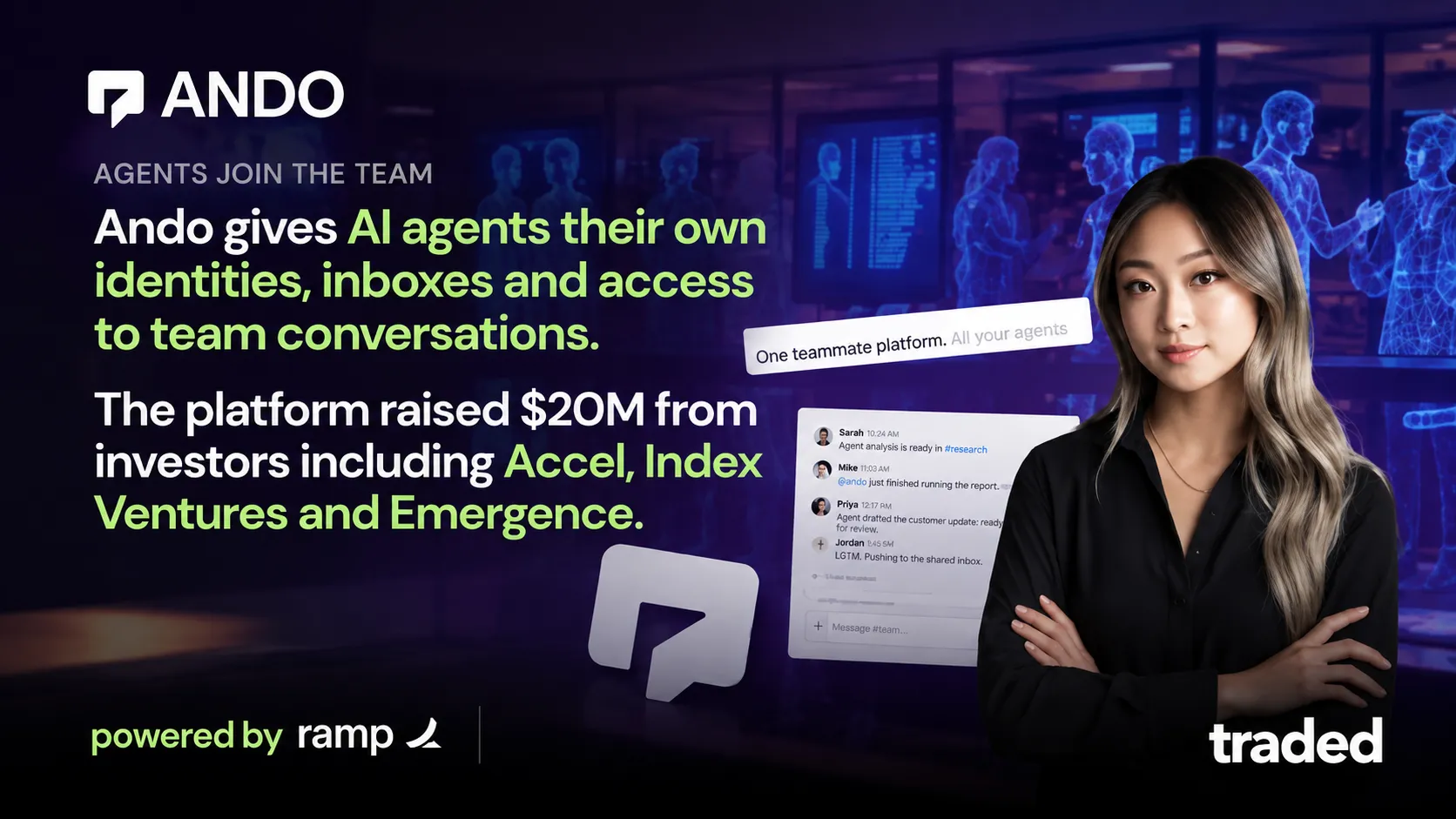
Ando, a San Francisco-based start-up founded by Du, emerged from stealth on Thursday, September 24, with $20 million in pre-seed and seed funding to build a team messaging platform in which AI agents participate as members of the team, according to TechCrunch and the company's announcement.
The funding came from Accel, Index Ventures and Emergence Capital, with Contrary Capital also backing the company. Accel led the pre-seed round, while Index Ventures and Emergence Capital led the seed round, according to reports. The company did not disclose its valuation.
The problem Du set out to solve
Du's idea grew out of hands-on experience. In 2025, she was helping companies build MCP servers — software connectors, based on the Model Context Protocol, that allow AI agents to access tools and data. In that work, she saw a recurring problem: companies were struggling to use AI agents effectively inside existing communication platforms such as Slack, because of both technical limitations and a fundamental mismatch in design, according to TechCrunch.
Traditional workplace chat tools treat AI as an add-on. An agent may be connected through an integration or a bot, but it usually has to be summoned by a human, lacks context about what is happening across the organisation and cannot easily take part in ongoing conversations.
Du coined a memorable phrase for the result: "meat proxies" — humans who end up relaying an AI agent's work to their colleagues because the agent cannot participate directly in the conversations where decisions are made.
How Ando works
Ando is designed as a full replacement for Slack or Microsoft Teams, offering familiar features such as channels, direct messages and group conversations, as well as live calls with transcriptions that agents can access.
What sets it apart is how it treats AI agents. On Ando, agents have their own identities and inboxes. They can browse channels, join conversations without being tagged and start conversations with human colleagues. They maintain persistent context and memory about what is happening across the conversations they are part of, and they can contribute proactively when they have something useful to add.
The platform is agent-agnostic, meaning teams can bring the cloud agents and harnesses they already use, including OpenAI's Codex, Anthropic's Claude, Grokbot and others, according to the company's announcement.
Du described the goal as allowing agents to "participate in the shared conversations where work already gets coordinated", so that they can "understand why a decision was made, ask a colleague a question, build on another agent's work", according to TechCrunch.
What investors see
Ivan Zhou, a partner at Accel, framed Ando as part of a larger shift in how work is organised.
"Every major computing shift creates new systems for how work gets coordinated," he said. "Agents aren't simply another feature inside existing workplace software. They're becoming participants in companies themselves." He added that Du had seen early that this shift would require an entirely new kind of workspace built around collaboration between people and agents.
The investor line-up is notable. Accel and Index Ventures are among the world's most prominent venture firms, and Emergence Capital has a long track record in enterprise software, including an early investment in Zoom. Their backing signals confidence that workplace communication, long dominated by a few large players, may be open to disruption as AI changes how teams operate.
Early customers
Ando says teams in software, real estate and financial services are already using the platform across 15 countries, according to TechCrunch. Most of its current customers are small teams.
Du acknowledged to TechCrunch that some early users initially found the app less polished than established messaging tools — until they saw what its agents could do. That candour reflects the reality facing any challenger to entrenched workplace software: features and reliability that incumbents have refined over many years are hard to match quickly.
The new funding will be used to expand the team and to pay for the computing resources needed to run AI agents at scale, which can be expensive.
Taking on the incumbents
Ando is entering one of the most competitive markets in enterprise software. Slack, owned by Salesforce, and Microsoft Teams dominate workplace messaging, and both have been adding AI capabilities aggressively. Slack has turned its native assistant into an AI agent, and Microsoft has integrated its Copilot AI deeply into Teams and the rest of its Microsoft 365 suite.
Other start-ups are also experimenting with agent-first communication tools. Earlier this year, Jack Dorsey, the co-founder of Twitter and Block, announced Buzz, a messaging app that brings people and AI agents together, though it is aimed primarily at developers.
Ando's bet is that teams will switch platforms to give AI agents a native role, rather than bolting agents onto existing tools. The trade-off for customers is having to learn a new workspace and move their communications — a significant hurdle, especially for large organisations.
A woman founder in AI infrastructure
Du's success in raising a substantial early-stage round from top-tier investors is notable in an industry where women founders still receive a small share of venture funding. In the United States, all-female founding teams have received only a low single-digit percentage of venture capital in recent years, even as female-founded companies have raised record totals, largely because of a handful of very large AI rounds.
Ando's round shows that women founders building at the frontier of AI infrastructure can attract strong investor support when they address a clear, emerging need.
What it means for the future of work
For businesses around the world — including India's vast technology services and global capability centre workforce — Ando's vision raises important questions. If AI agents become regular participants in team conversations, how will responsibilities be divided between people and machines? How will accountability work when an agent makes a mistake? And how will organisations manage the security and permissions of agents with access to internal discussions?
Ando is betting that these questions will soon become everyday realities, and that companies will need new tools designed around them. Its $20 million round gives it the resources to test that bet. If it succeeds, the way teams communicate could change as profoundly as it did when email gave way to chat.