Anthropic, one of the world's leading artificial intelligence developers, has announced plans to set aside a significant share of its ownership for public benefit, in one of the largest corporate philanthropic commitments in the technology industry.
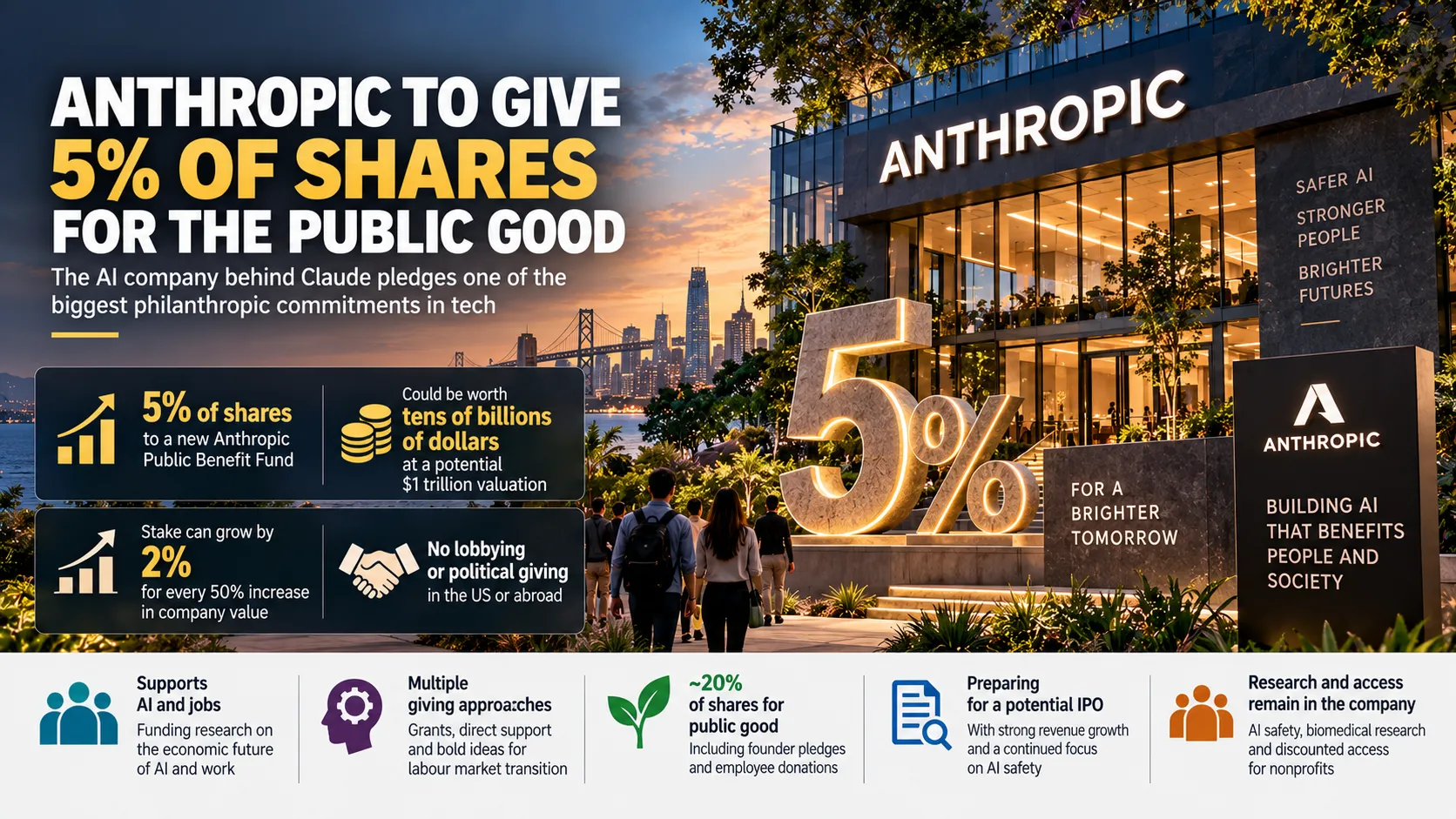
The San Francisco-based company, which builds the Claude family of AI models, said on October 18 that it will commit 5% of its shares to a new entity called the Anthropic Public Benefit Fund, subject to approval by its stockholders. The fund's stake is designed to grow as the company grows: Anthropic's board may add a further 2% of shares for every 50% increase in the company's value above a set baseline.
The announcement comes as Anthropic is reported to be preparing for a potential initial public offering that, according to media reports, could value the company at more than $1 trillion. At that valuation, a 5% stake would be worth tens of billions of dollars, placing the fund among the largest pools of philanthropic capital in the world.
How the fund will work
Anthropic said the fund will be structured as a wholly owned limited liability company rather than as a traditional 501(c)(3) charitable foundation. The company said this structure gives it flexibility to pursue different forms of giving, from large grants to established nonprofits to approaches that a conventional charity might find difficult.
The company outlined several potential uses. These include large donations to traditional nonprofits, direct distributions to specific populations, and what it described as bolder approaches to dealing with the impact of AI on labour markets. Anthropic has already committed $200 million to research on the economic future of AI and work.
Anthropic also drew a firm line on politics. "Equity held by the Fund will not be used for lobbying or political giving, in the US or abroad," the company said. That commitment is significant at a time when AI companies are spending heavily to influence regulation in Washington, Brussels and other capitals.
What stays inside the company
Anthropic distinguished between the fund's work and activities that will remain within the company itself. Research on AI safety and interpretability, applied biomedical research and discounted access to Claude for nonprofits and scientific institutions will continue to be run by Anthropic directly, because these activities have both public benefit and commercial value.
The company also linked the fund to executive pay. Anthropic said it was directing equity that might otherwise have gone towards escalating awards for executives into public benefit instead, an unusual choice in an industry known for enormous compensation packages for top talent.
The new commitment builds on earlier pledges. At Anthropic's founding, its co-founders pledged to give away 80% of their equity. The company also runs an employee equity donation matching programme, in which about half of its employees participate. Including those commitments, Anthropic said roughly 20% of its shares will be dedicated to the public good, plus any additional shares allocated as valuation milestones are reached.
A public benefit corporation preparing for public markets
Anthropic is organised as a public benefit corporation, a legal structure that requires its directors to balance shareholder returns with a stated public mission, in Anthropic's case the responsible development of AI. The company was founded in 2021 by former OpenAI researchers, including chief executive Dario Amodei and president Daniela Amodei, with an explicit focus on AI safety.
Its commercial growth has been rapid. According to figures reportedly shared with prospective investors, Anthropic's quarterly revenue rose 45% to $16.8 billion in the three months to September. Demand for its models from businesses and software developers, particularly for coding and automation, has made it one of the fastest-growing companies in history.
Preparing for a listing raises difficult questions for a mission-driven company. Public investors expect steady growth and returns, while Anthropic has repeatedly warned about the risks of powerful AI. Its draft prospectus is reported to devote a large share of its pages to risk factors, including the possibility that AI could pose catastrophic risks. Locking a sizeable share of equity into a public benefit vehicle before listing could help the company demonstrate that its commitments extend beyond words.
Why AI and jobs are central
The fund's emphasis on labour markets reflects a growing debate about how AI will affect employment. The International Monetary Fund has estimated that nearly 40% of jobs worldwide are exposed to AI, rising to about 60% in advanced economies. At its annual meetings in Bangkok this month, IMF officials noted that demand for roles AI can replace fell initially before stabilising, while demand for AI-skilled workers is rising.
For countries such as India, the stakes are particularly high. India's large information technology and business process services industry employs millions of people in roles such as software testing, customer support and back-office processing, many of which are being reshaped by AI tools. How the gains from AI are shared, and how workers are supported through the transition, will be one of the defining policy questions of the coming decade.
Philanthropic funds alone cannot solve those challenges, but they can finance experiments, from retraining programmes to studies of direct income support, that governments may later scale.
Questions still to be answered
Several important details remain unclear. Anthropic has not disclosed the baseline valuation that would trigger additional share allocations, the governance structure of the fund or a timetable for the stockholder vote. The company said it would share more about the fund's structure and governance, including the valuation milestones, in the coming months, and would publish a public benefit report on its progress.
Critics may also question how independent the fund will be, given that it is wholly owned by Anthropic, and how its priorities will be set. Supporters will argue that the structure allows it to move faster and take bolder bets than a conventional foundation.
What is clear is that the announcement raises the bar for the AI industry. As companies building frontier AI models approach valuations once reserved for the largest technology groups, pressure is growing for them to show how the extraordinary wealth they generate will benefit society more broadly. Anthropic's pledge offers one answer. Whether others follow may shape how the public, and regulators, view the next phase of the AI boom.