
ImpactSustainability5 MIN READ

Ares Buys 80% of EDP Renewables’ 384 MW California Solar-and-Storage Portfolio Valued at About $800 Million

Ares has acquired an 80% stake in a 384 MW California solar and battery-storage portfolio from EDP Renewables, valuing the assets at about $0.8 billion at the start of operations.

By Aravind Kumar · Author24 September 2026New
Ares Buys 80% of EDP Renewables’ 384 MW California Solar-and-Storage Portfolio Valued at About $800 Million

Alternative asset manager Ares has acquired an 80% stake in a 384 MW solar and battery-storage portfolio in California from EDP Renewables, in a transaction that values the assets at approximately $0.8 billion at the start of operations, ESG Today reported on Wednesday, September 23.

The portfolio includes 200 MW of solar generation and 184 MW of battery energy storage. The solar capacity is contracted through a 20-year power purchase agreement, while the storage capacity operates under a 20-year capacity tolling agreement, according to the report.

Why long-term contracts matter

The structure of the portfolio is central to its appeal. Long-term contracts provide predictable revenue for decades, reducing exposure to fluctuations in wholesale power prices.

Under a power purchase agreement, a buyer — typically a utility or large corporation — agrees to purchase electricity from a solar project at a set price over a fixed period. Under a capacity tolling agreement for storage, the buyer pays for the right to use the battery’s capacity, charging and discharging it according to its own needs, while the owner receives contracted payments regardless of how market prices move.

For investors, those contracts transform renewable assets into something closer to infrastructure bonds: long-duration, contracted cash flows that can be valued, financed and held for years. That profile fits well with the investment mandates of alternative asset managers, pension funds and insurance companies seeking stable, inflation-resistant returns.

EDPR’s capital recycling model

For EDP Renewables, the sale reflects a well-established strategy. The company, one of the world’s largest renewable energy developers, has long relied on selling stakes in completed or near-complete projects — a practice it calls asset rotation — to recycle capital into new development.

Developers typically earn their highest returns during the development and construction phases, when projects are de-risked and their value increases significantly. Selling a majority stake once projects are contracted and nearing operation allows developers to crystallise that value, return capital to their balance sheets and redeploy it into new projects. Retaining a 20% stake allows EDPR to keep some exposure to the assets’ long-term returns.

California’s storage imperative

California is one of the most important markets in the world for battery storage. The state’s heavy reliance on solar power creates a pronounced daily pattern: abundant solar generation during the day, followed by a sharp rise in demand for other sources as the sun sets.

The valuation of about $0.8 billion for 384 MW implies a price of roughly $2 million per megawatt across the combined solar and storage capacity, reflecting the premium investors place on assets that come with long-term contracts already in place.

Batteries help manage that transition by storing surplus solar power during the day and releasing it in the evening, when demand remains high and solar output falls. Combining solar and storage in a single portfolio allows owners to capture value from both generation and the flexibility that storage provides.

State policy has strongly supported storage deployment, and California has built one of the largest fleets of grid-scale batteries anywhere. As more renewable energy enters the grid, the need for storage to maintain reliability is expected to keep growing.
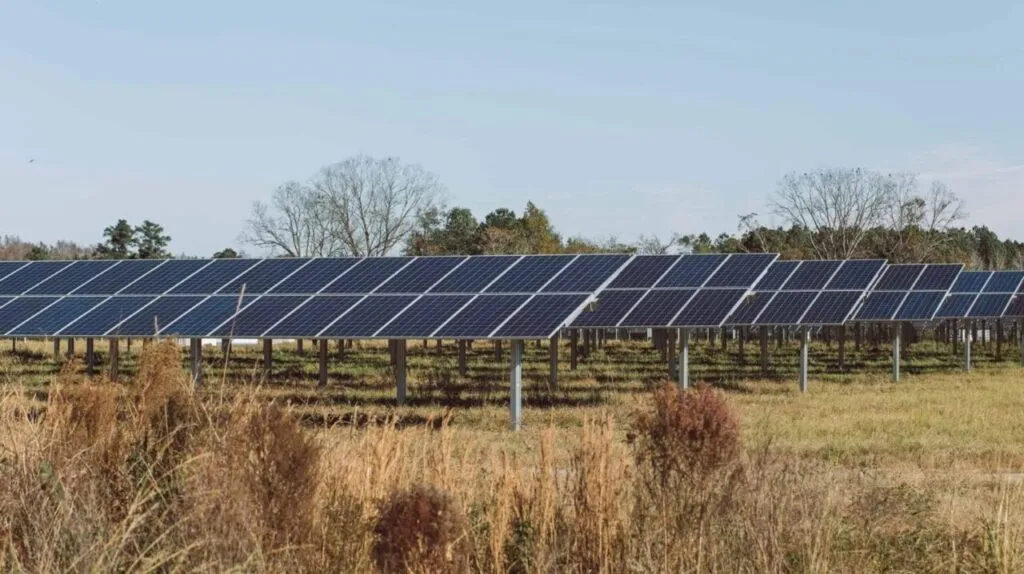

Twenty-year contracts turn volatile power assets into something close to infrastructure bonds — which is exactly what alternative asset managers want to own.
TIGI Impact Desk

image.png

Institutional capital pours into storage

The Ares deal is part of a broader wave of institutional investment in energy storage. On the same day, Energy Vault announced the acquisition of a 2.3 GW Goshe Energy Storage portfolio that includes ready-to-build battery projects, according to ESS News.

Storage has become one of the most attractive segments of the energy transition for investors. Rising electricity demand — driven in part by data centres supporting artificial intelligence — is increasing the need for flexible capacity, while long-term contracts with utilities provide the revenue certainty that institutional capital requires.

The AI and power demand connection

The growth in electricity demand from data centres has become a defining theme in energy markets in 2026. Utilities in several US states are reporting record peak demand, and grid operators are seeking new resources that can be deployed quickly. Solar-plus-storage projects are among the fastest to build, making them attractive both to utilities and to investors seeking exposure to the power-demand boom.

That dynamic is also reshaping climate finance. At Climate Week NYC this week, investors noted that capital is flowing strongly into energy, critical minerals and supply-chain businesses even as fundraising for dedicated climate venture funds has fallen — a sign that the energy transition is increasingly being financed as mainstream infrastructure.

Rising rates, resilient appetite

The deal comes at a time of rising interest rates. US Treasury yields climbed to their highest levels in nearly two decades on Wednesday, increasing the cost of capital for infrastructure investments. Higher rates can reduce the valuations investors are willing to pay for long-duration assets.

That Ares agreed a transaction of this size in such an environment underscores the strength of investor appetite for contracted renewable assets. Long-term contracts, particularly those with creditworthy counterparties, can offer resilience even as financing costs rise.

Implications for India

India is pursuing a similar path at enormous scale. The country is rapidly expanding solar capacity and has begun procuring large volumes of battery storage through state and central auctions. The Ares–EDPR deal illustrates the kind of institutional capital that contracted solar-and-storage assets can attract once projects are de-risked — a model that Indian developers are increasingly using to recycle capital by selling stakes in operating portfolios to infrastructure investors.

The bottom line

The Ares acquisition shows how the economics of renewable energy have matured. Solar and storage projects backed by long-term contracts are no longer niche investments; they are core infrastructure assets that attract some of the world’s largest alternative asset managers.

For EDPR, the sale unlocks capital to build more projects. For Ares, it adds stable, long-duration cash flows. And for California’s grid, it supports the continued expansion of solar and storage capacity needed to keep the lights on as the state’s energy system evolves.

Investors will also watch how quickly the portfolio reaches full commercial operation, since the valuation is tied to the assets at the start of operations.

TagsAresEDP RenewablesEDPRSolar EnergyBattery StorageCaliforniaRenewable EnergyInfrastructure InvestmentPrivate EquityEnergy TransitionTolling AgreementPPAClean EnergySustainability

Reader reviews

Sign in to rate and review this article.
Loading reviews…