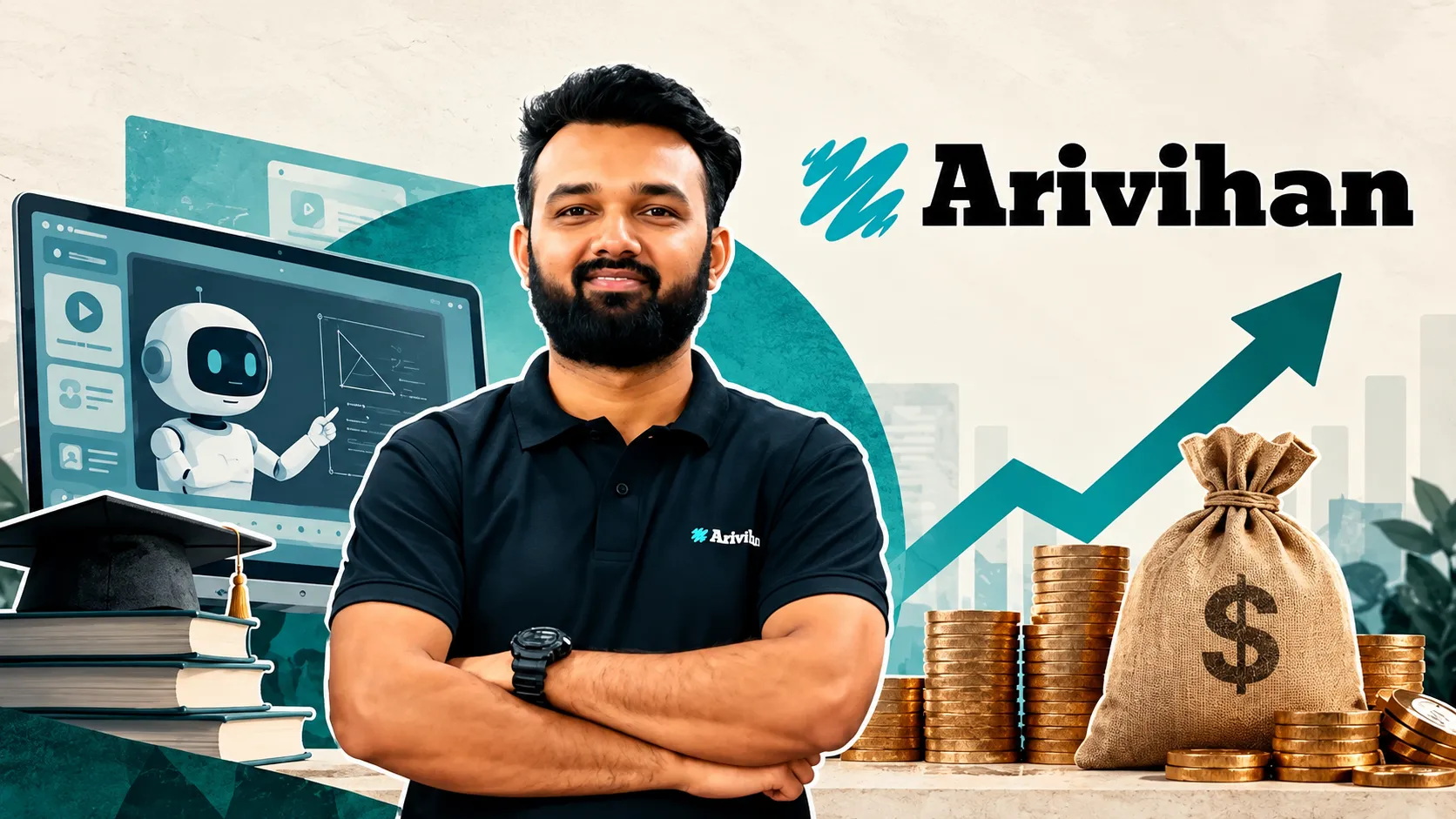
Arivihan, an artificial intelligence-powered learning platform built for school students outside India's big cities, has raised $10 million in a Series A round co-led by its existing investors Accel and Prosus Ventures. The Indore-based company, which announced the round on 30 September 2026, also raised a further $200,000 from GSF angel investors, taking its total funding to more than $15 million.
Regulatory filings put the company's valuation at around ₹570 crore after the round, according to reports, although Arivihan has not confirmed the figure.
The deal stands out in Indian education technology, a sector that has spent the past three years recovering from the collapse of pandemic-era valuations and the troubles at several of its best-known companies. It suggests investors are once again willing to back edtech, but with a sharper focus on affordability, outcomes and underserved markets.
Built for Bharat, not the metros
Arivihan was founded by IIT Roorkee alumni Ritesh Singh Chandel and Sonu Kumar, together with mathematics educator Rushabh Kothari. The company's app combines interactive video lessons, instant doubt-solving and AI-generated study plans that adapt to each student's performance. It serves students preparing for state board examinations, the Central Board of Secondary Education (CBSE) and NEET, the national entrance test for medical colleges.
A distinctive feature is that the platform does not rely on live teachers. Instead, it uses technology to deliver a personalised learning experience at a cost that families in smaller towns can afford.
That focus is reflected in its user base. About 80% of Arivihan's subscribers come from smaller towns and rural India, the company says. That makes it one of the few edtech businesses whose growth is driven primarily by what Indian investors often call "Bharat", the vast population outside major metropolitan areas.
Why state boards matter
Most Indian school students study under state education boards rather than national boards such as CBSE. Yet for years, many edtech companies built products primarily for urban CBSE students and for competitive exam aspirants in major coaching hubs. State board students, who often study in regional languages and have different syllabi, were frequently an afterthought.
Arivihan's approach targets that gap. By building content aligned with state syllabi and in local languages, it can address a market that is large, under-served and less crowded with well-funded competitors.
Where the money will go
Arivihan plans to use the new capital to expand into new states, broaden its CBSE offering and build more learning content in local languages. The company has identified Madhya Pradesh, Uttar Pradesh, Rajasthan and Bihar as priority markets, a group of states that together account for a very large share of India's school-age population.
It will also invest in AI research, performance marketing, offline distribution and hiring. The emphasis on offline distribution is notable. In smaller towns, parents often rely on local word of mouth, schools and community networks when choosing educational products, which means purely digital marketing can be expensive and less effective.

A different edtech model
India's edtech sector has gone through a dramatic cycle. During the pandemic, companies raised billions of dollars to sell online courses to students stuck at home. When schools reopened, many of those businesses struggled with high customer acquisition costs, aggressive sales tactics and falling demand. Several firms cut thousands of jobs, and the sector's largest company became embroiled in financial and legal troubles.
The industry has since consolidated. In the July–September quarter of 2026, upGrad agreed to acquire Unacademy for about $200 million, according to Inc42, while Imarticus Learning bought BELLS for about $84 million. At the same time, PhysicsWallah, which built its brand around low-cost test preparation, has listed on Indian stock exchanges, showing that affordable education models can scale profitably.
Arivihan sits closer to that low-cost, high-volume model. Using AI to provide personalised instruction without live teachers allows it to keep prices low while still offering a tailored experience, a combination that has historically been difficult to achieve.
The role of AI
Generative AI has given education companies new tools. Systems can now answer student questions instantly, explain concepts in multiple ways, generate practice problems and track where a student is struggling. For a student in a small town with limited access to good tutors, such tools can provide support that was previously available only to those who could afford private coaching.
There are also risks. AI tutors can make mistakes, and educators warn that technology works best when it complements rather than replaces human guidance. Arivihan's investment in AI research suggests it sees accuracy and pedagogy as central to its product, rather than simply relying on general-purpose AI models.
AI was the most funded sector in Indian startups in the third quarter, attracting $438 million, according to Inc42. Most of that capital went to enterprise and infrastructure companies. Arivihan's round is one of a smaller number of deals applying AI directly to a mass consumer need with clear social impact.
Language is a central part of the challenge. Many students in Hindi-speaking states learn science and mathematics in Hindi at school but encounter English-heavy material in most digital products and coaching resources. Advances in AI translation and speech technology now make it far cheaper to produce and adapt high-quality content in Indian languages, an area where Arivihan says it will invest heavily.
Backers doubling down
The participation of Accel and Prosus, both existing investors, is significant. Follow-on investments by early backers often indicate that a company has met or exceeded the milestones set at the previous round. Prosus, the Netherlands-listed technology investor, has long been one of the largest investors in Indian edtech, while Accel has backed many of India's best-known consumer technology companies.
The impact case
Arivihan's significance goes beyond its funding. India's learning outcomes remain uneven, with large gaps between urban and rural students and between private and government schools. Affordable, personalised learning tools that work in local languages could help narrow those gaps, particularly for students preparing for board examinations that shape their future education and careers.
The company's challenge will be to grow without repeating the mistakes of the previous edtech cycle: overspending on marketing, overselling to families and neglecting learning outcomes. If it can show that its AI-led model improves results for students in small towns, Arivihan could become a template for how technology can expand access to quality education in India and other emerging markets.