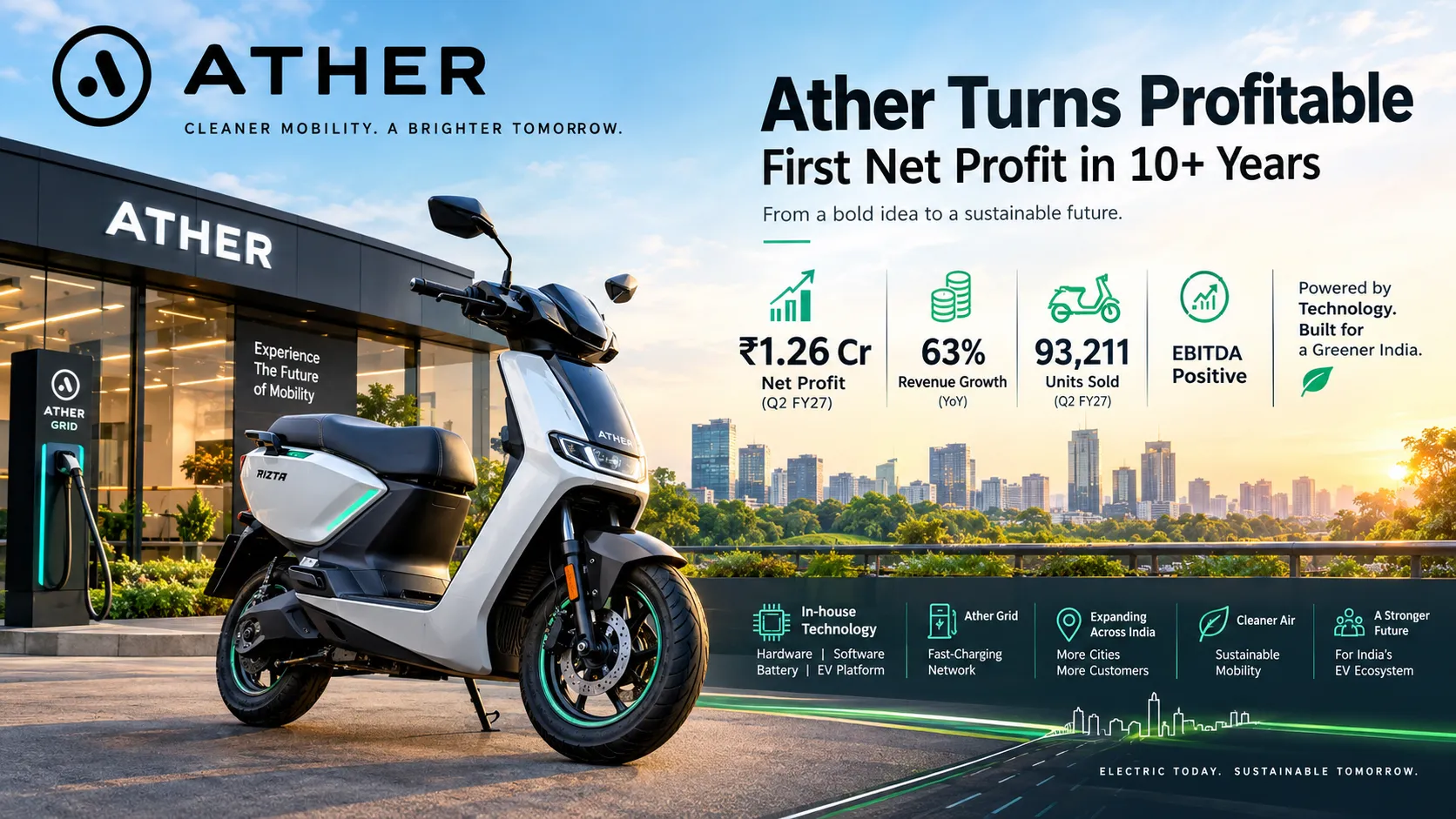
Ather Energy, the Bengaluru-based electric scooter maker, has reported its first quarterly net profit since it was founded more than a decade ago, marking a milestone for India's electric two-wheeler industry and for a company that investors once questioned could ever make money.
The company posted a consolidated net profit of ₹1.26 crore for the quarter ended 30 September, the second quarter of the 2027 financial year, compared with a net loss of ₹154 crore in the same period last year, according to results released on 26 October. In the previous quarter, Ather had reported a loss of about ₹51 crore.
Revenue from operations rose 63 per cent year on year to ₹1,464.24 crore, while total income, including other income, increased 62 per cent to ₹1,526.95 crore. The company sold 93,211 electric two-wheelers during the quarter, up 42 per cent from a year earlier, and remained positive at the EBITDA level.
A Thin but Symbolic Profit
The profit is modest. Other income of about ₹62.7 crore, largely returns on cash raised in the company's stock market listing, played a significant role in pushing the bottom line into positive territory. Without it, Ather would still have been loss-making at the net level.
But the trajectory matters more than the absolute number. A year ago, the company was losing more than ₹150 crore a quarter. It turned EBITDA positive for the first time in the June quarter and has now built on that progress to deliver a net profit, demonstrating that its losses have narrowed rapidly as volumes have grown.
For a capital-intensive manufacturing business that has spent years investing in research, product development, factories and charging infrastructure, the shift is significant. It suggests that Ather has reached the scale at which its fixed costs are being absorbed by a much larger revenue base.
Scale Drives the Turnaround
The 42 per cent rise in volumes reflects both growth in India's electric two-wheeler market and Ather's gains in market share. The company has expanded its product range beyond its premium 450 series with the Rizta, a family-oriented scooter that has broadened its appeal to a much wider set of customers.
Ather has also expanded its retail footprint beyond its traditional strongholds in southern India, opening experience centres across northern, western and eastern states. That expansion has helped it compete more effectively in large markets where it previously had a limited presence.
Higher volumes improve the economics of every part of the business. Purchasing costs for batteries, motors and electronics fall as order sizes increase, factory utilisation improves, and spending on research and marketing is spread across more vehicles.
A Changed Competitive Landscape
Ather's results arrive at a time of upheaval in India's electric two-wheeler market. Ola Electric, which once dominated the segment, has lost significant market share amid service complaints, regulatory scrutiny and financial pressure. Ather overtook Ola in quarterly revenue last year and has continued to strengthen its position.
Legacy manufacturers have become formidable competitors. TVS Motor, with its iQube, and Bajaj Auto, with its Chetak, have used their manufacturing expertise, dealer networks and brand recognition to capture large shares of the electric market. Hero MotoCorp, which is also one of Ather's largest shareholders, sells electric scooters under its Vida brand.
In this environment, Ather's differentiation rests on technology and product quality. The company designs much of its hardware and software in-house, including battery packs, vehicle control units and its connected-scooter software platform, and it has built its own fast-charging network, Ather Grid.