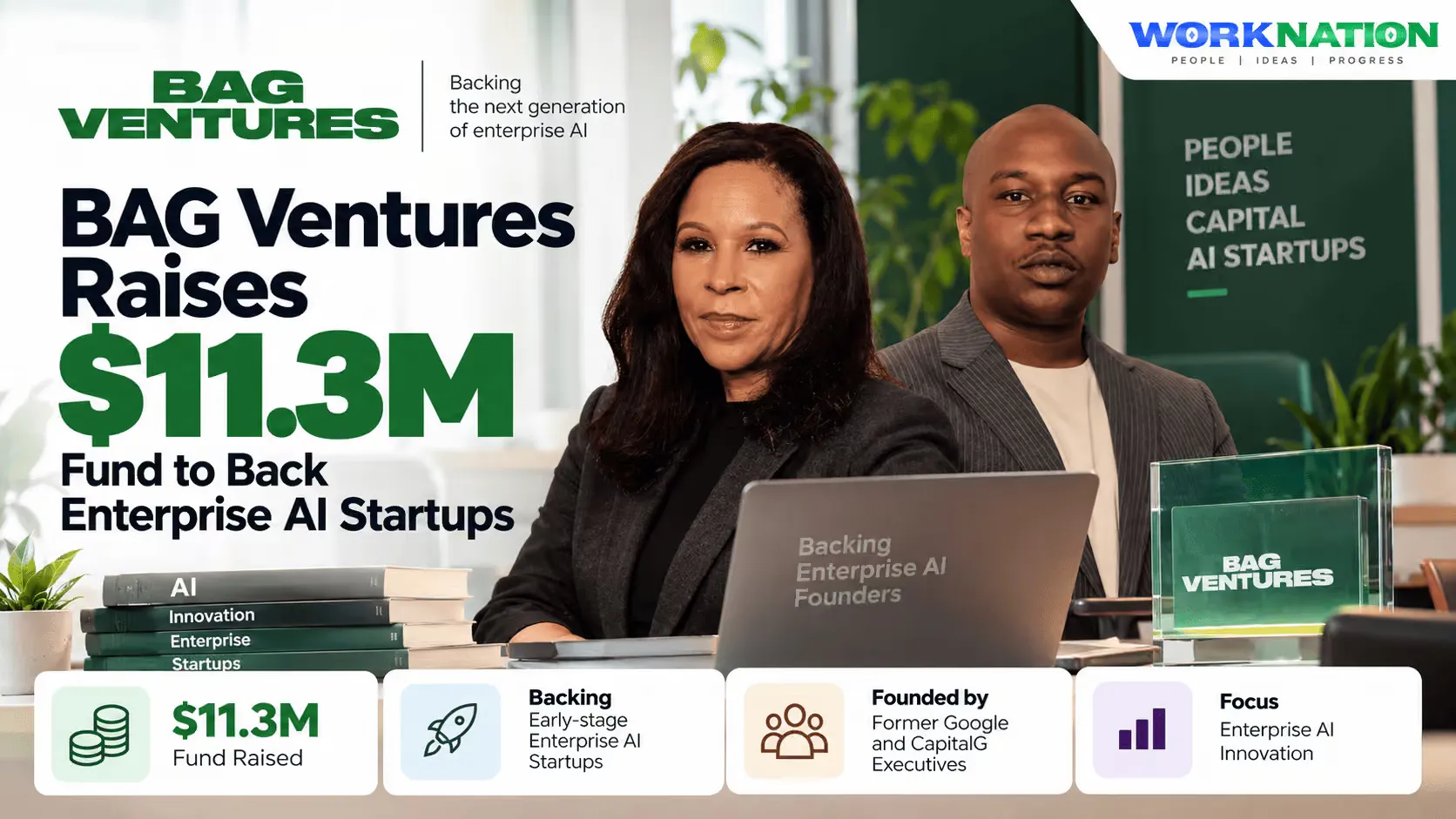
BAG Ventures, a venture capital firm co-founded by former Google vice president Bonita Stewart and former CapitalG partner Jackson Georges Jr., has closed an $11.3 million debut fund to invest in early-stage artificial intelligence startups. The close was announced on 30 September 2026.
The firm is betting that the era of corporate experimentation with AI is ending, and that enterprises will increasingly pay only for AI products that deliver measurable, dependable results inside their workflows.
BAG Ventures spent about two years investing from the fund as it came together, and has already backed ten companies, including software company SXD, AI travel booking startup BizTrip and agentic reasoning platform Nomadic. Its cheques range from $100,000 to $500,000, and the team plans to invest the remainder of the fund over the next two years.
A woman-led firm with deep enterprise roots
Stewart spent 17 years at Google, including nearly a decade as a vice president, and is widely recognised as the first Black woman to hold a vice-president title at the company. During her time there, she served on the board of Gradient Ventures, Google's early-stage AI fund. She is also a limited partner in the Female Founders Fund and Operator Collective.
Georges worked at GE Healthcare and at Google, where he met Stewart, before becoming a partner at CapitalG, the growth equity arm of Google's parent Alphabet. Together they previously co-led BAG Collective, an angel syndicate with more than 450 members.
Stewart's role as co-founder and general partner is significant in an industry where women remain underrepresented in investment decision-making. Women hold a minority of partner roles at venture capital firms globally, and the share of firms led by women of colour is smaller still. Funds led by experienced women operators can broaden who gets funded, both because of the networks their partners draw on and because of the perspectives they bring to evaluating founders.
Operators as limited partners
One of BAG Ventures' defining features is its limited partner base. The fund is backed by more than 150 LPs, including Google, as well as representatives from companies such as Nvidia, Amazon and Snowflake. Many are senior operators at large technology and enterprise companies.
That structure is central to the firm's strategy. The founders say their edge is access: warm introductions to enterprise buyers and practical advice on selling to large organisations. Georges said the pair launched BAG Ventures to "address the emerging AI divide between founders and operators".
For early-stage AI startups, winning the first few enterprise customers is often the hardest step. Large companies are cautious about adopting software from young vendors, particularly for sensitive data and mission-critical processes. A network of operators who can open doors and provide credibility can be decisive.
Against thin wrappers
BAG Ventures is explicit about what it will not fund. Georges said enterprises are moving away from paying for open-ended chatbots and towards paying for outcomes delivered by multi-agent workflows. Startups that are "just a thin wrapper around a frontier model API", he warned, risk being wiped out as large AI labs launch competing products.
The firm instead favours founders who own proprietary enterprise data, build for regulated industries and develop the infrastructure that will allow AI agents to operate safely inside companies, including identity and access management and zero-trust security architectures.
Its investment thesis is organised around three pillars: Scale, covering AI data infrastructure, compute and physical and edge AI; Secure, covering AI-native security and agentic governance; and Deliver, covering vertical software applications.
The firm looks for core technical teams that have worked together before, have a minimum viable product and at least one partner, and show a clear path to generating revenue.
A changing market for enterprise AI
BAG Ventures' thesis reflects a broader shift in how investors view AI. In 2023 and 2024, many startups raised money by building applications on top of large language models. As frontier model developers have expanded their own products and enterprise offerings, many of those startups have struggled to differentiate.
Investors are now focusing on companies that are deeply embedded in specific workflows, own valuable data or provide infrastructure that large AI developers do not. The same trend is visible in India, where a survey of institutional investors by Inc42 found that 39% favoured vertical AI applications built for specific industries over other AI opportunities, even as 63% worried that Indian AI valuations had risen too far.
Small fund, focused strategy
At $11.3 million, BAG Ventures is a small fund compared with the multi-billion-dollar vehicles raised by large venture firms. But small, specialised funds play an important role at the earliest stages of company formation, where cheques of a few hundred thousand dollars can help startups reach the milestones needed to raise larger rounds.
Emerging fund managers have faced a difficult fundraising environment in recent years, as institutional investors concentrated their commitments in established firms. Closing a debut fund with a large and diverse operator LP base is an achievement in that context, particularly for a firm led by a woman and a Black co-founder.
Lessons for India's investor community
The model has relevance beyond the United States. In India, a growing number of senior executives from global technology companies, many of them part of the Indian diaspora in Silicon Valley, have become angel investors and limited partners in early-stage funds. Operator-led funds that combine capital with direct access to enterprise buyers could help Indian AI startups selling to global customers, a market that India's software services heritage positions them to pursue. BAG Ventures' approach, built on an angel syndicate that grew into an institutional fund, offers a template that diaspora networks could replicate.
Why it matters
The question of who controls capital shapes which companies get built. As AI reshapes industries, the investors who decide which AI startups receive early funding will influence the direction of the technology and who benefits from it.
BAG Ventures brings together enterprise experience, an operator network and a clear thesis on where durable value in AI will be created. Its success will be measured by the companies in its portfolio, but its existence already adds a distinct voice to an industry that is still working to reflect the diversity of the founders and customers it serves.