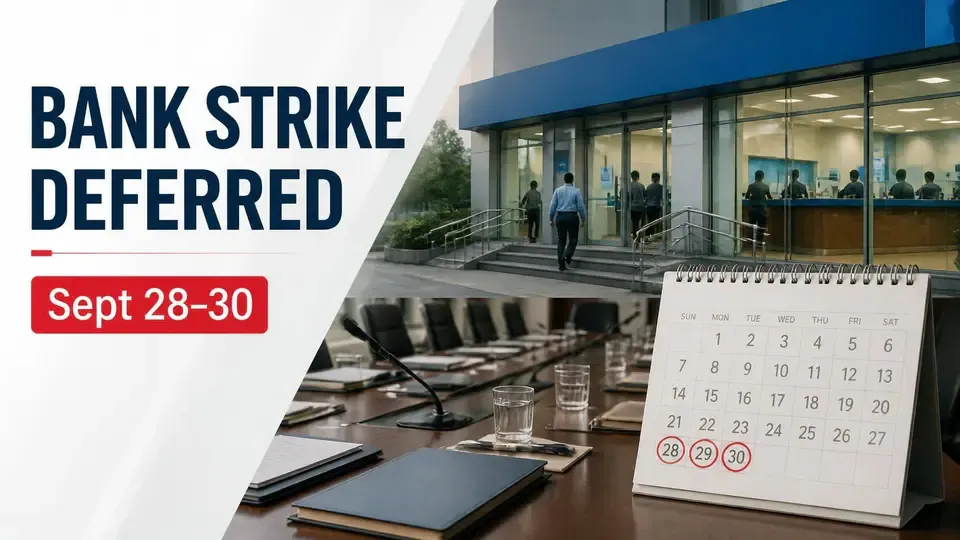
India's public sector bank unions say a three-day nationwide strike beginning on Monday, September 28, will go ahead, after last-minute efforts by the government and bank managements to secure a deferral failed. The dispute centres on a demand for a five-day working week that unions say was agreed more than two years ago but has never been implemented.
In a circular dated September 26, the United Forum of Bank Unions (UFBU), an umbrella body representing the large majority of officers and staff at public sector banks, said a conciliation meeting held in Delhi on September 22 had produced no positive outcome. The unions had told the Department of Financial Services and the Indian Banks' Association that they would reconsider the strike if they received a concrete response to their demands. Informal discussions with the IBA continued over two days, including an online meeting convened by the IBA chairman, but the circular said these did not produce a result, and preparations for the strike were continuing.
A Sunday opening and a protest in black
To limit disruption, the Ministry of Finance and the Reserve Bank of India directed public sector banks and regional rural banks to keep branches open on Sunday, September 27. Without that step, customers faced the prospect of five consecutive days without normal branch services: September 26 was the fourth Saturday of the month, a bank holiday, followed by Sunday and the three strike days.
The UFBU said that because September 27 was not a strike day, it had advised members to report for work and serve customers. But it also said employees attending branches would wear black attire, black badges or black ribbons in protest, and it criticised what it described as derogatory social media posts by some banks about the strike. The union body alleged that employees, particularly probationers, branch managers and officers at Scale IV and above, had faced pressure and intimidation from some managements, and it reminded members of their legal right to participate.
What the unions want
The core demand is a five-day banking week, with all Saturdays declared holidays. The issue has a long history. In 2015, the government made the second and fourth Saturdays of each month holidays for banks, and unions have since campaigned for the remaining Saturdays to follow. According to the unions, the Indian Banks' Association agreed to the change in a settlement and joint note dated March 8, 2024, under which employees would work longer hours on weekdays to make up for the lost Saturday hours. The proposal was sent to the government for approval, where it has remained pending.
"In 2024, the Indian Banks' Association and other bank unions agreed to increasing the working hours on weekdays in lieu of the working hours lost on Saturdays. The proposal was then sent to the government for approval but it is still pending," said YK Arora of the National Confederation of Bank of India Staff Unions, according to ThePrint.
The unions have also objected to a revised performance-linked incentive scheme for senior officers. At an earlier conciliation meeting on September 8, the Department of Financial Services said the scheme for officers in Scales 4 to 8 had been kept in abeyance for 2025-26 and would be discussed bilaterally, and that five-day banking was under consideration by the government. The unions said this did not amount to the concrete timeline they were seeking.
An escalating campaign
The strike is part of an escalating programme of action. The UFBU, whose constituents include the All India Bank Employees' Association (AIBEA), the All India Bank Officers' Confederation (AIBOC), the All India Bank Officers' Association (AIBOA), the Bank Employees Federation of India (BEFI), the National Confederation of Bank Employees (NCBE), the Indian National Bank Employees' Federation (INBEF) and the Indian National Bank Officers' Congress (INBOC), held a one-day nationwide strike on September 11. The unions have said they will begin an indefinite strike from October 26 if the dispute remains unresolved.
The finance ministry has appealed to employees not to strike, arguing that most of the unions' concerns have already been substantially addressed and that remaining differences should be resolved through dialogue. The Department of Financial Services has reviewed contingency arrangements with public sector banks, regional rural banks and the IBA, including security for critical banking infrastructure. The government has warned that the strike could effectively disrupt physical banking services for several days, affecting customers, businesses and trade-related transactions.
Why work-life balance has become a women's issue in banking
The dispute has drawn support from UNI Global Union, the international federation to which several UFBU constituents are affiliated, which has framed it partly as a question of gender equity. Women now make up a rapidly growing share of India's banking workforce, and union leaders argue that the six-day week falls especially heavily on them.
"For Indian women bankers, who represent a rapidly growing share of the financial workforce, the lack of work-life balance is exacting a heavy toll on health and family life," said Bhavneet Kaur Alang, national treasurer and women coordinator of the All India Bank of Baroda Officers' Association and deputy president for women at UNI Apro. The argument echoes broader debates in India about women's labour force participation, where research has pointed to long working hours and a lack of flexibility as factors that push women out of mid-career roles.
What customers should expect
Past UFBU strikes have mainly disrupted branch-based services at public sector banks, such as cash deposits and withdrawals over the counter, cheque clearing and loan processing. Digital channels, including UPI, internet banking and card networks, have generally continued to function, and ATMs have largely remained operational, although cash availability can become a concern if a strike runs for several days. Private sector banks are typically less affected. Customers with urgent branch transactions have been advised to use digital banking where possible and to watch for updates from their banks.
For businesses, particularly smaller firms that rely on branch services for cash management and trade documentation, three days of disruption at the end of the month and the quarter could create delays. The strike coincides with the close of the July–September quarter, when companies often settle payments and file documentation.
The road ahead
Both sides have left the door open. The unions say they would reconsider if they receive a concrete, positive response, and the government has emphasised its willingness to talk. But with an indefinite strike threatened from October 26, the pressure to find a settlement is growing. A formal timeline for implementing the five-day week, or a clear decision on the incentive scheme, would likely be needed to defuse the dispute.
For India's banking system, which serves hundreds of millions of customers and is central to the government's financial inclusion agenda, the stakes are considerable. How the dispute is resolved will also shape how the country's largest employers approach working hours at a time when productivity, digital banking and staff wellbeing are all under scrutiny.