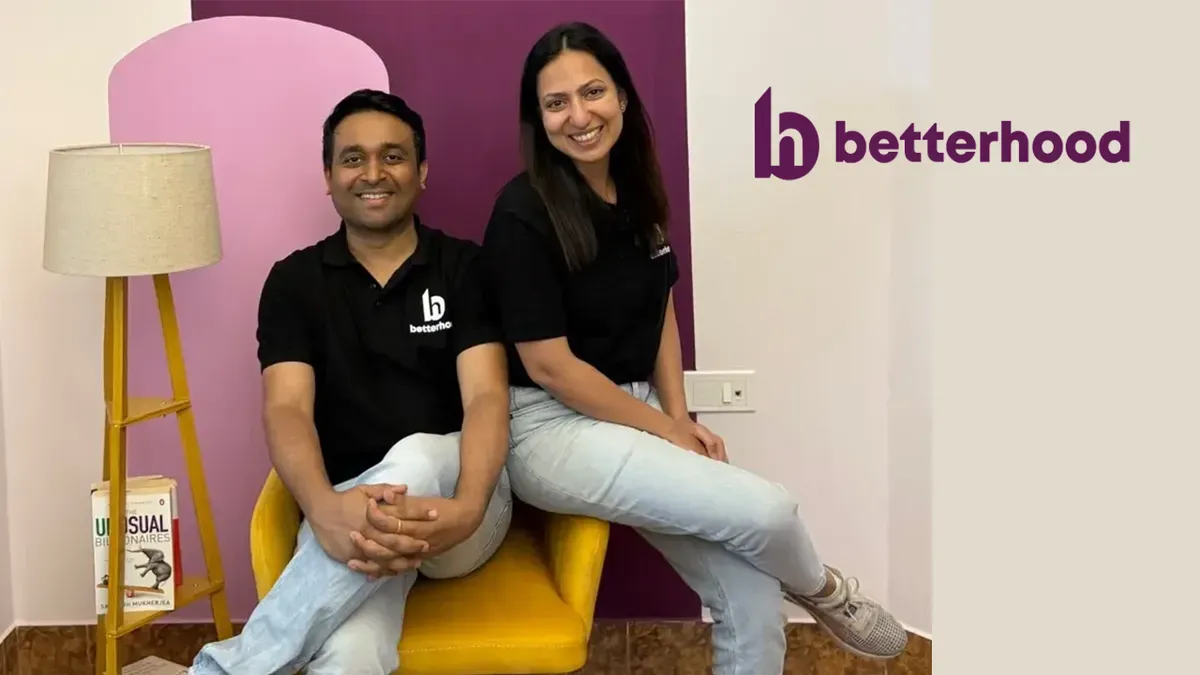
betterhood, a Bengaluru-based preventive pain-care brand co-founded by Neha Zade and Vikram Kadam, has raised ₹11.5 crore in a seed funding round led by consumer-focused venture firm Sauce, according to a report by Entrackr on Wednesday, September 23. Existing investor Kairon Capital also participated.
The round builds on ₹5 crore that betterhood raised earlier in the same round in March, led by Kairon Capital, with participation from Yogesh Kabra, Rishubh Satiya, Rohit Chawla, Sifat Khurana and Shayamal Vallabhjee.
The company said it would use the fresh capital to deepen its product portfolio, expand distribution across quick commerce and modern retail, and scale its content and physiotherapist community.
Catching pain early
Founded in October 2024, betterhood is building a brand focused on the early signs of back, neck and joint discomfort — the aches and stiffness that many people ignore until they turn into chronic pain or injury.
Its product range includes posture and ergonomic supports; orthotic soft goods such as back, knee, ankle and wrist supports; and pain-relief and recovery products. The positioning is preventive: helping consumers address discomfort before it requires medical treatment.
The opportunity is large. According to market research cited by the company, these categories represent a market of around ₹20,000 crore in India, growing at a low-to-mid-teens rate.
Why pain is a growing market
Several trends are driving demand. Desk-based work, long commutes and extended screen time have made posture-related discomfort increasingly common among urban professionals. The shift to hybrid work has moved many people into home offices that were never designed for eight-hour working days. And an ageing population is increasing demand for joint support and mobility aids.
At the same time, many consumers are reluctant to visit a doctor or physiotherapist for what they see as minor aches. That creates space for trusted consumer brands that offer credible, easy-to-use products — provided they can earn consumers’ trust in a category where quality and effectiveness vary widely.
A community-led strategy
betterhood’s differentiation lies partly in its relationship with physiotherapists. The company is building Physio Circle, a nationwide community of physiotherapists focused on awareness around posture, pain prevention, movement and recovery. The community currently has more than 7,000 physiotherapists, the company said.
betterhood has also launched The Physio Edge, a certification programme for early-career physiotherapists designed to bridge the gap between academic training and clinical practice.
The strategy serves several purposes. Physiotherapists are trusted advisers for people experiencing pain, and a community of engaged professionals can provide credibility, product feedback and word-of-mouth recommendations. The certification programme deepens that relationship while contributing to the professional development of a workforce that plays an important role in India’s healthcare system.
Since its launch, betterhood says it has served more than 200,000 customers and published 1,500 pieces of educational content across platforms covering posture, pain prevention, movement and recovery. Content is central to its approach: by educating consumers about the causes and early signs of pain, the company aims to build trust before a purchase is made.
Distribution: quick commerce and modern retail
The planned expansion into quick commerce and modern retail reflects how Indian consumer brands are thinking about distribution in 2026. Quick-commerce platforms have become an important channel for health and wellness products, allowing consumers to buy items such as supports and pain-relief products within minutes of realising they need them.
Modern retail — pharmacies, supermarkets and large-format stores — offers visibility and the opportunity to reach customers who prefer to see and try products before buying. For a category where fit and comfort matter, physical retail can play a valuable role alongside online channels.
A woman co-founder in consumer health
betterhood is one of a relatively small number of Indian consumer-health startups with a woman co-founder to raise capital this month. Women remain underrepresented among venture-backed founders in India, and consumer health — despite its relevance to women’s daily lives — has not always attracted proportionate investment.
The use of content and professional endorsement also helps betterhood address a common problem in consumer health: scepticism about product claims. By grounding its messaging in guidance from physiotherapists and focusing on posture, movement and early intervention, the company is positioning itself as an educator as well as a seller.
That approach may also help it build a defensible brand. In categories such as braces and supports, products can be copied quickly and sold cheaply online; trust built through expert advice and consistent quality is far harder to replicate.
Neha Zade’s role in building a brand that combines products, content and professional community points to a broader shift in Indian consumer entrepreneurship: founders are increasingly building brands around trust and expertise rather than purely around price and discounts.
A competitive but fragmented field
betterhood operates in a segment that has seen growing investor interest. Entrackr noted that Nivaan Care raised $7 million to scale its non-surgical chronic-pain management clinics, while CURAPOD, a wearable pain-management device from Litemed, raised ₹20 crore in a pre-Series A round. Heatronics raised ₹1.8 crore for preventive pain-management and heat-therapy devices, Zanskar raised ₹2.8 crore in 2025 to expand its pain-care portfolio, and Stance Health raised $1 million for a tech-enabled musculoskeletal care model.
These companies take different approaches — clinics, devices, digital care and consumer products — but share a common premise: that musculoskeletal pain is a large, underserved problem in India that can be addressed more effectively and affordably outside traditional hospital settings.
What comes next
With fresh capital from Sauce and continued backing from Kairon Capital, betterhood will focus on broadening its product range, expanding distribution and scaling its physiotherapist network. The company’s challenge will be to turn its content-led, community-driven model into consistent repeat purchases and brand loyalty in a category where many products are seen as one-off purchases.
If it succeeds, betterhood could become one of the defining consumer brands in India’s preventive health market — built not on discounts, but on trust, education and the endorsement of the professionals who treat pain every day.
For women-led consumer brands in India, a successful scale-up by betterhood would add another example to a growing list of founders building category leaders in health and wellness.