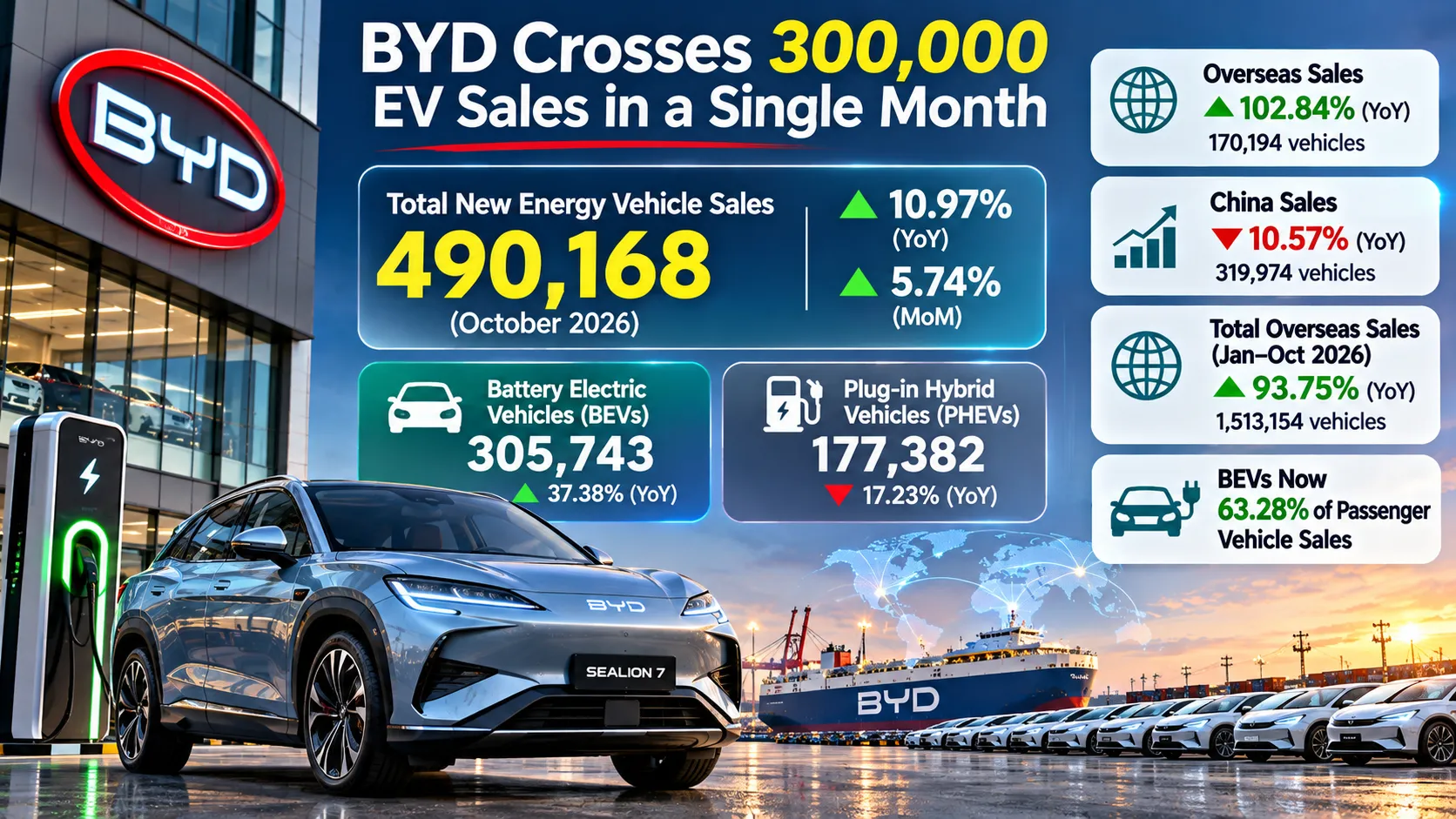
The world's largest electric vehicle maker has reached a symbolic milestone, selling more than 300,000 fully electric passenger cars in a single month for the first time, while its rapidly growing overseas business offset weakness in its home market.
BYD sold 490,168 new energy vehicles in October 2026, up 10.97% from a year earlier and 5.74% from September, according to data released on Sunday, November 1, and reported by CnEVPost. Sales of battery electric passenger vehicles (BEVs) rose 37.38% to 305,743, accounting for 63.28% of its passenger vehicle sales.
The shift to full electrics
Sales of plug-in hybrid passenger vehicles (PHEVs) fell 17.23% to 177,382, according to CnEVPost. The divergence between surging BEV sales and falling PHEV sales marks a notable shift for BYD, which built much of its earlier growth on affordable plug-in hybrids that combine a battery with a petrol engine.
The trend suggests that Chinese consumers, and buyers in overseas markets, are increasingly comfortable with fully electric cars as charging networks expand, battery ranges improve and prices fall. BYD's investment in fast-charging technology, which it says can add hundreds of kilometres of range in minutes, has been part of its effort to address concerns about charging times.
Overseas growth
BYD's overseas sales rose 102.84% to 170,194 vehicles in October, although they fell 5.81% from September, according to CnEVPost. For the first ten months of the year, overseas sales rose 93.75% to 1,513,154 vehicles.
The company has expanded aggressively into Europe, Southeast Asia, Latin America, the Middle East, Australia and other markets, building factories in countries including Hungary, Turkey, Brazil, Thailand and Indonesia to serve local markets and reduce exposure to tariffs. Its fleet of car-carrying ships helps it deliver vehicles worldwide.
A weaker home market
In China, BYD's sales fell 10.57% to 319,974 in October, according to CnEVPost. For January to October, total sales fell 2.16% to 3,621,744, despite the overseas surge.
China's car market has become intensely competitive, with dozens of EV makers engaged in a prolonged price war. Rivals including Leapmotor, Xiaomi, Xpeng and Geely have gained market share in some segments, and the government has expressed concern about excessive price competition, urging carmakers to avoid destructive discounting. October data showed Leapmotor delivering a record 106,127 vehicles and Xiaomi and Xpeng each passing 50,000 for the first time.
The global EV race
BYD has overtaken Tesla as the world's largest seller of battery electric vehicles and has continued to extend its lead. Its vertical integration, producing its own batteries, chips and many components, gives it a significant cost advantage over Western rivals. This has allowed it to offer electric cars at prices that undercut many petrol vehicles in some markets.
Western governments have responded with trade measures. The United States has imposed steep tariffs on Chinese EVs, effectively shutting BYD out of the American market, while the European Union has imposed additional duties on Chinese-made EVs. BYD has responded by building factories in Europe and elsewhere.
Climate significance
The rapid growth of BYD's battery electric sales has significant implications for global emissions. Transport accounts for a large share of greenhouse gas emissions, and the shift from petrol and diesel cars to electric vehicles is a key part of decarbonisation strategies worldwide. China's dominance in EV production has helped drive down costs, accelerating adoption in many countries.