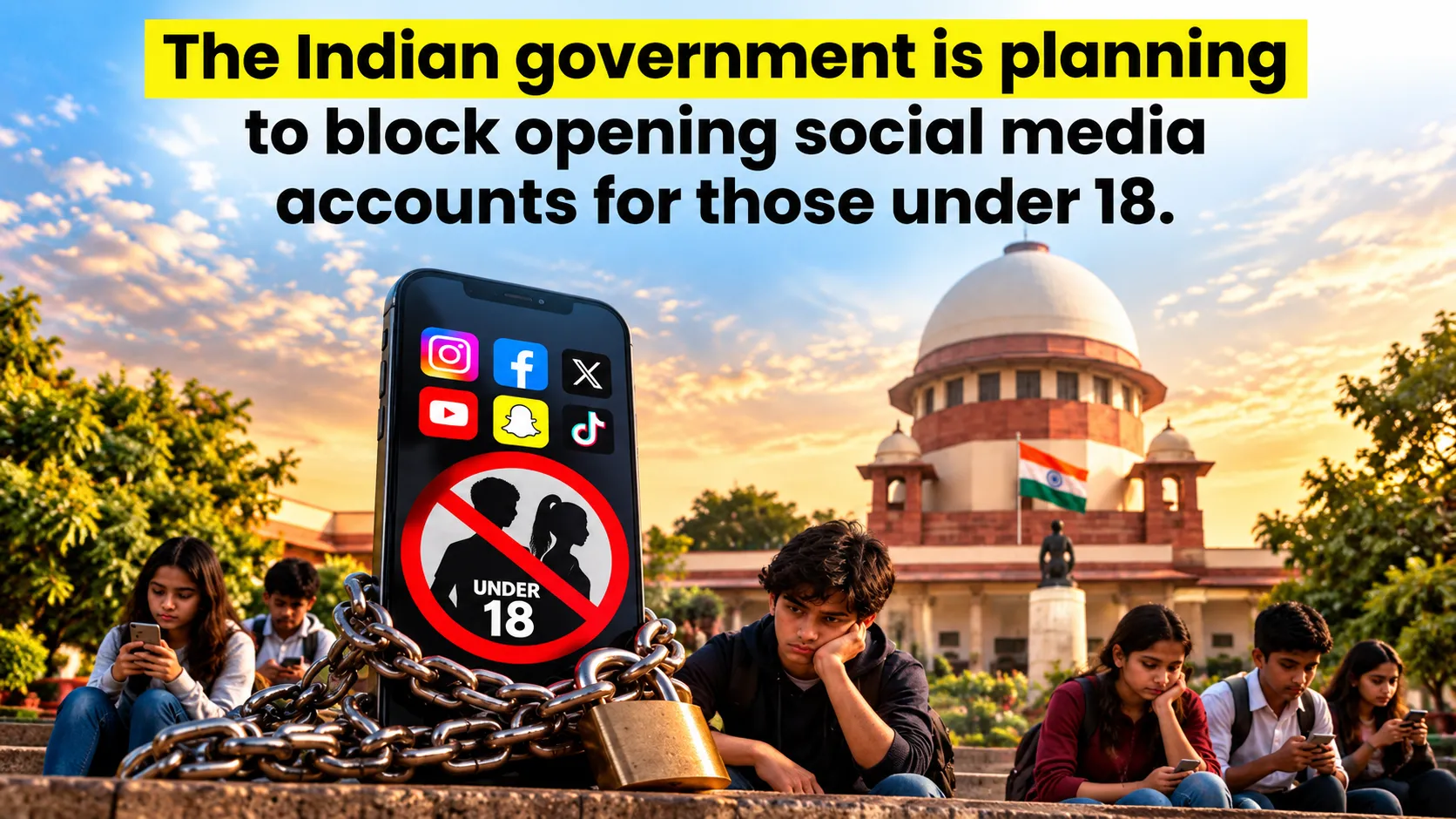
The Indian government has told the Supreme Court that it will amend the country's information technology rules to make it a legal obligation for social media platforms to prevent children under 18 from opening accounts, a commitment that could transform how global technology companies operate in their largest market by users.
Solicitor General Tushar Mehta made the statement before a bench led by Chief Justice of India Surya Kant, with Justices Joymalya Bagchi and V Mohana, during a hearing on 29 September 2026. "Something can be done, something should be done and something will be done," Mehta told the court, according to reports of the proceedings.
The government said it would amend the Information Technology (Intermediary Guidelines and Digital Media Ethics Code) Rules to make age restrictions statutorily binding on intermediaries. If implemented as described, India would join a small but growing group of countries that have moved to restrict children's access to social media by law, rather than relying on voluntary policies set by the platforms themselves.
The case before the court
The proceedings stem from a petition filed by the Just Rights for Children Alliance, a non-governmental organisation. The petitioners argue that minors cannot legally enter into contracts with social media companies. Under Section 11 of the Indian Contract Act, 1872, a person below the age of majority is not competent to contract. Yet, the petition contends, platforms routinely allow children to accept their terms of service, effectively treating them as parties to binding agreements.
The petitioners have not sought a blanket ban on children using the internet. Instead, they have pressed for robust age-verification mechanisms and parental consent requirements, so that minors are not able to sign up for social media services independently.
During the hearing, the bench raised pointed questions about jurisdiction and enforcement. Justice Bagchi observed that platforms registered under US law cannot simply apply restrictions designed for the American market to India's digital space. The court also asked whether the Centre could direct platforms to modify their software to comply with Indian legal requirements, a question that goes to the heart of how national rules apply to global services.
Mehta indicated that the government would distinguish between different kinds of online services. "Membership of educational websites can be taken through consent of parents," he said, suggesting that learning platforms would be treated differently from social networks.
What could change
The most immediate impact would fall on the largest social media and messaging platforms, including those operated by Meta, Google, Snap and X, as well as Indian services such as ShareChat and Moj. India has hundreds of millions of social media users, and a significant share of them are teenagers. Platforms that currently set a minimum age of 13 in line with US regulations would need to raise that threshold to 18 for Indian users and build systems to enforce it.
Enforcement is the central challenge. Age verification online is notoriously difficult. Self-declared birthdates are easily falsified, while more robust methods, such as identity document checks, facial age estimation or verification through government databases, raise concerns about privacy, data security and exclusion. In India, the possibility of linking age checks to Aadhaar or DigiLocker has been discussed in policy circles, but any such approach would face scrutiny over data protection and the risk of excluding people without easy access to documents.
Links to India's data protection law
The move builds on obligations already contained in the Digital Personal Data Protection Act, 2023. The Act defines a child as anyone under 18 and requires data fiduciaries to obtain verifiable consent from a parent or lawful guardian before processing a child's personal data. It also prohibits tracking, behavioural monitoring and targeted advertising directed at children.
In practice, those provisions already make it harder for platforms to serve personalised content and advertising to minors. Amending the IT Rules to bar under-18s from opening accounts would go further, shifting the question from how children's data is processed to whether children can be on these platforms at all.
A global trend
India is not alone in tightening rules on children's use of social media. Australia became the first country to enact a nationwide minimum age for social media, barring under-16s from holding accounts on major platforms, with the law taking effect in December 2025. Several European countries have debated or introduced age limits and parental consent requirements, and a number of US states have passed laws requiring age verification or parental approval, many of which have faced legal challenges.
The motivations are similar across jurisdictions: growing evidence and public concern about the effects of social media on children's mental health, exposure to harmful content, cyberbullying, and the design of platforms to maximise engagement. Governments have also grown sceptical of platforms' self-regulation, arguing that commercial incentives work against meaningful protection for young users.
India's approach, if it proceeds, would be among the most expansive by age threshold. Setting the limit at 18 rather than 16 reflects the legal definition of a minor under Indian law, but it would also affect a much larger population of older teenagers who use social media for communication, education and self-expression.
Concerns and trade-offs
Digital rights advocates are likely to raise several concerns. Requiring age verification for all users could mean collecting more personal data from adults as well as children, since platforms would need to verify everyone's age to exclude minors. That could create new privacy risks in a country where data breaches have been a recurring problem.
There are also questions about access and equity. For many young people, particularly in smaller towns and rural areas, social media platforms serve as sources of information, community and economic opportunity. Young creators and entrepreneurs use them to reach audiences and customers. A blanket prohibition could push some users towards less regulated platforms or towards using adults' accounts, undermining the intended protections.
What happens next
The government's commitment to the court is a statement of intent rather than a finished policy. The Ministry of Electronics and Information Technology will need to draft amendments to the IT Rules, which are typically released for public consultation before being notified. The details, including how age will be verified, which services will be covered, what role parental consent will play and what penalties platforms will face, will determine the practical impact.
The Supreme Court is expected to continue monitoring the matter, and its observations on jurisdiction and enforceability will shape how far the government can go. Platforms, meanwhile, will engage closely with policymakers to influence the final rules, and may push for approaches such as parental controls and teen accounts rather than outright exclusion.
For India's technology sector and its global partners, the message is clear. The era in which social media companies set their own rules for young users in India is drawing to a close. How the country balances child safety, privacy and digital inclusion in the rules that follow will be watched closely around the world, given the scale of India's online population and its growing influence on global technology policy.