India's coal sector is preparing for a future in which mines are not only opened more efficiently but also closed more responsibly. New rules from the Ministry of Coal aim to address both.
The Ministry of Coal has issued the Guidelines for Preparation of Mining Plan and Mine Closure Plan for Coal and Lignite Mines, 2026. The guidelines, dated November 20, were made public on Monday, November 23, and take effect 30 days after issue, according to current affairs reports.
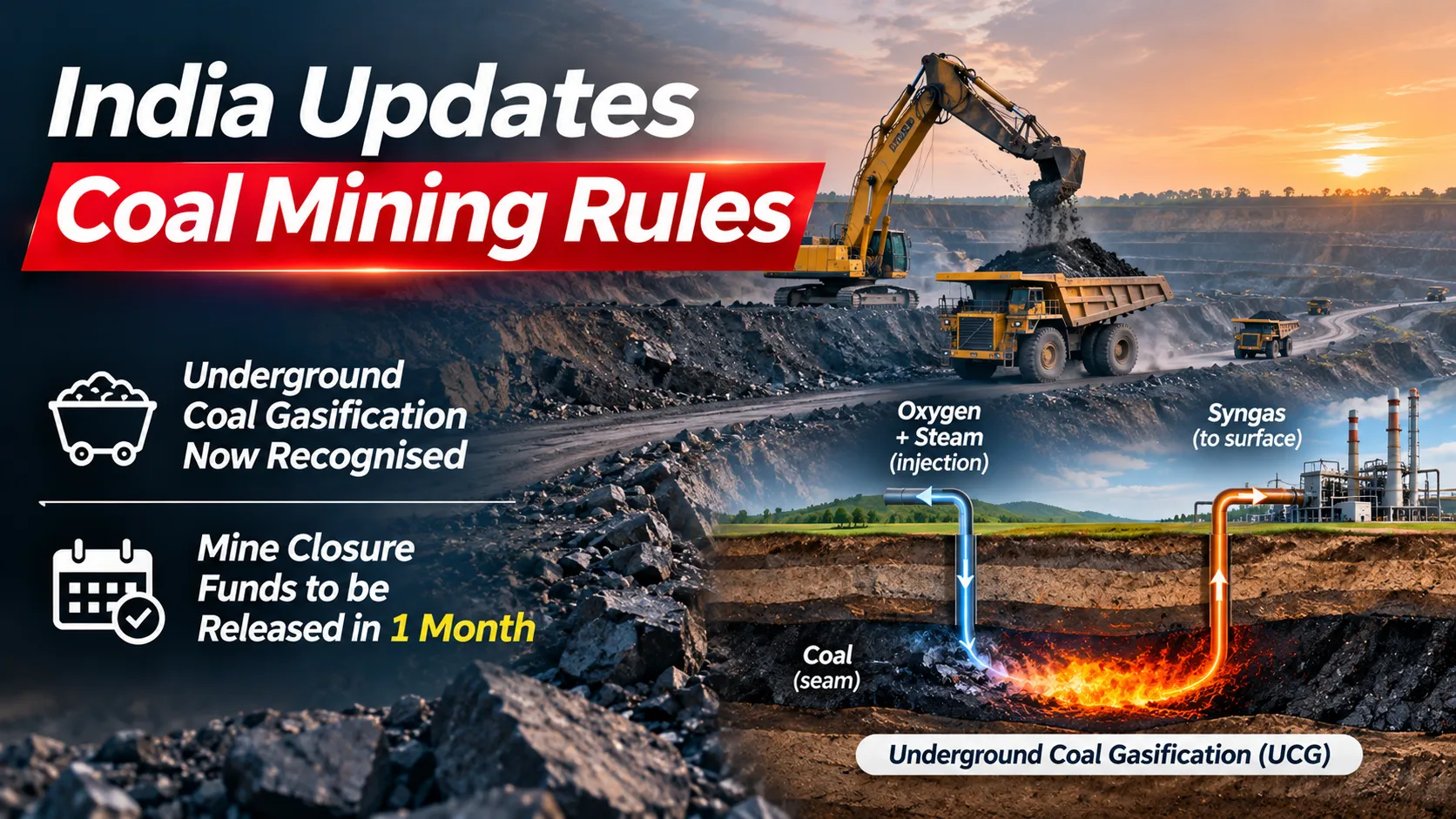
Two changes stand out. For the first time, underground coal gasification is formally recognised as a mining method. And the Coal Controller must now allow withdrawals from escrow accounts for mine closure costs within one month of receiving a claim.
What a mine closure plan is
In India, every coal and lignite mine must have an approved mining plan, which sets out how the deposit will be extracted, and a mine closure plan, which describes how the land will be restored once mining ends. Mine operators are required to deposit money into an escrow account over the life of the mine to fund closure activities.
Closure activities can include backfilling mined-out areas, stabilising slopes, treating contaminated water, removing infrastructure, restoring soil and vegetation, and making land safe for future use. Progressive closure, in which land is restored during mining rather than only at the end, is increasingly encouraged.
Faster access to closure funds
The requirement for the Coal Controller to approve escrow withdrawals within one month of a claim is designed to remove a bottleneck. Mine operators have previously faced delays in accessing money deposited for closure, which can slow down restoration work.
Faster release of funds should allow operators to carry out progressive closure more efficiently, improving environmental outcomes and reducing the risk of abandoned, unrestored mines.
Recognising underground coal gasification
Underground coal gasification (UCG) is a process in which coal is converted into gas while still underground, by injecting oxygen and steam into the coal seam and igniting it under controlled conditions. The resulting synthesis gas, or syngas, which contains hydrogen, carbon monoxide and methane, is brought to the surface and can be used for power generation, chemicals, fertilisers or fuels.
UCG can make it possible to use coal deposits that are too deep or otherwise uneconomical to mine conventionally. It avoids the need to bring coal to the surface, reducing some of the environmental impacts of mining, such as land disturbance and waste dumps.
By formally recognising UCG as a mining method, the guidelines provide a regulatory pathway for companies seeking to develop such projects.
India's coal gasification push
The government has set a target of gasifying 100 million tonnes of coal by 2030 as part of its strategy to reduce imports of natural gas, ammonia, methanol and other chemicals, and to make greater use of domestic coal reserves. It has offered financial incentives for surface coal gasification projects and has worked on frameworks for underground gasification.
Earlier in 2026, the ministry issued draft norms for mining plans for underground gasification and proposed escrow arrangements for UCG blocks, according to industry reports. The new guidelines bring these elements into the formal framework.
Environmental concerns
Underground coal gasification is not without risks. Experience in other countries has shown that UCG can contaminate groundwater if not carefully managed, and it still produces carbon dioxide when the syngas is used. Environmental groups argue that coal gasification locks in fossil fuel use and that investments should prioritise renewable energy instead.