WomenLeadership Impact5 MIN READ

Colette Kress and the Glass Cliff: Nvidia's First Woman Leader Takes Charge at the Company's Moment of Maximum Risk

Colette Kress, Nvidia's chief financial officer since 2013, became the first woman to lead the $4 trillion chipmaker when she was named interim CEO on November 12 after Jensen Huang's resignation. Leadership experts quoted by Fast Company asked whether she is standing on a "glass cliff", the pattern in which women are put in charge during crises, while analysts praised her credibility with investors.

By Prathista Lazar · Author13 November 2026New
Colette Kress and the Glass Cliff: Nvidia's First Woman Leader Takes Charge at the Company's Moment of Maximum Risk

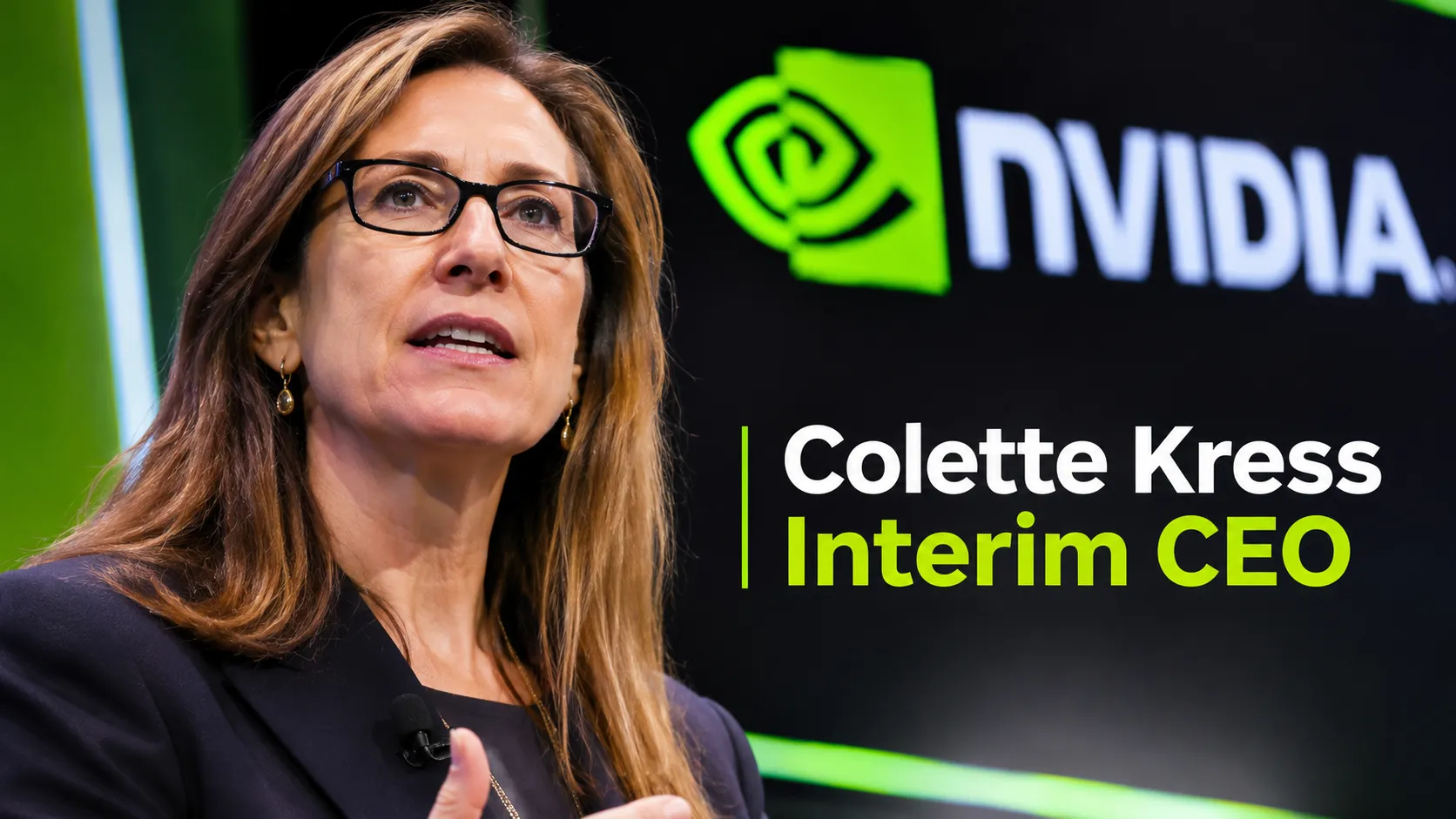
For 13 years, Colette Kress was the calm voice explaining Nvidia's numbers to Wall Street, quarter after quarter, as the company grew from a niche chipmaker into the engine of the artificial intelligence boom. On Thursday, November 12, she became something more: the first woman to lead the world's most valuable semiconductor company.

Nvidia named Kress, 59, interim chief executive after co-founder Jensen Huang resigned with immediate effect following a scandal over his personal conduct. She will continue as chief financial officer while the board searches for a permanent successor from inside and outside the company.

Her appointment has been widely welcomed by investors. But it has also revived a long-running debate about why women are so often handed the top job when a company is in crisis, and whether they are given the authority and time to succeed.

The glass cliff

The term "glass cliff" was coined by researchers at the University of Exeter, Michelle Ryan and Alex Haslam, in the mid-2000s, after they found that women were more likely to be appointed to leadership roles when companies were performing poorly. The idea is that women break through the glass ceiling only to find themselves on a precarious ledge, with a higher risk of failure.

Fast Company asked on November 12 whether Kress is now standing on that cliff. "It is unclear whether Kress is being set up to fail," Christina Lindley of VPRG Consulting told the magazine, asking whether she will "get the accountability without the power."

Martin Lanik of leadership development firm Pinsight argued that in tough times, companies are more likely to sacrifice women and minorities than white men, according to Fast Company. Annie Scranton of Pace PR suggested that putting more women in leadership could help companies avoid crises in the first place.

A respected operator

Whatever the risks, Kress brings considerable credibility. She joined Nvidia as CFO in September 2013 after serving as CFO of Cisco's business technology and operations finance organisation, and before that spent 13 years at Microsoft, where she was CFO of the server and tools division, according to Fox Business.

She has been a central figure on Nvidia's earnings calls throughout the AI boom, explaining record results and fielding questions from analysts about demand, supply and margins. Huang recruited her, and she has worked alongside him through the company's most dramatic period of growth.

The view from Wall Street

Analysts were quick to back her. "Kress has built enormous credibility internally and externally, and we are big fans of her strategically," said Dan Ives of Yorkville Ives, according to Fox Business. "We always believed she would eventually be CEO of a major public tech company."

Bret Kenwell of eToro said Kress should "provide stability and reassurance" to investors, describing her as "a recognizable voice during an already fragile situation." Gil Luria of DA Davidson said she is well respected by investors and should be able to guide Nvidia through the period, though he cautioned that the task is "daunting."

Others were more measured. Susannah Streeter of Wealth Club called Kress a "safe pair of hands" but said she "lacks global status" and is "unlikely to be able to forge such deep commercial ties" as Huang, who personally negotiated with heads of state and technology chief executives.

“Will she get the accountability without the power?”
— Christina Lindley, VPRG Consulting, to Fast Company
0f947e64-5dc7-4d7a-8cd2-f8d9ca84f913.png

The scale of the challenge

Kress takes charge of a company worth about $4 trillion at Thursday's close, with Nvidia shares down more than 30% from their October peak. She must reassure customers, partners and employees that the company's product roadmap remains on track, manage scrutiny from US lawmakers over Huang's reported contacts with a woman suspected of ties to Chinese intelligence, and prepare for third-quarter results on November 17.

She also faces a governance transition: the board has appointed Harvey Jones as its first independent chair, signalling a shift away from the founder-centric model under which Huang concentrated decision-making.

Women at the top of tech

Kress's appointment is notable in an industry where women remain scarce in top roles. Only a small share of the world's largest companies are led by women, and the proportion is even lower in semiconductors and hardware. Lisa Su, chief executive of rival AMD, is one of the few women to lead a major chipmaker, and has become one of the industry's most respected figures after engineering AMD's turnaround.

Women are better represented in finance roles than in chief executive positions, and CFOs are an increasingly common pool for CEO appointments. But interim roles carry particular risks: they can be a stepping stone to the permanent job, or a holding position until a board finds someone else.

The research on crisis appointments

Studies of the glass cliff have found mixed evidence across industries and countries, but the pattern has been observed in politics as well as business. Researchers argue that boards and selection committees may see women as better suited to managing crises, or may be more willing to take a risk on a non-traditional candidate when the situation is already difficult.

The danger is that if the crisis deepens, the woman in charge may be blamed for problems she inherited, reinforcing biases about women's leadership.

A day of two departures

Kress's elevation came on the same day that another prominent woman technology leader stepped down. Yamini Rangan, the Indian-origin chief executive of software company HubSpot, left her role on November 12 as co-founder Brian Halligan returned to lead the company. The two moves together highlight the fragility of women's representation at the top of the technology industry.

Lessons for India Inc

India has a growing number of women leaders in business and finance, from bank chief executives to founders of high-profile startups, but women remain under-represented in boardrooms and top management. Indian regulations require listed companies to have at least one woman director, a rule that has increased representation on boards but has had less effect on executive leadership.

The debate over Kress's appointment offers a lesson for Indian companies: promoting women into leadership is only meaningful if they are given genuine authority, adequate support and a fair chance to succeed.

What comes next

Kress's first major public test will be Nvidia's earnings call on November 17. The board has not set a timetable for naming a permanent CEO. Whether Kress is ultimately given the job permanently, or returns to the CFO role, her handling of the coming weeks will be closely watched as one of the most high-profile examples of a woman leading a company through crisis.

TagsColette KressNvidiawomen in leadershipglass cliffwomen CEOsinterim CEOJensen Huangcorporate governancewomen in techsemiconductorsAIFast CompanyDan IvesWall Streetgender diversityboardroomsFortune 500Indian women leadersdiversityinvestors

Reader reviews

Sign in to rate and review this article.
Loading reviews…

