
The race to build commercial fusion power plants is increasingly becoming a race to build better chips. A day after Helion Energy announced federal funding for semiconductors, its rival Commonwealth Fusion Systems (CFS) has won its own award.
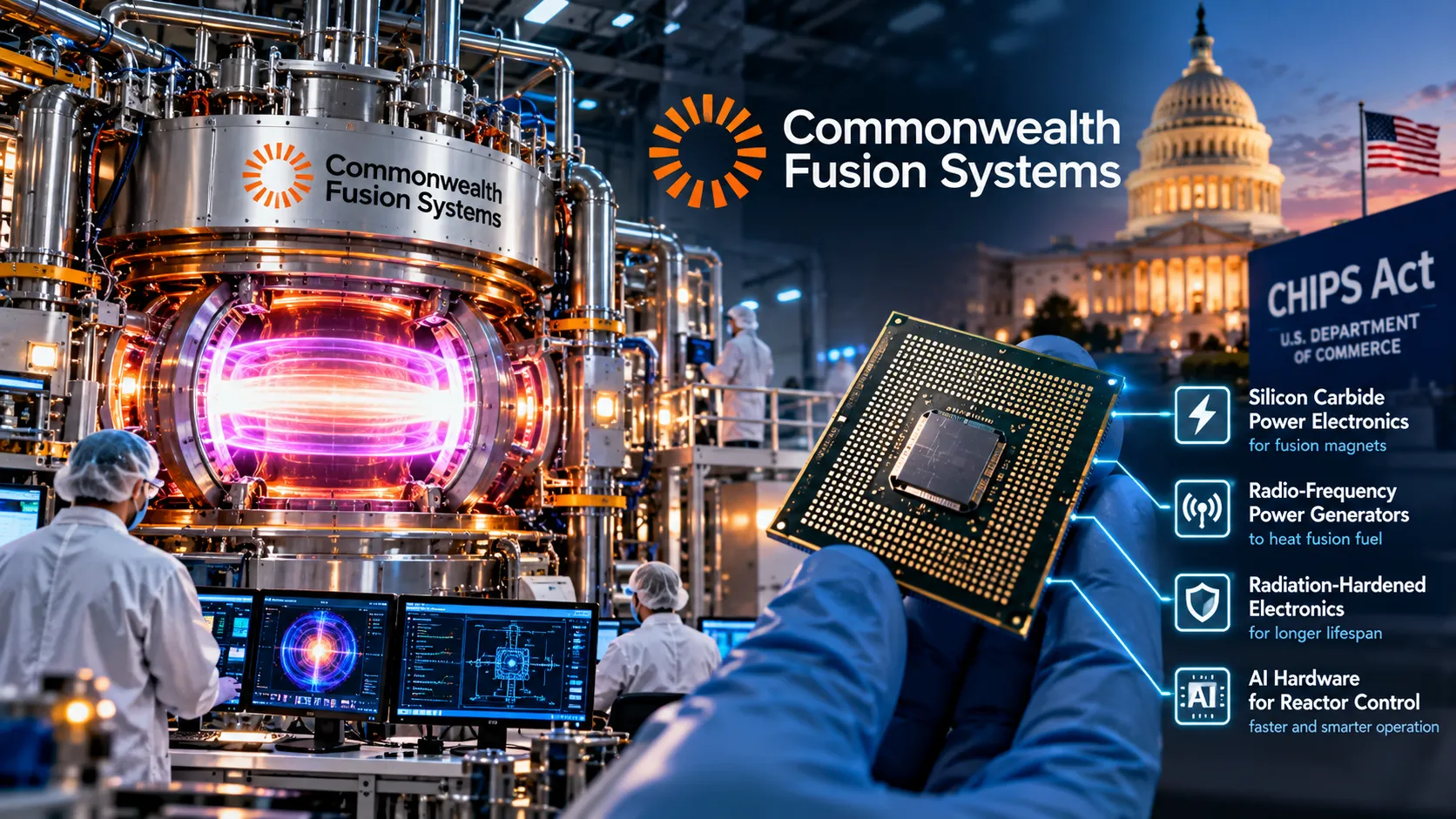
CFS will receive $85 million from the US Department of Commerce to develop advanced chips and power electronics for the fusion industry, TechCrunch reported on Friday, October 23. The money is a CHIPS Act award, and in exchange, the US government will take a stake in the company.
According to the company, the award will fund research, development and manufacturing capacity for US semiconductors used in fusion power plants.
Why fusion needs chips
Fusion power plants require sophisticated electronics to function. They must control powerful magnetic fields, heat fuel to temperatures hotter than the core of the sun, monitor and adjust the plasma in real time, and convert and manage huge amounts of electrical power.
"Ultimately, that means a more capable, economical power plant and a stronger U.S. supply chain to build it," CFS co-founder Brandon Sorbom wrote in a blog post. He said the funding would help improve the US chip and power electronics industries.
Five areas of work
The award supports five initiatives, four of which TechCrunch described.
The first is silicon carbide power electronics. Silicon carbide semiconductors handle high voltages efficiently and are used in electric vehicles, LED lighting, cell phone base stations and data centres. In CFS's machines, they will drive the superconducting magnets that confine the plasma.
The second is next-generation radio-frequency power generators, which are used to heat the fusion fuel to the extreme temperatures needed for fusion reactions.
The third is advanced electronics for faster reactor control, hardened against radiation to extend their lifespan and reduce operating costs. Fusion reactions produce intense neutron radiation, which can damage conventional electronics.
The fourth is adapting AI hardware, such as graphics processing units and tensor processing units, for use in power plants, where they could run control systems and monitoring.
The SPARC milestone
CFS, based in Massachusetts and spun out of the Massachusetts Institute of Technology, is one of the best-funded fusion startups in the world. It is building SPARC, a compact tokamak designed to demonstrate that fusion can produce more energy than it consumes. The company aims to switch on SPARC sometime next year, in 2027.
SPARC uses high-temperature superconducting magnets, a technology CFS has developed that allows tokamaks to be much smaller and cheaper than conventional designs such as the international ITER project in France. If SPARC succeeds, CFS plans to build ARC, a commercial power plant designed to deliver electricity to the grid. It has agreements with technology companies to buy power from future plants.
A single reactor demonstrating net energy would be a major scientific milestone. But commercial fleets of fusion plants would require durable power electronics and a robust supply chain, which is what the CHIPS award is intended to support.
A pattern of government stakes
The award continues a pattern in which the US government takes equity stakes in companies receiving support under industrial policy programmes. The Trump administration has taken stakes in companies including Intel and several critical minerals firms, arguing that taxpayers should share in the upside of public investment.


