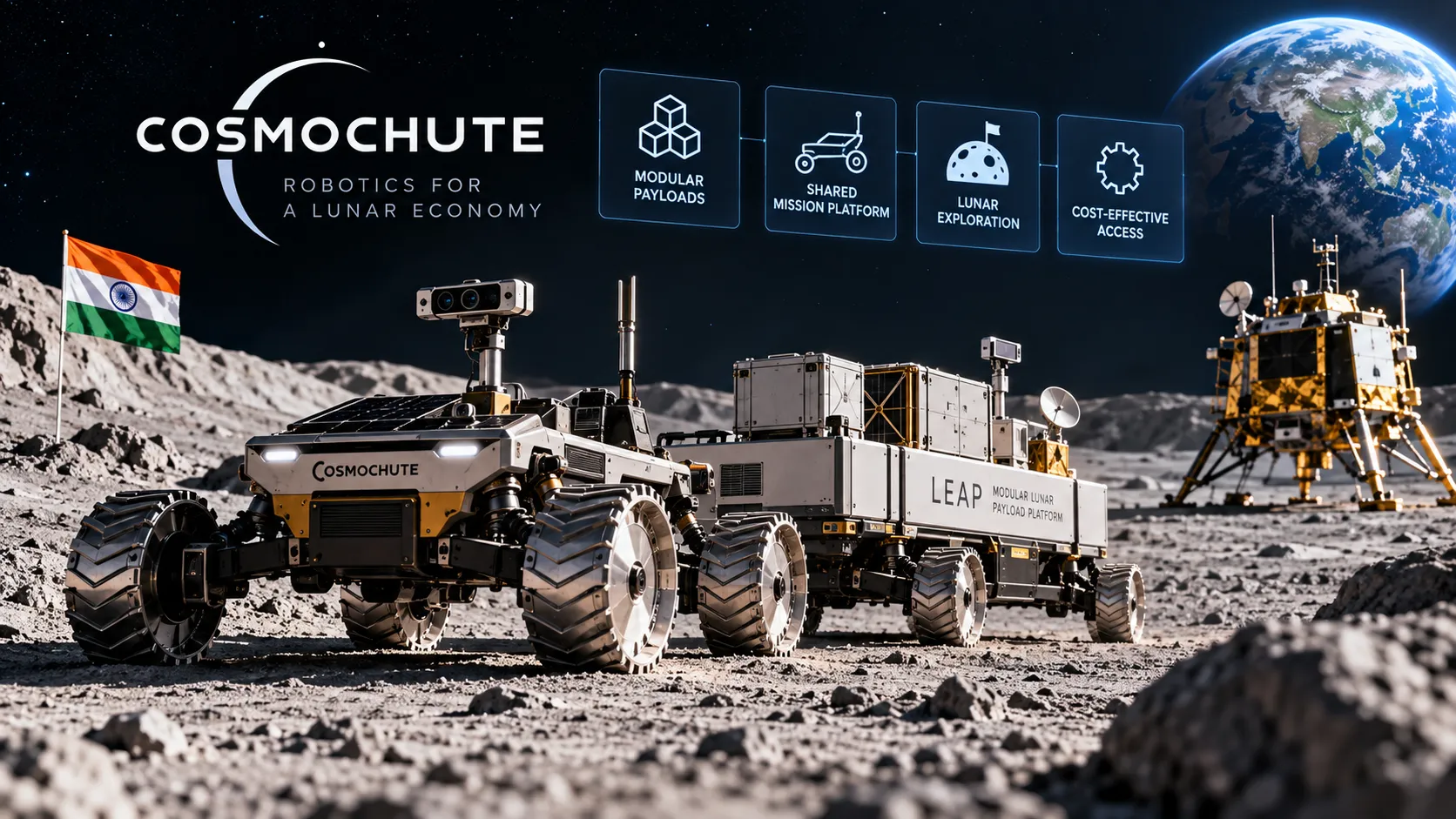
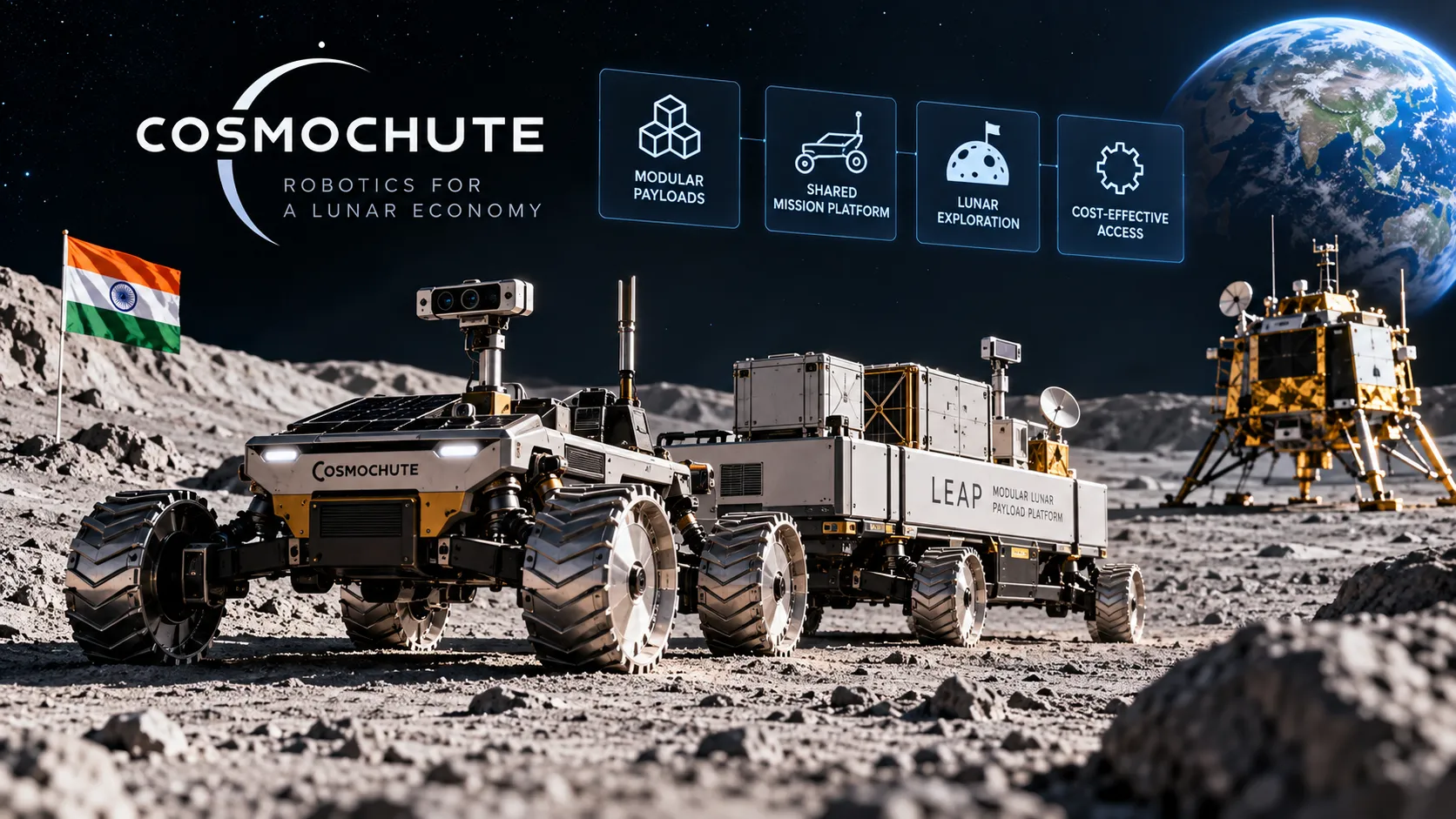
Cosmochute, an Indian space robotics startup co-founded by Janhavi Gore, has raised $1.5 million in pre-seed funding to build robotic infrastructure for the emerging lunar economy, one of the most ambitious bets yet by India's young deep-tech founders.
The round was led by Accel and Prosus Ventures through their Atoms X programme, according to Entrackr and Dealroom. IIMA Ventures' Deep-tech and Aerospace Acceleration Fund, Operators Studio and Chinmayi Muthyala also invested.
The company, founded in 2026 by Gore, Amit Chowdhary and Dhruv Alok Sangal, will use the money for product development, to expand its engineering team and to build its commercial roadmap.
LEAP: A Common Platform for Lunar Payloads
Cosmochute is developing LEAP, a modular platform that pairs a rover with a trailer and standard payload bays. The idea is to let multiple payloads from different customers share a common mission architecture, rather than each requiring its own custom-engineered vehicle.
That approach addresses a central inefficiency in lunar exploration. Today, most surface missions are bespoke: each lander and rover is designed around specific instruments and objectives, which drives up cost and lengthens timelines. Standardised transport and deployment could make lunar missions more repeatable and affordable, much as standard satellite buses and rideshare launches lowered the cost of reaching Earth orbit.
A Bet on the Lunar Economy
Interest in the Moon has surged over the past decade. Government programmes such as NASA's Artemis, China's Chang'e missions and India's Chandrayaan series have been joined by a growing number of commercial landers, rovers and payload providers.
India's Chandrayaan-3 mission, which landed near the lunar south pole in August 2023, made India the first country to land in that region and gave a significant boost to the country's space ambitions and its startup ecosystem.
Future lunar activity is expected to include scientific research, resource prospecting, particularly for water ice in permanently shadowed craters, and infrastructure to support longer human and robotic missions. Companies that can provide reliable surface mobility and payload delivery could become important suppliers to space agencies and commercial customers alike.
Backed by Atoms X
Cosmochute was selected as one of seven startups in the inaugural cohort of Atoms X, a programme launched earlier in 2026 by Accel and Prosus to back early-stage companies working on what they call "LeapTech", ambitious hardware and deep-technology ventures.
The company is also setting up lunar laboratories at IIMA Ventures' incubation facility, giving it space to develop and test hardware.
Dealroom noted that the round sits in the upper third of comparable deals by size, modest in absolute terms but significant for a first-year deep-tech company.
Women in India's Space Sector
Gore's role as a co-founder adds Cosmochute to a growing, though still small, list of women-led or women co-founded companies in India's space and deep-tech sectors. Women scientists and engineers have played prominent roles in India's national space programme, including in high-profile missions to the Moon and Mars, but they remain underrepresented among founders of venture-backed hardware companies.
Deep-tech startups led by women often face additional hurdles in raising capital, particularly in hardware-intensive sectors where investors tend to rely on founders' prior track records. Backing from Accel and Prosus at the pre-seed stage provides Cosmochute with credibility as it seeks partners and future funding.
India's Private Space Boom
Cosmochute's raise comes amid a broader expansion of India's private space industry following policy reforms that opened the sector to private companies. Startups are now building launch vehicles, satellites, ground systems and in-orbit services, and a growing number are exploring opportunities beyond Earth orbit.
The Indian government has set long-term ambitions in space exploration, including plans for a national space station and future crewed missions. Those programmes could create demand for domestic suppliers with lunar and deep-space capabilities.
The Economics of a Lunar Platform
Cosmochute's business model rests on the idea that the Moon will host a growing number of missions from many different customers. Space agencies, universities, research institutions and commercial companies all want to send instruments to the lunar surface, whether to study the regolith, test technologies or prospect for resources. Few of them want to build and operate their own rover.
A shared platform that can carry multiple payloads on a common vehicle could lower costs for each customer, in much the same way that shared rides on rockets have made it cheaper to put small satellites into orbit. The model also depends on the availability of commercial landers able to deliver rovers to the lunar surface, a market that is still emerging and has seen both successes and failures in recent years. Cosmochute's ability to secure rides on such landers, and to win anchor customers for its first missions, will be as important as the engineering of the rover itself.
Building such capabilities also requires a broad mix of skills, from mechanical and thermal engineering to autonomy software and mission operations, which is why the company has prioritised expanding its engineering team with the new funding.
Investor interest in Indian deep tech has risen in recent years, with funds increasingly willing to back hardware companies in sectors such as space, semiconductors, robotics and defence. Programmes such as Atoms X are designed to identify such founders at the earliest stage and support them through the long development cycles that hardware businesses require, before they can show commercial revenue.
The Road Ahead
Building robots for the Moon is one of the hardest engineering challenges in the space industry. Lunar surface conditions include extreme temperature swings, abrasive dust and radiation, and missions depend on access to landers and launches that remain limited and expensive.
Cosmochute will need to demonstrate its technology through ground testing and, eventually, flight opportunities, likely in partnership with lander providers or space agencies. That path will require significantly more capital than its pre-seed round provides.
For now, the company has secured backing from some of India's most prominent investors and a place in a high-profile deep-tech programme. If it can turn LEAP into a proven platform, Cosmochute could help position India not only as a nation that can reach the Moon, but as a supplier of the infrastructure that makes lunar exploration routine.