
India generates an estimated 12 billion used sanitary pads annually, almost all of them made from roughly 90% plastic and destined for landfills where they take decades to break down. Pune-based startup Cresa is trying to redesign the product from the inside out, developing a sanitary napkin that is certified 100% biodegradable, plastic-free and chemical-free — and that dissolves completely in hot water within about 80 seconds.
Cresa, short for "Creative Sanitation," was founded in 2021 by Sarika Pathak alongside her father, Mohan Kulkarni, after the pair identified pad disposal as a problem embedded at every stage of the product's life: manufacturing, use and, most acutely, what happens after. Every layer of Cresa's pad, including the absorbent core, is plant-based and starch-derived. Once used, the pad dissolves in hot water in roughly 80 seconds and breaks down completely within a month if flushed — a fraction of the six-to-eight-month decomposition window typical of compostable pads currently on the market, according to the company. In one internal compostability test, Cresa grew plants directly in compost made from used pads to demonstrate the material's full biodegradability.
The problem Cresa is targeting extends beyond landfill waste. For many users, pad disposal in India carries a burden shaped by stigma: pads must be carefully wrapped before disposal, reflecting cultural discomfort that still surrounds menstruation in many households and public spaces. That same waste stream, once discarded, is frequently segregated manually by waste pickers and sanitation workers, exposing them to serious health risks including E. coli, salmonella, hepatitis and tetanus. By allowing used pads to dissolve in hot water rather than requiring wrapping, collection or landfill disposal, Cresa's product is designed to address disposal dignity, environmental impact and worker safety simultaneously.
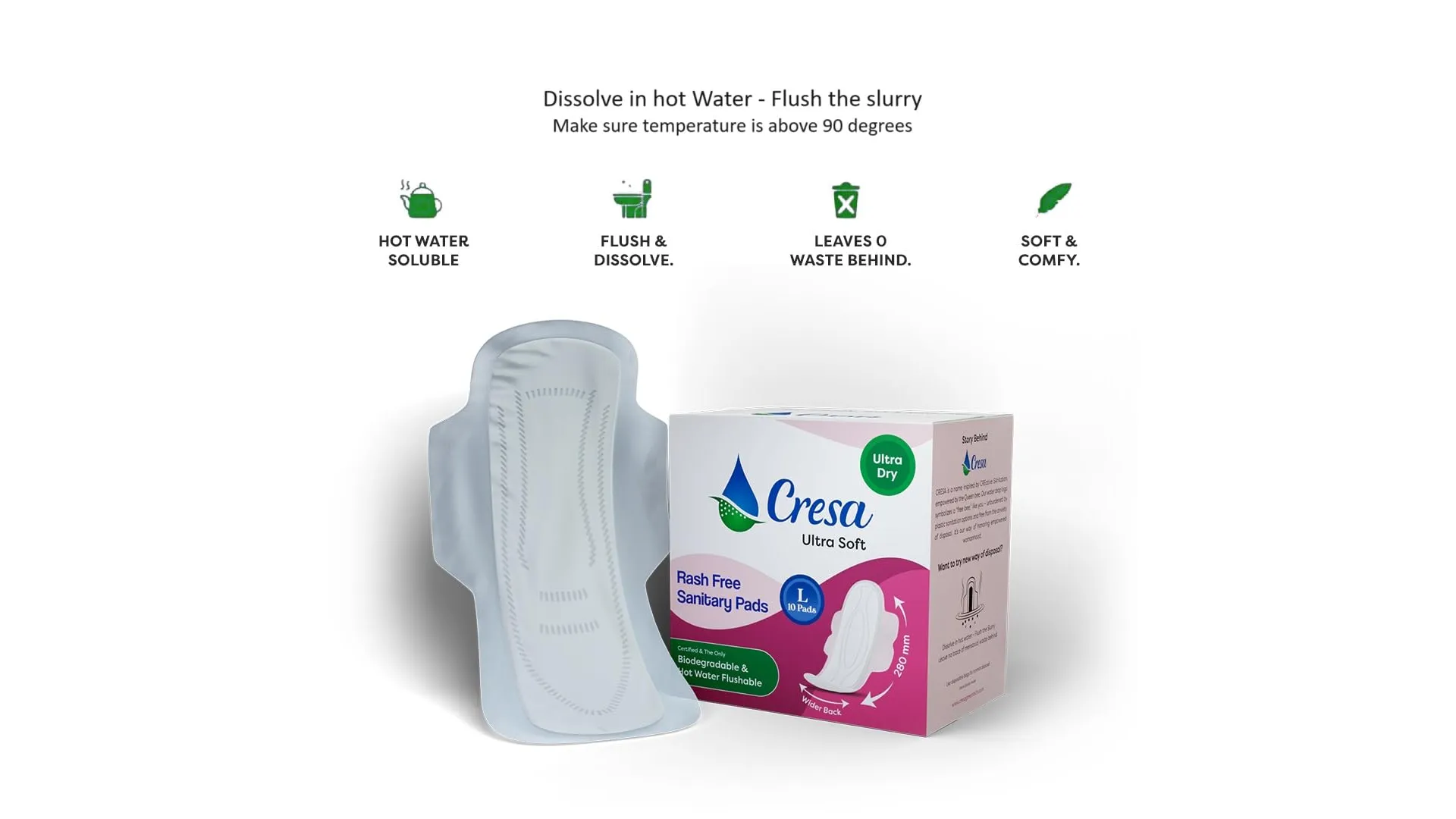
The company has been granted Indian patents for both its hot-water flushable sanitary pad and a companion dissolving bin designed for western-style commodes. Its current product, a 280mm XL pad, is priced at Rs 235 for a pack of ten and requires water heated to roughly 75-80 degrees Celsius to dissolve. During its early growth phase, the Cresa team identified two central challenges: dependency on external suppliers for specialised dissolvable materials, and the behavioural shift required to get users comfortable disposing of pads in hot water rather than a bin. To reduce supplier dependency, the company developed its own proprietary bio-based film that remains leak-proof during use but breaks down on contact with water — a material that has now become the foundation for Cresa's next product, a fully water-soluble pad that dissolves without requiring hot water at all. That next-generation product is currently in its final round of certification ahead of a planned launch, and according to the company, no other commercially available product in India currently offers a comparable feature.