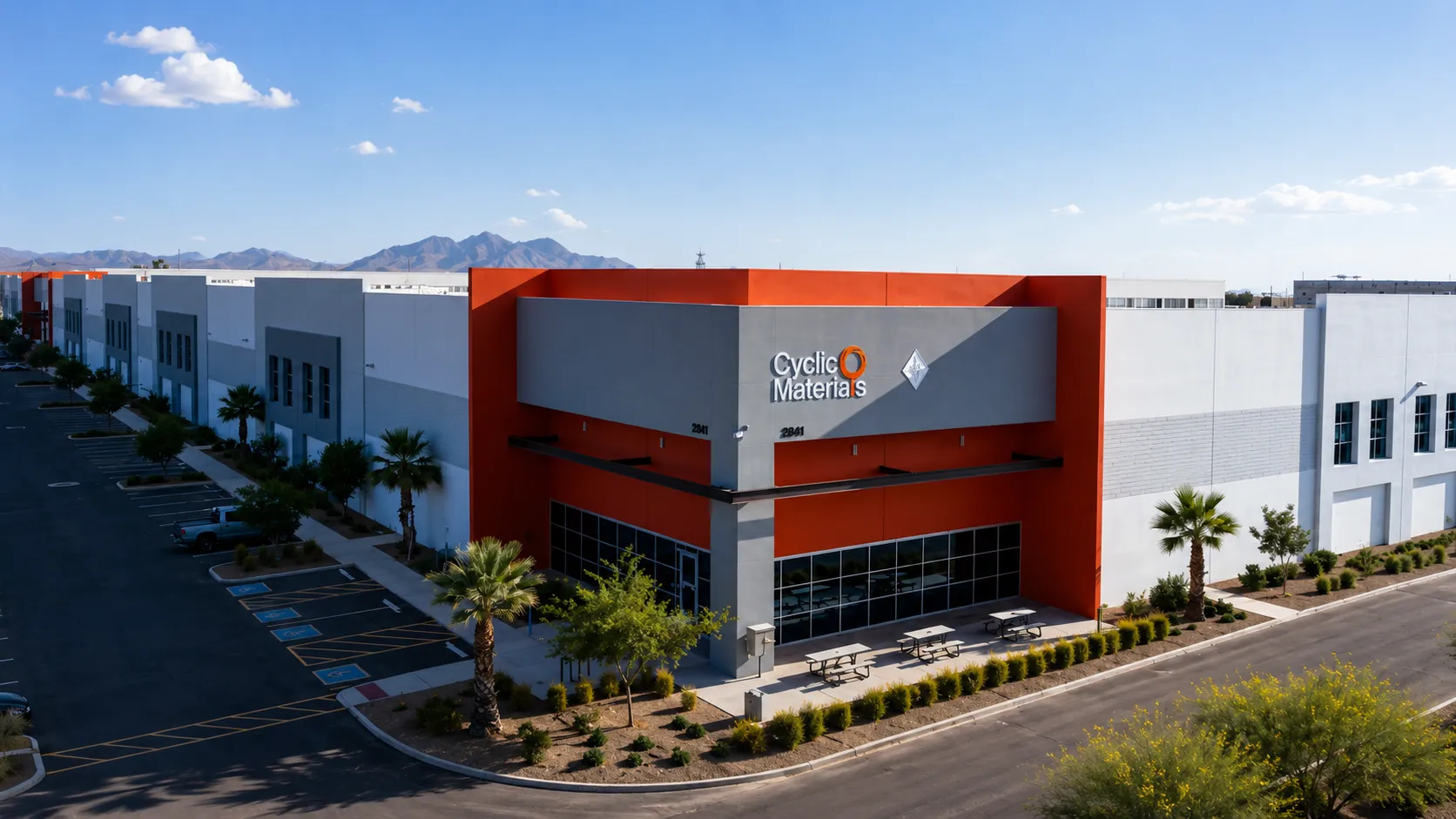
Cyclic Materials, a Canadian clean-technology company specialising in the recovery of rare earth elements from electronic waste and industrial scrap, has raised $75 million from investment firm T. Rowe Price, adding significant capital to a sector that has moved rapidly from niche sustainability concern to strategic industrial priority.
Rare earth elements are essential components in a wide range of modern technologies, from electric vehicle motors and wind turbine generators to consumer electronics and defence systems, yet global supply remains heavily concentrated in a small number of geographies — creating both environmental and geopolitical incentives to develop domestic, recycled sources of supply.
Cyclic Materials' process is designed to recover rare earth materials from end-of-life products and manufacturing scrap, converting what would otherwise be discarded electronic waste into high-purity oxides suitable for reuse in new manufacturing — a circular-economy approach that addresses both the environmental burden of e-waste and the supply-chain vulnerability created by geographic concentration of primary rare earth mining and processing.
The funding arrives amid intensifying global attention to rare earth supply security, as governments and manufacturers across multiple industries have grown increasingly concerned about dependence on a small number of dominant suppliers for materials with no readily available substitutes in many high-performance applications.
T. Rowe Price's investment reflects growing institutional investor interest in critical-minerals recycling as a distinct, investable category within the broader clean-technology sector — one that offers a more immediately deployable solution to supply-chain concentration risk than the multi-year timelines typically associated with developing new primary mining capacity.
For manufacturers across the electric vehicle, renewable energy and electronics sectors, recycled rare earth supply chains offer a potential hedge against both price volatility and geopolitical disruption, particularly as export restrictions and trade tensions have periodically affected access to primary rare earth supply from dominant producing nations.
As demand for rare earth elements continues to climb alongside the broader electrification and clean-energy transition, companies like Cyclic Materials are positioning circular supply chains not merely as an environmental nicety but as core industrial infrastructure. The fresh capital gives the company runway to scale processing capacity at a moment when both manufacturers and policymakers are increasingly treating rare earth supply security as a matter of strategic urgency rather than a secondary sustainability consideration.