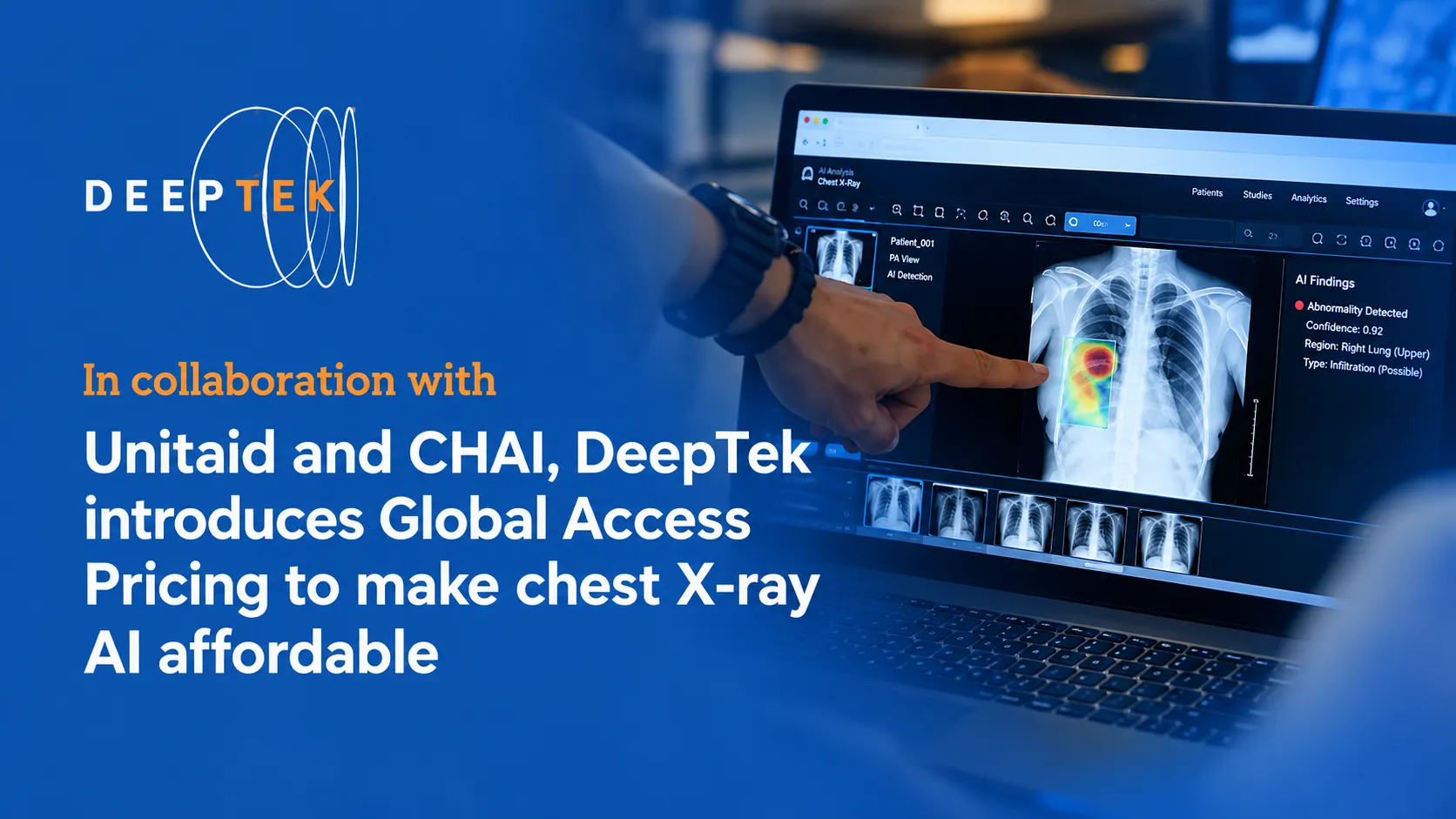
DeepTek, an Indian company that builds artificial intelligence tools for medical imaging, has launched a Global Access Pricing initiative with Unitaid and the Clinton Health Access Initiative that cuts the cost of its tuberculosis screening software to roughly one-third of its previous price across 138 low- and middle-income countries.
The company says the new pricing will allow health systems to screen up to three times as many people for tuberculosis within existing budgets. The model covers DeepTek's chest X-ray AI solution, which is among the computer-aided detection tools recommended by the World Health Organization for TB screening.
Announced on 29 September 2026, the initiative addresses one of the most persistent problems in global health: a disease that is preventable and curable, yet continues to kill more than a million people each year, largely because many of those infected are never diagnosed. By lowering the cost of detection, DeepTek and its partners aim to find more of the "missing" patients who drive transmission.
How the pricing works
Under the new model, health systems pay an all-inclusive annual subscription that covers installation, training and maintenance. The software can be deployed in online, offline and mobile settings, an important feature for programmes that operate in remote areas with limited connectivity, including mobile X-ray vans that travel to villages, prisons, mines and informal settlements.
Beyond tuberculosis, DeepTek's tool can detect more than 20 other chest abnormalities. That broader capability matters in settings where radiologists are scarce. A single X-ray, read by AI, can flag a range of potential conditions for follow-up, making each screening more valuable for patients and health systems alike.
The involvement of Unitaid and CHAI is significant. Unitaid, a global health agency hosted by the World Health Organization, invests in innovations that make health products more affordable and accessible in low- and middle-income countries. CHAI, founded by former US President Bill Clinton, has a long record of negotiating price reductions for medicines and diagnostics, including landmark deals on HIV treatment. Their participation signals that the pricing is designed to shift markets, not merely to offer a temporary discount.
Why chest X-ray AI matters for TB
Tuberculosis remains the world's leading cause of death from a single infectious agent, according to the WHO. The disease is concentrated in low- and middle-income countries, with India carrying the largest share of the global burden, at roughly a quarter of all cases.
Chest X-rays are a powerful tool for identifying people who may have TB, including those who do not yet show typical symptoms. But interpreting X-rays requires trained radiologists, who are in short supply in many high-burden countries. In rural areas, there may be no radiologist at all within reach, meaning images can wait days or weeks to be read, if they are read at all.
In 2021, the WHO recommended that computer-aided detection software could be used in place of human readers to interpret chest X-rays for TB screening and triage in people aged 15 and older. The recommendation opened the door for AI tools to be integrated into national TB programmes, and several countries have since deployed them at scale. Cost, however, has remained a barrier to wider adoption, particularly for programmes operating on tight budgets.
The economics of finding missing patients
Every year, a significant share of people who fall ill with TB are not diagnosed or reported to health systems. Undiagnosed patients can transmit the disease to others for months, and their own condition may worsen, increasing the risk of death and of developing drug-resistant forms of TB that are harder and more expensive to treat.
Active case-finding, in which health workers seek out people at risk rather than waiting for them to present at clinics, is one of the most effective ways to close that gap. Mobile X-ray units combined with AI reading can screen hundreds of people a day in communities with high TB prevalence, identifying those who need confirmatory testing. The cost of the AI software is only one part of such programmes, but reducing it frees budget for more screening, more testing and more treatment.
By making it possible to screen three times as many people for the same spending on software, the Global Access Pricing model could significantly expand the reach of active case-finding campaigns. For national programmes, it also makes the business case for AI adoption easier to present to finance ministries and donors.
An Indian innovation with global reach
DeepTek's initiative is part of a broader trend of Indian health technology companies developing solutions for resource-constrained settings and then taking them to other countries with similar challenges. India's own experience as the country with the largest TB burden has created a large domestic market for innovations in screening, diagnosis and treatment adherence, and a proving ground for tools that can then be deployed elsewhere.
India's National TB Elimination Programme has set ambitious goals for reducing incidence and mortality, and has increasingly embraced technology, from molecular diagnostic machines to digital adherence monitoring. AI-based X-ray reading has been piloted in several states, and handheld X-ray devices have extended screening to hard-to-reach communities.
The global access model allows DeepTek to scale its technology beyond India while supporting a public health mission. For a company operating in a competitive field that includes other AI developers, it also offers a way to build market share and establish its tool as a standard in national programmes.
Challenges ahead
Lower prices alone will not solve the TB crisis. Screening is only effective if it is followed by confirmatory testing, diagnosis and treatment completion. Many health systems face shortages of diagnostic capacity, trained staff and medicines. AI tools also require careful validation in local populations, integration with existing health information systems and ongoing quality monitoring.
There are also questions about sustainability. Access pricing models depend on volume to remain viable for suppliers. If adoption does not grow as expected, companies may struggle to maintain reduced prices. The involvement of Unitaid and CHAI, which have experience structuring such agreements, is intended to address that risk by aggregating demand and supporting procurement.
Still, the initiative represents a meaningful step. Global health has seen repeatedly how dramatic price reductions, for antiretroviral drugs, malaria diagnostics and vaccines, can transform access. If AI-based TB screening follows a similar path, the combination of cheaper technology and determined public health programmes could help find and treat millions of people who would otherwise be missed. For a disease that has afflicted humanity for millennia, that would be a significant contribution from an Indian company to a global cause.