Swedish investment group EQT has agreed to buy Cleanaway Waste Management, Australia's largest listed waste and recycling company, in one of the biggest infrastructure takeovers in the country this year and a striking bet on the long-term value of the circular economy.
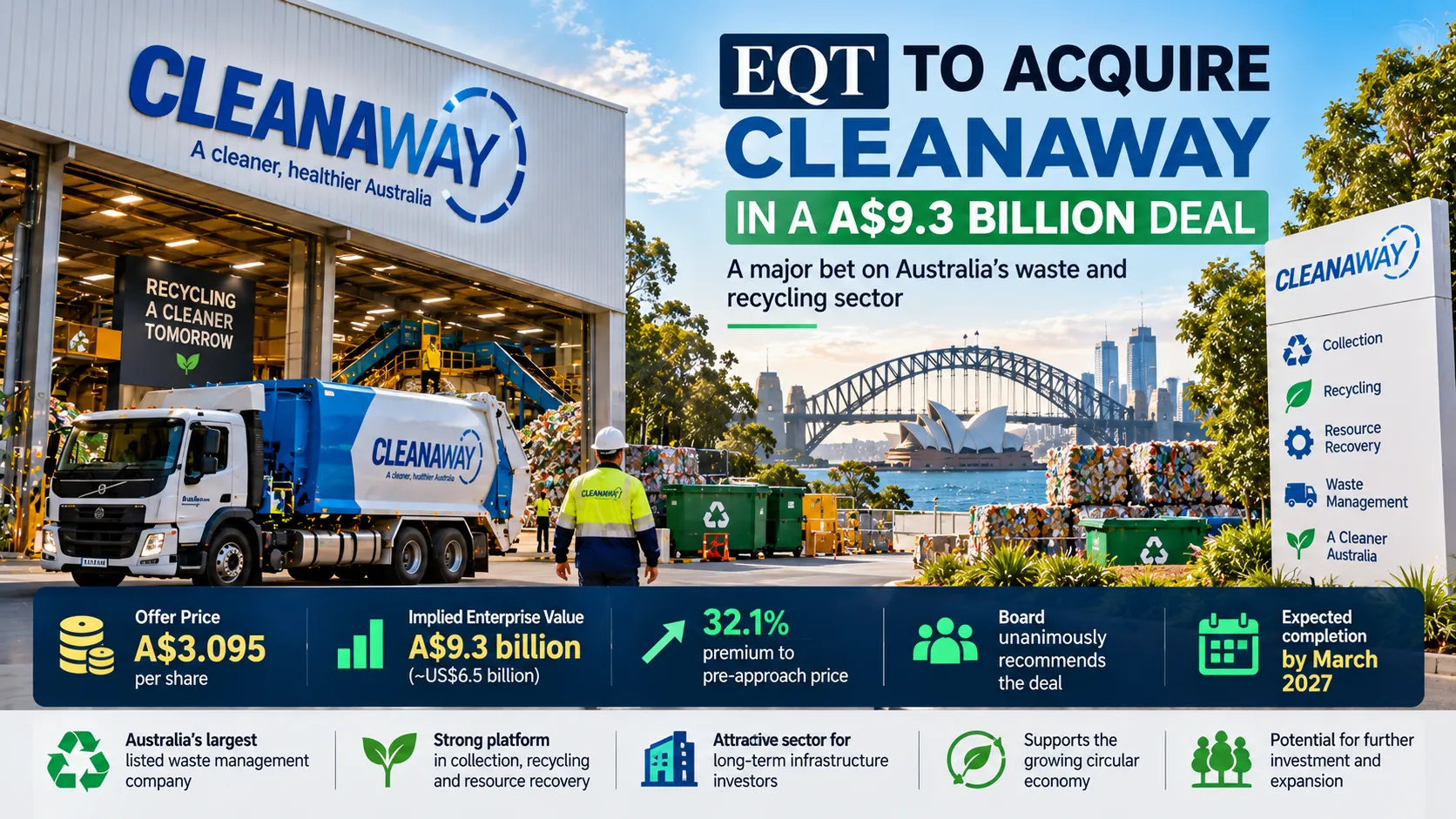
Under the agreement announced on October 18, EQT Infrastructure VI will acquire 100% of Cleanaway's shares for A$3.095 in cash per share through a scheme of arrangement. The offer values Cleanaway at an implied enterprise value of about A$9.3 billion on a fully diluted basis, or roughly US$6.5 billion. Cleanaway shares surged about 20% when trading opened in Sydney on Monday, October 19, closing in on the offer price.
The price represents a premium of 32.1% to Cleanaway's closing share price of A$2.37 on August 12, 2026, the last full trading day before the company first disclosed that it had received a takeover approach. EQT made its initial non-binding proposal in August, and the two sides have since worked through due diligence and negotiations.
A unanimous recommendation
Cleanaway's board has unanimously recommended that shareholders vote in favour of the scheme, in the absence of a superior proposal and subject to an independent expert concluding that the deal is in shareholders' best interests. Each director intends to vote their own shares in favour, on the same conditions.
Chair Samantha Hogg said the board viewed the scheme as delivering "strong and certain cash value to shareholders" at a significant premium. For investors, an all-cash offer removes the uncertainty of waiting for the business to deliver on its own strategic plans in a period of volatile markets.
The deal includes a ticking fee: if the scheme has not been implemented by May 31, 2027, the price will rise by A$0.0002 per share for each day from June 1, 2027. The offer price will also be reduced by any dividends Cleanaway pays or declares before completion.
Approvals and timeline
The transaction requires approval from Cleanaway shareholders and the Federal Court of Australia, as well as regulatory clearances and other customary conditions set out in the scheme implementation deed. Completion is expected by the end of March 2027. A scheme booklet containing the independent expert's report will be sent to shareholders ahead of a vote; no action is required from shareholders at this stage.
J.P. Morgan and RBC Capital Markets are acting as joint financial advisers to EQT, with Allens as legal adviser. EQT said that once the Cleanaway deal is included, its EQT Infrastructure VI fund is expected to be 85% to 90% invested.
Why EQT wants a waste company
Sam Franklin, managing director at EQT Infrastructure, said Cleanaway had built an "exceptional national platform," and pointed to opportunities to invest further in infrastructure. Tobias Küng, a partner at EQT Infrastructure, said the firm looked forward to partnering with Cleanaway's management team.
Waste management has become a sought-after asset class for infrastructure investors around the world. The business shares many features investors prize: essential services that households and businesses need regardless of the economic cycle, long-term contracts with councils and companies, and physical assets such as landfills, transfer stations, recycling facilities and collection fleets that are hard and expensive to replicate.
The sector is also being reshaped by the push towards a circular economy, in which materials are recovered, recycled and reused rather than buried in landfill. Governments in Australia and elsewhere have set targets to cut waste sent to landfill, increase recycling rates and reduce plastic pollution. Meeting those goals requires large investments in sorting plants, recycling technology, organics processing and energy-from-waste facilities, a capital-intensive programme well suited to patient private capital.
A wave of infrastructure deals in Australia
The Cleanaway agreement is the latest in a series of large takeovers of Australian companies by global investors. On the same weekend, Brookfield's US$2.53 billion offer for plumbing supplies group Reliance Worldwide cleared a "go-shop" period without a rival bid. Australia's stable regulatory environment, long-term infrastructure assets and deep pension savings pool have long attracted international buyers.
Private ownership could give Cleanaway more freedom to invest for the long term without the quarterly scrutiny of public markets. Supporters of such deals argue that infrastructure funds can provide the capital needed to modernise ageing facilities and build new ones. Critics, however, often raise concerns about higher debt levels, cost-cutting and the potential impact on prices for essential services when they move into private hands.
Lessons for India's waste sector
The deal holds particular relevance for India, where waste management is one of the largest unmet infrastructure needs. Indian cities generate enormous volumes of municipal solid waste each year, and a large share still ends up in open dumps and landfills, creating health and environmental risks. Programmes such as the Swachh Bharat Mission have improved collection and sanitation, but processing capacity, recycling infrastructure and the formalisation of informal waste pickers remain major challenges.
Global investors have begun to take an interest in Indian waste and recycling companies, and several domestic players are scaling up. Cleanaway's journey, from a collection business to an integrated national platform attractive to one of the world's largest infrastructure investors, illustrates how the sector can become an investable asset class when regulation, contracts and scale come together.
Cleanaway's place in Australia
Cleanaway is Australia's largest listed waste management company, providing collection, recycling, treatment and disposal services to households, councils and businesses across the country. Its operations span solid waste, liquid and hazardous waste, and industrial services, supported by a national network of facilities and a large fleet of collection vehicles.
The company has been investing in resource recovery and recycling infrastructure in line with national targets to reduce waste and increase recycling. Those investments are expensive and long-term, which is one reason infrastructure investors see value in the business. Private ownership could provide capital to accelerate such projects, while the stable cash flows from collection contracts provide a dependable base of earnings.
What comes next
Over the coming months, Cleanaway shareholders will receive the scheme booklet and independent expert's report, which will assess whether the price is fair. Regulators will review the deal, and the board's recommendation remains subject to no superior proposal emerging.
If completed, the takeover will remove one of the ASX's most prominent sustainability-linked companies from the share market and place it in the hands of a private infrastructure fund. It will also send a clear signal: for long-term investors, the business of handling what society throws away has become one of the most valuable infrastructure plays of the energy transition era.