ImpactSustainability5 MIN READ

European Parliament Votes to Delay Methane Rules for Oil, Gas and Coal Importers by Three Years, to 2031

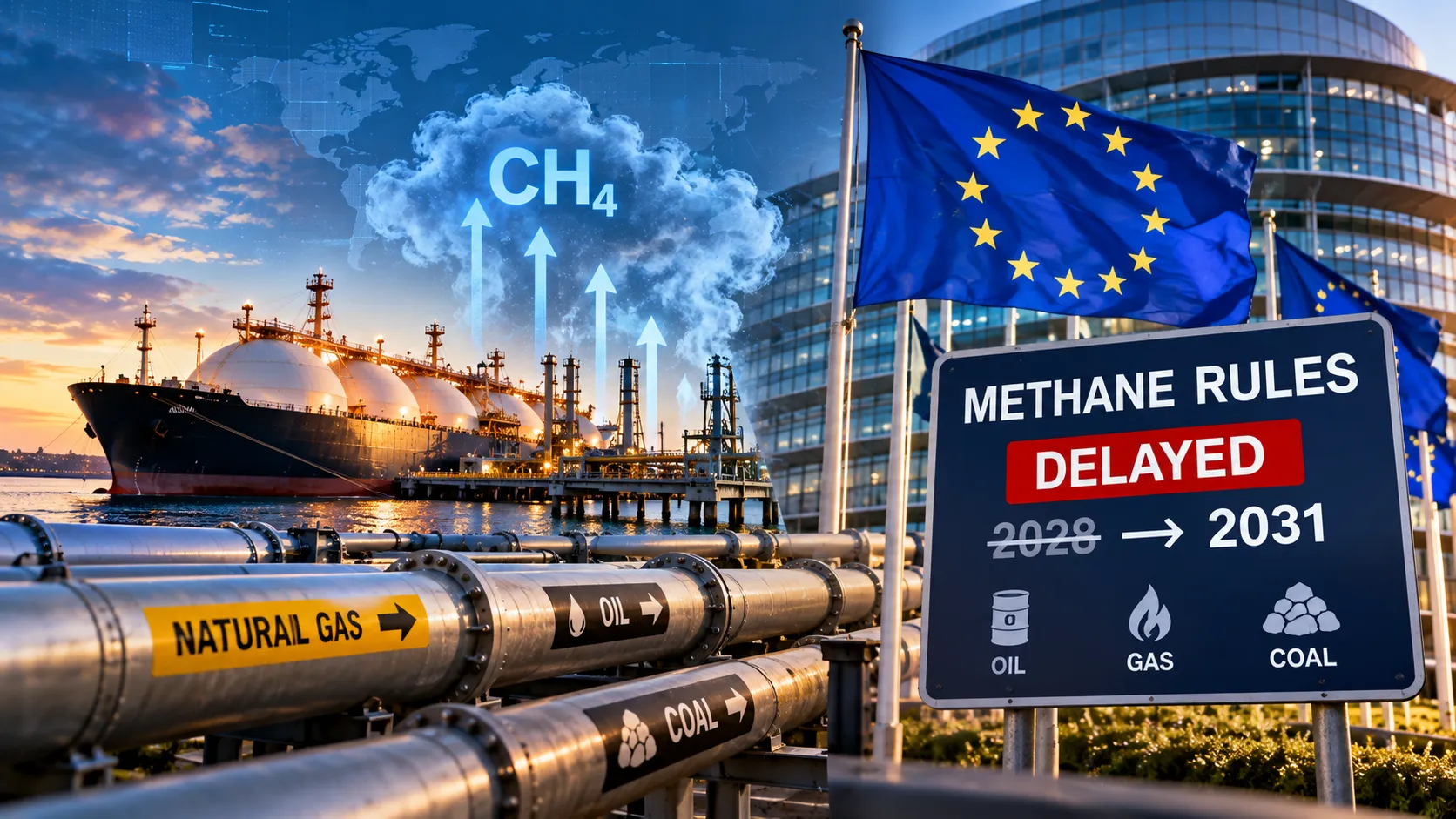
The European Parliament voted 341 to 225 on October 23 to delay methane monitoring and reporting rules for importers of oil, gas and coal by three years, pushing the start date from 2028 to 2031. The proposed delay, far longer than the one-year postponement sought by the European Commission, reflects worries about energy security as markets remain strained.

By Prathista Lazar · Author24 October 2026New

Europe's landmark effort to curb methane emissions from the fossil fuels it imports has been thrown into doubt, as lawmakers prioritise energy security over climate ambition amid strained global energy markets.

The European Parliament voted 341 to 225 on Thursday, October 23, to delay methane monitoring, reporting and verification requirements for importers of oil, gas and coal by three years, ESG Today reported. The vote sets Parliament's negotiating position on a European Commission proposal to postpone requirements for fossil fuel importers under a 2024 methane law.

Parliament's proposed delay is much longer than the one-year postponement the Commission proposed earlier this month. The stated aim is to "ensure secure energy supply for EU economies."

What the delay means

Under the 2024 regulation, importers of oil, gas and coal into the European Union were due to begin meeting monitoring, reporting and verification requirements in 2028, ensuring that the fossil fuels entering the bloc met methane standards equivalent to those for EU producers.

Parliament agrees that importers need a postponement but wants to push the start date to 2031, because importers warned they might not be able to secure enough compliant supplies while energy markets are strained.

Parliament also wants to extend deadlines for EU oil and gas operators to submit verified reports combining source-level and site-level methane measurements, from 2027 to February 2030 for operated assets and to August 2031 for non-operated assets.

The world's first import standard

The 2024 law was hailed as a significant achievement. It sets rules for measuring, reporting and verifying methane emissions, finding and repairing leaks, and limiting venting and flaring in the oil, gas and coal sectors. ESG Today described it as the world's "first comprehensive legislation to regulate methane emissions related to imports of oil, gas and coal."

Because the EU imports most of the fossil fuels it consumes, the import provisions were seen as the law's most powerful feature, potentially forcing exporters around the world, from the United States and Norway to Qatar and Algeria, to improve their practices to maintain access to the European market.
7098fbc8-bfb3-4add-9f91-6c7dd8535526.png

Why methane matters

Methane is a potent greenhouse gas, with as much as 80 times the warming power of carbon dioxide over a 20-year period, according to ESG Today. Oil and gas facilities are among the largest industrial sources of methane emissions, which occur through leaks from pipelines and equipment, deliberate venting and incomplete flaring.

Scientists consider rapid cuts in methane emissions one of the most effective near-term actions for slowing global warming, because methane breaks down in the atmosphere much faster than carbon dioxide. Cutting methane could reduce the rate of warming within decades.

More than 150 countries have joined the Global Methane Pledge, launched in 2021, which aims to reduce global methane emissions by at least 30% from 2020 levels by 2030.

Energy security takes priority

The vote reflects the pressures facing Europe's energy system. Brent crude has risen above $110 a barrel amid conflict in West Asia, including attacks on Saudi Arabia and shipping in the Gulf. Europe has also had to replace most Russian gas imports since 2022, relying heavily on liquefied natural gas from the United States, Qatar and other suppliers.


“Methane is an extremely potent greenhouse gas, with as much as 80x the warming power of CO2.”
— ESG Today

Industry groups and some governments have argued that strict methane rules could make it harder to secure supplies, particularly from exporters that lack the monitoring infrastructure to meet EU standards. The concern has grown as Europe seeks to diversify its energy sources while prices remain high.

A broader retreat?

The vote is part of a wider pattern of the EU softening or delaying some environmental rules in response to economic pressures. In recent months, EU institutions have scaled back sustainability reporting and due diligence requirements, delayed a deforestation regulation and debated changes to car emission targets.

Environmental groups have criticised the methane delay. They argue that the technology to detect and fix leaks is readily available and cost-effective, and that delaying the rules undermines the EU's climate leadership just weeks before the COP31 climate summit in Antalya, Turkey. The UN Environment Programme warned this week that projected global warming has risen, with even the best-case scenario reaching 1.7°C to 1.8°C by mid-century.

Next steps

Parliament's vote sets its position for negotiations with EU member states in the Council. The final length of the delay will be decided in those talks. The Commission's one-year proposal and Parliament's three-year proposal mark the range of possible outcomes.

What it means for India

India is not a major supplier of oil, gas or coal to the EU, so the direct impact of the import rules is limited. However, the debate is relevant in several ways. India is one of the world's largest methane emitters, mainly from agriculture and coal mining, and has not joined the Global Methane Pledge, citing the importance of agriculture to livelihoods.

The EU's approach of using import standards to drive environmental improvements abroad, as with the Carbon Border Adjustment Mechanism, affects Indian exporters in other sectors such as steel and aluminium. A softening of EU climate rules under energy security pressures may also shape the dynamics of climate negotiations, where India argues for flexibility for developing countries.

Measuring methane

One reason the rules have proved challenging is the difficulty of measuring methane emissions accurately. Emissions come from countless sources, including leaking valves, compressors, storage tanks and pipelines, as well as from venting and flaring. Traditional estimates based on standard emission factors have often underestimated actual emissions.

New technologies, including satellites that can detect methane plumes from space, aircraft surveys and ground-based sensors, have revealed large emissions from oil and gas facilities around the world. The UN Environment Programme's International Methane Emissions Observatory uses satellite data to alert governments and companies to major leaks, though many alerts go unanswered.

What comes next

Negotiations between Parliament and member states will determine the final timeline. For the global energy industry, the outcome will signal how firmly Europe intends to use its market power to drive down methane emissions from the fossil fuels it imports. Environmental groups have said they will continue to press lawmakers and member states to limit the length of any delay, arguing that the climate cost of postponement far outweighs the short-term supply concerns.

TagsEU methane regulationmethane emissionsEuropean ParliamentEuropean Commissionoil and gasLNG importscoalenergy securityclimate policygreenhouse gasesflaringventingleak detectionUS LNGQatarNorwayGreen Dealemissions reportingIndia coalenergy transition

Reader reviews

Sign in to rate and review this article.
Loading reviews…