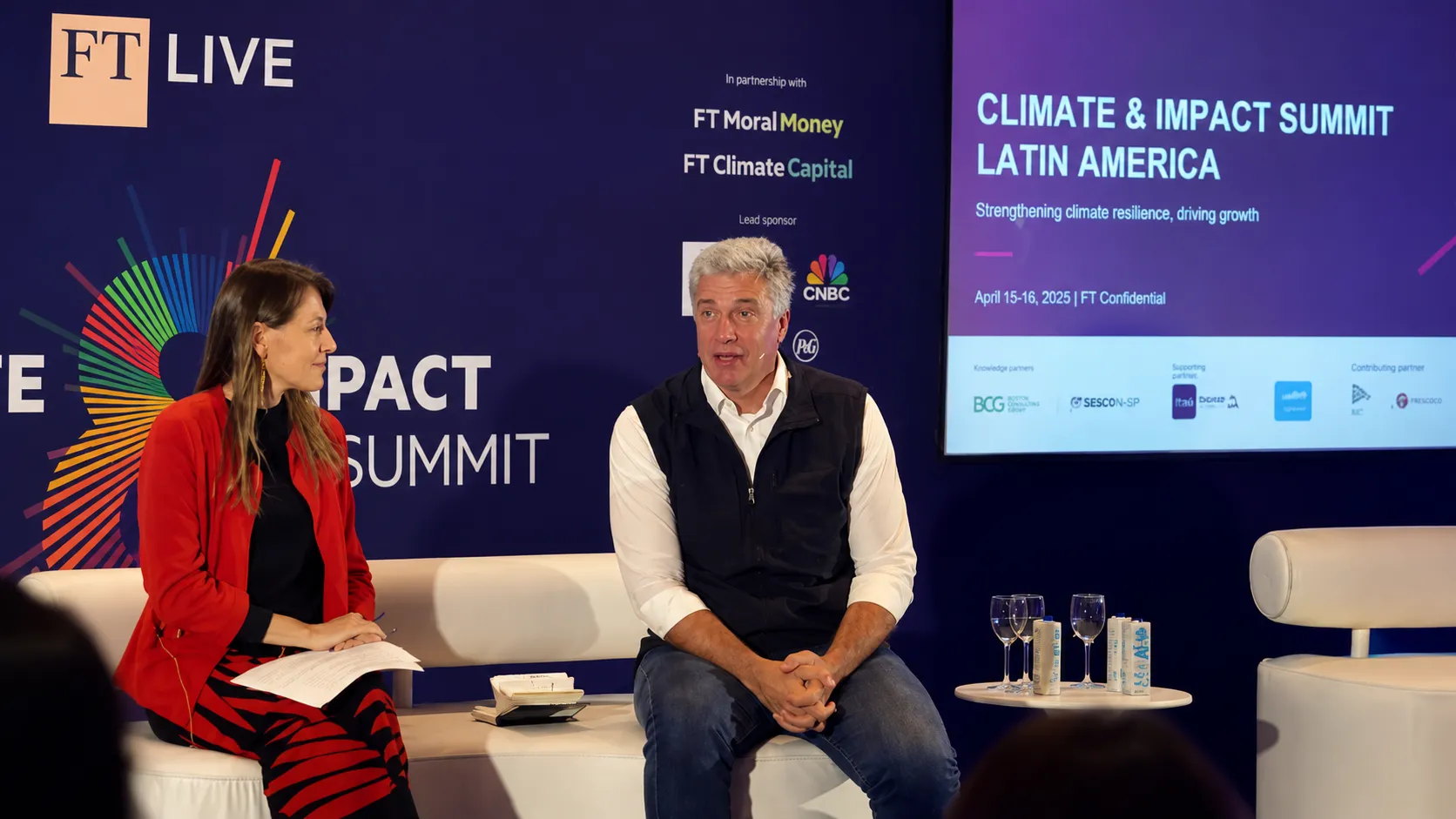
The Financial Times' Climate & Impact Summit Latin America convened in São Paulo, Brazil, on August 19, bringing together international finance leaders, policymakers and sustainability executives to address sustainable finance and environmental sustainability across the region. The summit forms part of a broader calendar of climate-focused business events in 2026, as sustainable finance continues to move from a niche investment consideration toward a mainstream component of institutional capital allocation strategy globally.
The gathering adds to an increasingly dense 2026 calendar of major sustainability summits, reflecting how central climate-aligned capital allocation has become to global financial-sector strategy this year.
Latin America has occupied an increasingly prominent position in global sustainable finance discussions, given the region's significant renewable energy potential, its role in global agricultural and commodity supply chains, and its exposure to climate-related physical risks ranging from drought to extreme weather events. The São Paulo summit's focus on connecting sustainability priorities with capital allocation decisions reflects a broader theme visible across sustainability-focused business events in 2026: a shift from articulating climate ambition toward the more difficult work of translating that ambition into measurable capital deployment and business outcomes.
The summit also convenes at a moment when several major Latin American economies are actively revising national climate and energy policy frameworks, creating a particularly relevant window for financial institutions and policymakers to align investment strategy with evolving regulatory direction. Regional development banks and multilateral institutions active in Latin America have signalled growing interest in blended-finance structures that combine public and private capital to de-risk early-stage renewable energy and climate-resilient infrastructure investment, a theme expected to feature prominently in the summit's sustainable finance discussions.
Discussions at the summit are expected to address how financial institutions operating in Latin America can strengthen resilience against physical and transition climate risks, while identifying practical pathways to accelerate decarbonisation across carbon-intensive sectors including agriculture, mining and energy — industries that remain central to several of the region's largest economies. This focus on execution over ambition echoes similar themes raised at other major 2026 sustainability gatherings, including WBCSD's engagement at Climate Week NYC, reflecting a broader convergence across the global sustainability community around the need for tangible implementation.
The summit's Latin American focus also comes as international climate finance flows toward the region have faced periodic criticism for being insufficiently aligned with local development priorities or inadequately structured to ensure long-term environmental and social accountability. Discussions in São Paulo are expected to address these structural concerns directly, reflecting a broader maturation within the global sustainable finance community toward more locally grounded, accountability-focused approaches to climate capital deployment, rather than the more generic, top-down frameworks that characterised earlier phases of international climate finance engagement with the region.
Regional business media covering the summit noted strong attendance from both domestic Brazilian financial institutions and international investors, reflecting sustained cross-border interest in Latin America's sustainable finance opportunity despite broader global economic uncertainty affecting investment flows into emerging markets more generally this year.
The event forms part of the Financial Times' broader global calendar of climate and impact summits held across multiple regions throughout 2026, each tailored to the specific investment themes and regulatory context most relevant to its host region, with the São Paulo edition drawing particular attention for its focus on connecting international capital with Latin America's distinctive renewable-energy and natural-capital investment landscape.
The summit also arrives amid an increasingly fragmented global regulatory landscape for climate disclosure and sustainability reporting, with jurisdictions ranging from California to the European Union pursuing distinct — and at times diverging — approaches to mandatory climate-related disclosure requirements. For multinational financial institutions and corporations operating across Latin America, this regulatory fragmentation adds complexity to sustainable finance strategy, making forums such as the FT summit valuable venues for aligning cross-border approaches to climate risk management and capital allocation.
Latin America's position within the global sustainable finance conversation has grown increasingly distinctive, shaped by the region's dual role as both a major potential beneficiary of climate-resilient investment and a significant source of the natural capital — from Amazon rainforest carbon sequestration to lithium and renewable energy resources — that global decarbonisation efforts increasingly depend upon. This dual positioning has made regional financial institutions important intermediaries in channelling international climate finance toward local projects, while also requiring them to navigate complex questions around equitable benefit-sharing and environmental governance that differ meaningfully from sustainable finance discussions centred primarily on developed markets. Summit discussions in São Paulo are expected to reflect this regional specificity, moving beyond generic sustainable finance frameworks toward approaches tailored to Latin America's particular combination of climate risk exposure and natural-resource opportunity.
From a global-finance perspective, the São Paulo summit also reinforces how central regional specificity has become to effective sustainable finance strategy, with global investors increasingly recognising that generic, one-size-fits-all climate capital frameworks are less effective than approaches tailored to each region's particular blend of climate risk and natural-resource opportunity.
As sustainable finance continues to mature as a discipline, gatherings such as the FT Climate & Impact Summit Latin America play an increasingly important role in connecting regional financial institutions with global best practices and capital sources. With Latin America positioned at the intersection of significant climate risk exposure and substantial renewable energy opportunity, the region's approach to sustainable finance is likely to remain closely watched by global investors through the remainder of 2026 and beyond.
As the summit concludes, its discussions are expected to feed into ongoing regional and international efforts to mobilise climate-aligned capital toward Latin America at greater scale, building on similar conversations held at other major sustainability gatherings throughout 2026. For global investors and financial institutions, the summit reinforces Latin America's growing centrality to the broader sustainable finance conversation, both as a source of climate risk and as a region offering substantial renewable energy and natural-capital investment opportunity.
Organisers have indicated that key discussion outcomes from the summit will be compiled into a public report intended to inform regional policy and investment discussions in the months following the event.
Brazilian officials attending the summit reportedly used the platform to highlight the country's own renewable-energy transition progress, positioning São Paulo's hosting of the event as part of a broader effort to establish Brazil as a leading regional hub for sustainable finance dialogue and investment coordination across Latin America's diverse and rapidly evolving climate-investment landscape.