ImpactSustainability5 MIN READ

GE Vernova's Orders Nearly Double to $29.3 Billion as AI Power Demand Lifts Gas Turbine Bookings; Backlog Heads Past $200 Billion

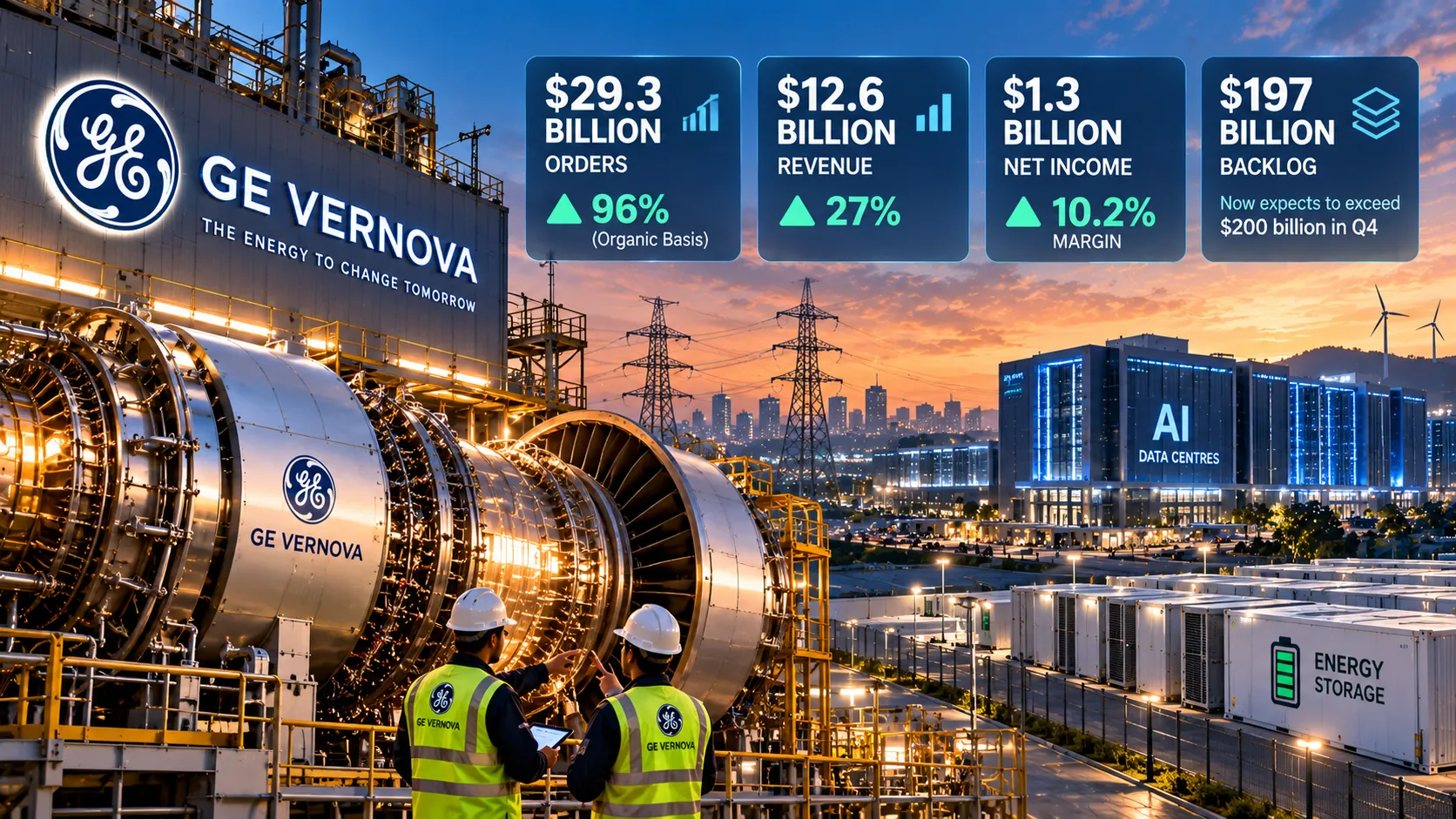
GE Vernova reported third-quarter orders of $29.3 billion, up 96% organically, and revenue of $12.6 billion, up 27%, as power equipment demand from utilities and data centres surged. Its backlog reached $197 billion, the company raised its 2026 revenue and cash flow guidance, and it doubled its share buyback authorisation to $20 billion.

By Prathista Lazar · Author29 October 2026New
GE Vernova's Orders Nearly Double to $29.3 Billion as AI Power Demand Lifts Gas Turbine Bookings; Backlog Heads Past $200 Billion

The artificial intelligence boom is driving a historic surge in demand for electricity, and one of the world's largest makers of power generation equipment is reaping the rewards.

GE Vernova reported orders of $29.3 billion for the third quarter, up 96% on an organic basis, led by power equipment and continued strength in services, according to its earnings release on Wednesday, October 28. Revenue rose 27% to $12.6 billion, or 18% organically.

Net income was $1.3 billion, a 10.2% margin, and diluted earnings per share were $4.81. Adjusted EBITDA reached $1.9 billion, with a margin of 15.4%, up 690 basis points organically. Free cash flow was a strong $5.4 billion.

"Our opportunity to create value is accelerating," said chief executive Scott Strazik.

A record backlog

GE Vernova's backlog, the value of orders it has yet to deliver, rose by $20 billion during the quarter to $197 billion. "We now expect our backlog to exceed $200 billion in the fourth quarter," Strazik said.

The backlog provides years of revenue visibility and reflects the scale of investment in power infrastructure around the world.

The gas turbine boom

The Power segment, which makes gas turbines and provides services, was the star. Orders rose 178% organically to $21.8 billion, and revenue increased 25% to $6.1 billion. The segment's EBITDA margin rose 800 basis points to 21.4%.

Gas turbine demand has soared because utilities and data centre developers need reliable power that can run around the clock. Gas power equipment backlog plus slot reservation agreements, in which customers reserve future production capacity, rose to 122 gigawatts from 116 gigawatts. GE Vernova expects that figure to reach at least 130 gigawatts by the end of 2026.

Gas equipment backlog grew to 64 gigawatts from 53 gigawatts, as customers converted slot reservations into firm orders.

Electrification and wind

The Electrification segment, which supplies grid equipment such as transformers and switchgear, reported revenue of $3.9 billion, up 51%, or 16% organically, with an EBITDA margin of 19.1%. Orders fell 9% organically to $5.4 billion after very strong prior periods.

The Wind segment remained weaker. Orders rose 16% organically to $2.1 billion, and revenue increased 4% to $2.7 billion, with a thin EBITDA margin of 2.6%. GE Vernova now expects wind revenue to decline by a mid-single-digit percentage organically this year, and expects segment losses of $400 million to $500 million.

The contrast between booming gas turbines and struggling wind highlights a shift in the energy industry, where demand for dispatchable power has surged while offshore wind in particular has faced cost and policy challenges.
57e80f33-8c78-4b38-84bf-484f744a4bfe.png

Raised guidance

GE Vernova raised its full-year 2026 guidance. It now expects revenue of $46.5 billion to $47.5 billion, up from $45.5 billion to $46.5 billion, and an adjusted EBITDA margin of 13.5% to 14.5%, up from 12% to 14%. Free cash flow guidance was raised sharply to $16 billion to $17 billion from $11.5 billion to $12.5 billion.

The board also doubled its share repurchase authorisation to $20 billion from $10 billion.

The AI power crunch

Electricity demand is rising at the fastest pace in decades in many countries, driven by AI data centres, electrification of transport and industry, and manufacturing growth. Data centres in particular require large amounts of reliable power, and many developers are turning to gas-fired generation to supplement grid supply.


“We now expect our backlog to exceed $200 billion in the fourth quarter.”
— Scott Strazik, CEO, GE Vernova

The surge has created bottlenecks in the supply of gas turbines, transformers and other equipment, allowing manufacturers such as GE Vernova to command higher prices and secure long-term commitments. Customers are reserving production slots years in advance.

Climate considerations

The boom in gas turbines raises questions for climate goals. Natural gas emits less carbon dioxide than coal when burned, but it is still a fossil fuel, and new gas plants can operate for decades. Climate advocates warn that a surge in gas capacity could lock in emissions, while supporters argue that gas is needed for reliability as renewable capacity grows. Some new turbines are being designed to run on hydrogen blends in the future.

What it means for India

India's electricity demand is also growing rapidly, driven by economic growth, air conditioning, electric vehicles and data centres. The country is expanding renewable capacity aggressively, targeting 500 gigawatts of non-fossil capacity by 2030, and also needs grid infrastructure such as transformers and transmission equipment.

GE Vernova has significant operations in India, including manufacturing and engineering for grid and power equipment. Global shortages of transformers and other grid equipment have affected Indian projects, and Indian manufacturers have been expanding capacity to meet demand.

From spin-off to market leader

GE Vernova was spun off from General Electric in 2024 as GE broke itself into three separate companies focused on aviation, healthcare and energy. Since then, it has become one of the best-performing large industrial stocks, as investors have recognised its position in the fast-growing market for power generation and grid equipment. Its gas turbine business has benefited from the surge in electricity demand from data centres, while its grid business supplies the transformers, switchgear and other equipment needed to expand and modernise power networks.

The company's wind business has been more challenging, with losses in offshore wind and slower growth in onshore wind. Management has focused on improving the profitability of the wind segment while prioritising growth in gas power and electrification.

Supply constraints

Demand for gas turbines has outpaced manufacturing capacity across the industry, leading to long waiting times for new orders. GE Vernova, Siemens Energy and Mitsubishi Heavy Industries, the main manufacturers of large gas turbines, have all reported strong order books. The shortage has given manufacturers pricing power and visibility, but it has also led to concerns that some power projects could be delayed.

What comes next

Investors will watch whether GE Vernova's backlog continues to grow and whether it can expand production to meet demand. The trajectory of AI data centre investment, which is driving much of the gas turbine demand, will be a key factor. The company's wind business, meanwhile, remains a drag that management is working to stabilise. Investors will also follow the company's progress in executing its huge backlog, delivering turbines on schedule and improving margins in its wind business. With demand for electricity rising, GE Vernova's ability to expand manufacturing capacity will be a key factor in how quickly it can turn orders into revenue.

TagsGE Vernovagas turbinespower generationelectrificationwind energyAI data centreselectricity demandScott Strazikenergy transitiongrid infrastructureutilitiesbacklogfree cash flowshare buybackenergy securityIndia power sectorrenewablestransformersUS stocksinvestors

Reader reviews

Sign in to rate and review this article.
Loading reviews…
