
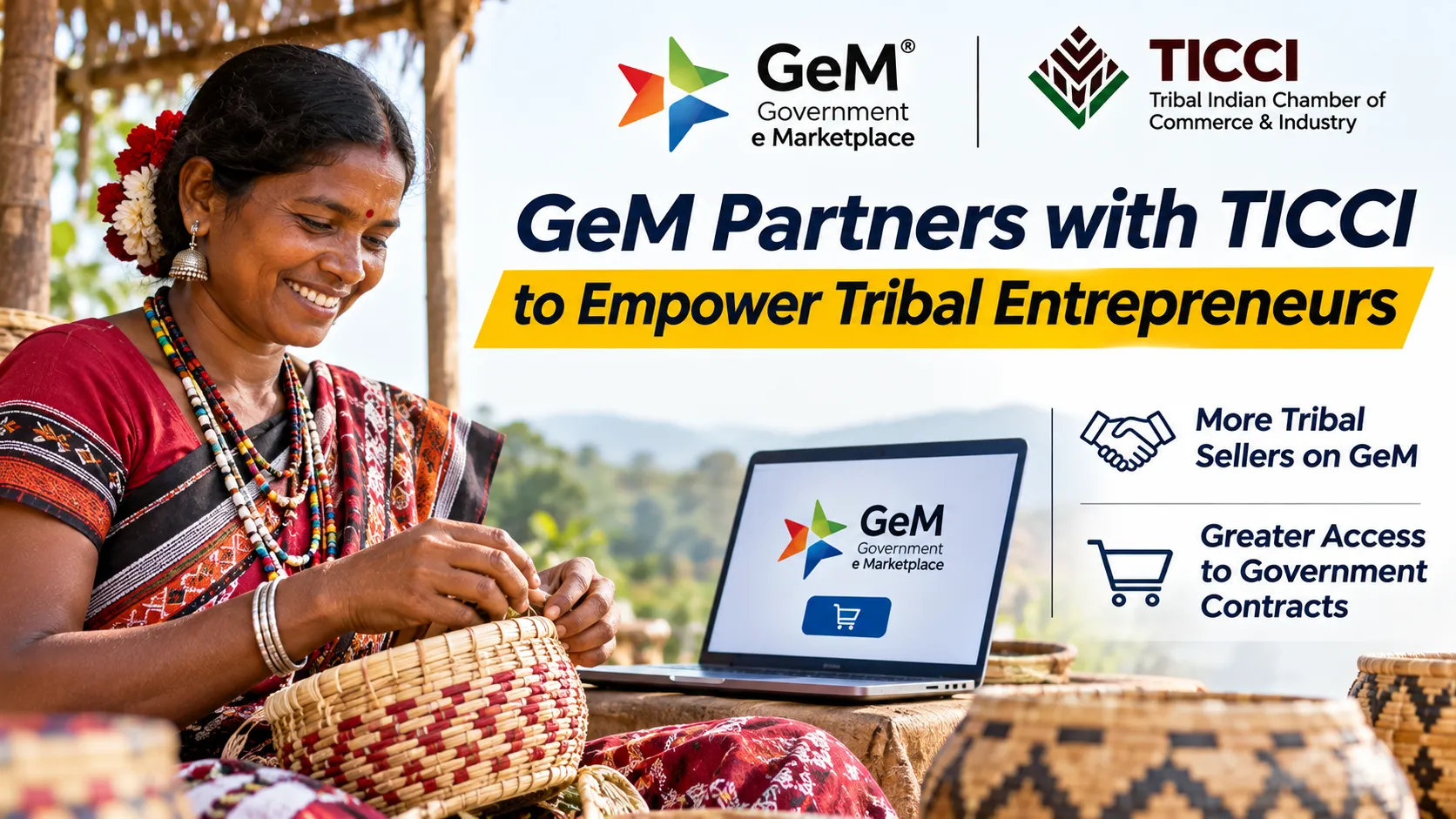
India's Government e-Marketplace (GeM), the national online platform for public procurement, has signed a Memorandum of Understanding with the Tribal Indian Chamber of Commerce and Industry (TICCI) to increase the participation of tribal entrepreneurs in government procurement.
The MoU was signed on November 20 and announced on November 21. It was signed by GeM Additional CEO Ajit B. Chavan and TICCI founder and chairman Sudhakar Dharavath.
Under the partnership, TICCI will identify tribal entrepreneurs and help them register and bid on the GeM portal. The two organisations will work together on outreach, capacity building, onboarding support and ongoing assistance to help tribal-owned businesses access government contracts.
Why public procurement matters
Government procurement is one of the largest sources of demand in any economy. In India, central and state government departments, public sector undertakings and other public bodies buy enormous quantities of goods and services every year, from office supplies and furniture to vehicles, IT services and construction materials.
For small businesses, winning government contracts can provide stable revenue, credibility and the scale needed to grow. However, many small and marginalised entrepreneurs have historically struggled to access public procurement. Complex procedures, documentation requirements, limited awareness and a lack of digital skills have created barriers.
GeM was launched in 2016 to address some of these issues. By moving procurement online, it aimed to make the process more transparent, efficient and accessible. Sellers can register on the portal, list their products and services, and respond to government bids. Government buyers can compare offers and place orders directly.
GeM has grown rapidly, processing a very large volume of transactions each year and becoming one of the largest public procurement platforms in the world. It has made particular efforts to include micro and small enterprises, women entrepreneurs, startups and artisans.
The case for tribal inclusion
India's Scheduled Tribes make up a significant share of the population, and many tribal communities live in remote, forested and hilly regions with limited infrastructure. Tribal communities have historically faced economic and social marginalisation, with lower access to education, credit, markets and formal employment.
Many tribal communities have rich traditions of craftsmanship, forest-based livelihoods and agriculture. Products such as handicrafts, textiles, honey, spices, millets and forest produce have growing markets, but tribal producers often depend on intermediaries and receive a small share of the final value.
What TICCI brings
TICCI represents tribal entrepreneurs and works to promote business development within tribal communities. Its founder, Sudhakar Dharavath, has been an advocate for tribal entrepreneurship and economic inclusion.
As a partner to GeM, TICCI's main role will be outreach. It will identify tribal entrepreneurs who could benefit from government procurement, help them understand the process, and support them with registration and bidding. This kind of hands-on support is often essential for first-time sellers who may be unfamiliar with digital platforms and procurement rules.
Capacity building, including training in documentation, pricing, quality standards and delivery, will also be important. Government buyers expect reliable supply, consistent quality and timely delivery, and new sellers need support to meet these expectations.
Policy support
India has several policies to encourage procurement from small and disadvantaged businesses. The Public Procurement Policy for Micro and Small Enterprises requires central government bodies to procure a minimum share of their annual purchases from micro and small enterprises, with a specific sub-target for enterprises owned by Scheduled Castes and Scheduled Tribes. Another sub-target applies to women-owned enterprises.
In practice, meeting these targets has been challenging, partly because there are not enough registered suppliers from these groups. Partnerships such as the GeM-TICCI MoU aim to expand the pool of eligible sellers, making it easier for government buyers to meet their targets.
Digital inclusion challenges
Bringing tribal entrepreneurs onto a digital platform involves practical challenges. Internet connectivity in many tribal areas remains limited. Digital literacy may be low, and many entrepreneurs may lack the formal documentation, such as business registration, tax registration and bank accounts, that platforms require.
Addressing these challenges requires on-the-ground support, local language assistance and partnerships with local institutions. Common service centres, self-help groups and tribal development agencies can play important roles.
Economic impact
If successful, the partnership could help tribal entrepreneurs access a large, stable market and reduce their dependence on intermediaries. Higher incomes for tribal producers could support local economic development, create jobs and help preserve traditional crafts and livelihoods.
There is also a broader economic benefit for the government. Expanding the supplier base can increase competition in procurement, potentially improving prices and quality for government buyers.
A model for inclusive commerce
For The Impactful Global Indian's readers, the GeM-TICCI partnership is an example of how digital public infrastructure can be used to promote inclusive growth. India has built large-scale digital platforms for payments, identity and commerce, and the challenge now is to ensure that marginalised communities can benefit from them.
Similar approaches have been used to bring women entrepreneurs, artisans and self-help groups onto GeM and other digital marketplaces. The tribal partnership extends this effort to a community that has often been left behind in India's economic growth.
Measuring success
The impact of the MoU will depend on implementation. Key indicators will include the number of tribal entrepreneurs registered, the value of orders they win and the sustainability of their businesses over time. Transparent reporting of these metrics would help assess whether the partnership is delivering results.
Experience from other inclusion programmes suggests that registration alone is not enough. Many newly registered sellers struggle to win their first order, and those that do may face challenges with payment timelines and working capital. Ongoing mentoring, access to credit and faster payments from government buyers can make a significant difference.
Looking ahead
The partnership comes as India continues to expand the reach of GeM and other digital commerce platforms. With government procurement representing a significant share of the economy, making it more inclusive could have a meaningful impact on livelihoods across the country.
For tribal entrepreneurs, the MoU opens a door to a market that has historically been difficult to access. Whether it leads to lasting economic change will depend on sustained support, practical problem-solving and the willingness of government buyers to engage with new suppliers.