
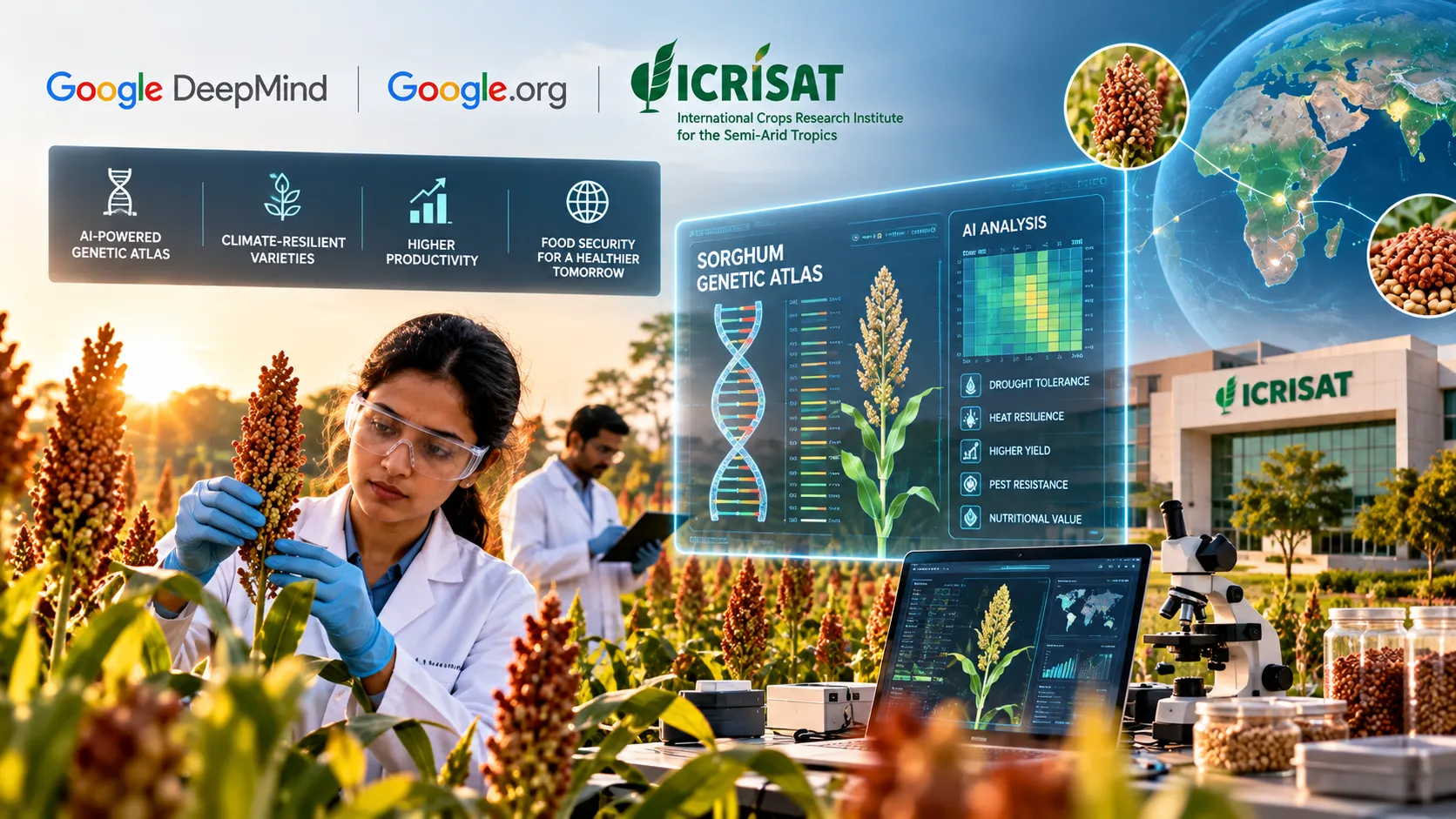
Google DeepMind and Google.org have partnered with the International Crops Research Institute for the Semi-Arid Tropics (ICRISAT), the Hyderabad-headquartered agricultural research organisation, to build an artificial intelligence-supported genetic atlas of sorghum, a staple grain for hundreds of millions of people in Asia and Africa.
The project, announced on 15 October as part of a series of Google AI initiatives in India, aims to create a free, public genetic catalogue that uses AI to help identify promising plant combinations. Breeders and researchers could then use those insights to develop sorghum varieties that are more resilient and productive, more quickly than through traditional trial-and-error breeding, which can take many years.
The collaboration also involves the HudsonAlpha Institute for Biotechnology and the University of Washington, according to Tech Startups.
Why Sorghum Matters
Sorghum is one of the world's most important cereals for food security in dry regions. It tolerates heat and drought better than many other grains, which makes it a critical crop for smallholder farmers in semi-arid parts of India, sub-Saharan Africa and elsewhere. It is used for food, animal feed and, increasingly, biofuels.
As climate change brings more frequent heatwaves, erratic rainfall and longer droughts, crops that can withstand harsh conditions are becoming more valuable. Sorghum and other millets have received renewed attention in India, which championed them during the International Year of Millets in 2023 as nutritious, climate-resilient alternatives to water-intensive crops.
"Unlock the global potential of indigenous climate-resilient crops like sorghum," is how Stanford Blade, ICRISAT's deputy director general of research and innovation, described the aim of the collaboration.
The Genetic Treasure Chest
ICRISAT holds one of the world's most important collections of crop genetic resources. The project draws on its collection of more than 44,000 sorghum seed samples gathered from over 90 countries, according to Tech Startups.
Such gene banks contain enormous genetic diversity, including traits for drought tolerance, pest resistance, nutritional quality and yield that could be bred into modern varieties. But identifying which samples carry the most useful traits, and how those traits interact, is slow and expensive using conventional methods.
AI can accelerate that process by analysing genetic data at scale, predicting which combinations are most likely to produce desirable characteristics and helping breeders focus their field trials on the most promising candidates.
Beyond Sorghum
The partnership extends to other crops important to India and the semi-arid tropics. Google DeepMind will fund a three-year postdoctoral fellowship at ICRISAT to develop tools to map and characterise the genomes of additional crops and pulses, including chickpea, groundnut and pigeon pea.
Pulses are a major source of protein in Indian diets and an important income source for farmers. They also improve soil health by fixing nitrogen. Developing more resilient and productive varieties could strengthen both nutrition and farm incomes.
Part of a Wider Google Push in India
The ICRISAT partnership was one of several announcements Google made in India on 15 October. The company said it is expanding access to its Agricultural Understanding Models, allowing developers, startups and researchers to build customised tools for local farming challenges. It is also expanding its AI Educator Series, launched in May with five states, to Bihar and Madhya Pradesh, and making it available as a free online resource across India.
Separately, Google.org announced a $15 million commitment to The/Nudge Institute to develop AI tools for India's micro, small and medium enterprises.
Taken together, the announcements reflect Google's strategy of positioning AI as a tool for development in India, spanning agriculture, education and small business, while building relationships with Indian institutions and government.
AI and the Future of Plant Breeding
The project is part of a broader shift in agricultural science. AI models are increasingly being used to predict protein structures, analyse genomes and model how plants respond to environmental stress. Google DeepMind's earlier work on protein structure prediction transformed parts of biological research, and the company has signalled interest in applying AI to food and agriculture.
For public research institutions such as ICRISAT, partnerships with technology companies offer access to computing power and AI expertise that would be difficult to build in-house. Making the resulting atlas free and public ensures that breeders in developing countries, who often lack the resources of large seed companies, can benefit.
Millets and India's Food Policy
The project aligns with India's broader policy push to revive millets, a group of hardy grains that includes sorghum, known locally as jowar. Millets were once staples across much of India but declined in importance after the Green Revolution prioritised rice and wheat, which offered higher yields under irrigation. In recent years, the government has promoted millets for their nutritional value and lower water requirements, and successfully led the campaign for the United Nations to declare 2023 the International Year of Millets.
Wider adoption of sorghum and other millets depends partly on improving yields and quality so that farmers can earn more from growing them. Higher-yielding, more resilient varieties could make the crops more attractive in semi-arid regions where water is scarce and rainfall unpredictable. A free genetic atlas that helps public and private breeders develop such varieties faster could therefore support both India's food security goals and the incomes of farmers in some of the country's most climate-vulnerable districts.
ICRISAT, established in 1972 and headquartered at Patancheru near Hyderabad, is part of the CGIAR network of international agricultural research centres. Its gene bank conserves collections of sorghum, pearl millet, chickpea, pigeon pea, groundnut and other crops that are vital to farmers in dryland regions of Asia and Africa. Partnerships that apply modern computational tools to these collections could make decades of conservation work far more useful to breeders.
Why It Matters
Climate change threatens food production in many of the world's most vulnerable regions. Crops that can tolerate heat and drought will be essential for feeding growing populations in South Asia and Africa. Yet the pace of conventional breeding has struggled to keep up with the pace of climate change.
By combining ICRISAT's genetic collections with Google DeepMind's AI capabilities, the partnership aims to shorten the path from gene bank to farmer's field. If successful, it could help smallholder farmers in India and beyond grow more food on increasingly stressed land, and offer a model for how AI can be applied to some of the world's most pressing development challenges.