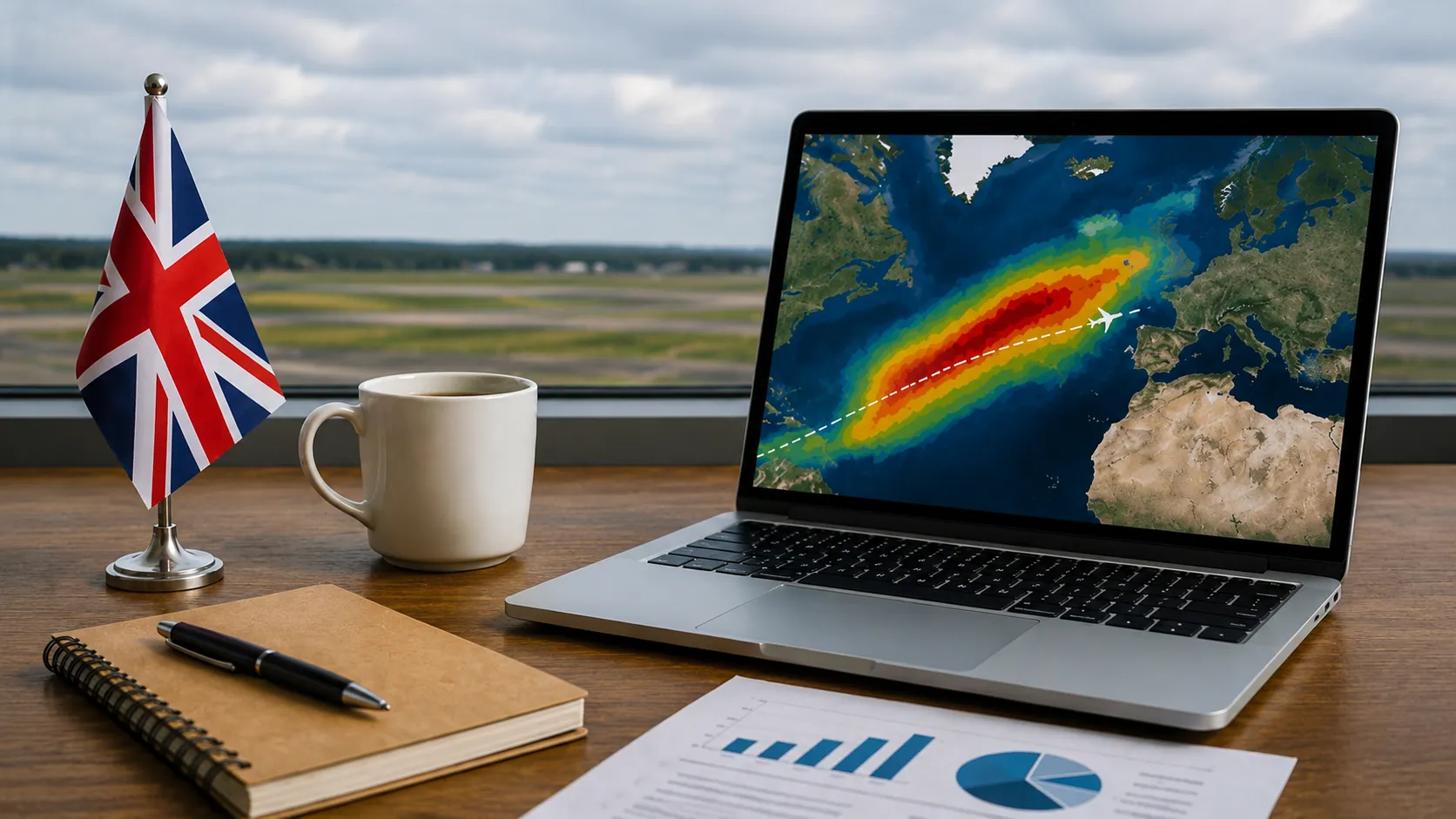
Google, the UK's National Air Traffic Services, the UK Met Office, Contrails.org, Imperial College London, the University of Cambridge and the UK Department for Transport have jointly launched Operation Blue Skies, a £5 million, 30-month programme billed as the first state-backed trial to reduce aviation contrails across an entire oceanic airspace. The initiative targets the North Atlantic Shanwick airspace, one of the busiest transoceanic flight corridors in the world, with roughly 10,000 flights per year expected to receive altitude adjustments during two four-month operational trial periods spanning the winters of 2026-27 and 2027-28.
The programme adds to a growing body of state-backed climate initiatives specifically targeting aviation's non-carbon-dioxide climate impacts, an area that has historically received comparatively limited dedicated public funding.
Contrails — the visible trails of ice crystals formed by aircraft exhaust under certain atmospheric conditions — have been identified by climate researchers as responsible for roughly a third of aviation's overall climate impact, a contribution that has historically received less policy attention than aviation's carbon dioxide emissions despite its significant warming effect. Operation Blue Skies aims to address this gap directly by using AI-based prediction models to identify atmospheric conditions likely to produce persistent, climate-warming contrails, and adjusting flight altitudes to avoid those conditions where operationally feasible.

The initiative's timing also reflects growing pressure on the aviation industry from environmental regulators and investors to address climate impacts beyond carbon dioxide emissions specifically, following years in which industry decarbonisation efforts focused predominantly on fuel-efficiency improvements and, more recently, sustainable aviation fuel adoption. Contrail mitigation represents a comparatively low-cost intervention relative to fleet-wide fuel transitions, since it primarily requires operational and routing adjustments rather than capital-intensive infrastructure investment, making it an attractive near-term complement to longer-term decarbonisation strategies still being developed across the industry.
Google's contribution to the programme includes £1.4 million in in-kind support, focused on AI-based contrail-prediction models and satellite-based verification systems designed to assess whether altitude adjustments successfully reduce contrail formation in practice. The technology company has invested in contrail-prediction research for several years as part of its broader climate-related AI initiatives, and Operation Blue Skies represents one of the most significant real-world operational deployments of that research to date, moving beyond modelling exercises into live flight-path adjustments across a major transoceanic corridor.
The programme's cross-institutional design — spanning air traffic control, meteorological science, academic research and technology providers — also reflects a broader recognition within the aviation sustainability community that effective contrail mitigation requires capabilities that no single organisation possesses in isolation. Air traffic controllers alone cannot reliably predict which flight paths are likely to generate persistent contrails without sophisticated atmospheric modelling, while meteorological scientists alone cannot translate predictive models into operational flight-path adjustments without close coordination with air navigation service providers — making Operation Blue Skies' multi-stakeholder structure as significant a feature of the initiative as its underlying technology.
Aviation industry groups have generally welcomed the launch of Operation Blue Skies, while cautioning that any programme found to meaningfully increase fuel burn through altitude adjustments will need to carefully balance climate benefit against the aviation sector's simultaneous, and sometimes competing, decarbonisation priorities around fuel efficiency.