
ImpactSustainability5 MIN READ

Google Signs Deal With Working Trees to Remove 270,000 Tonnes of CO2 Through Silvopasture in Brazil

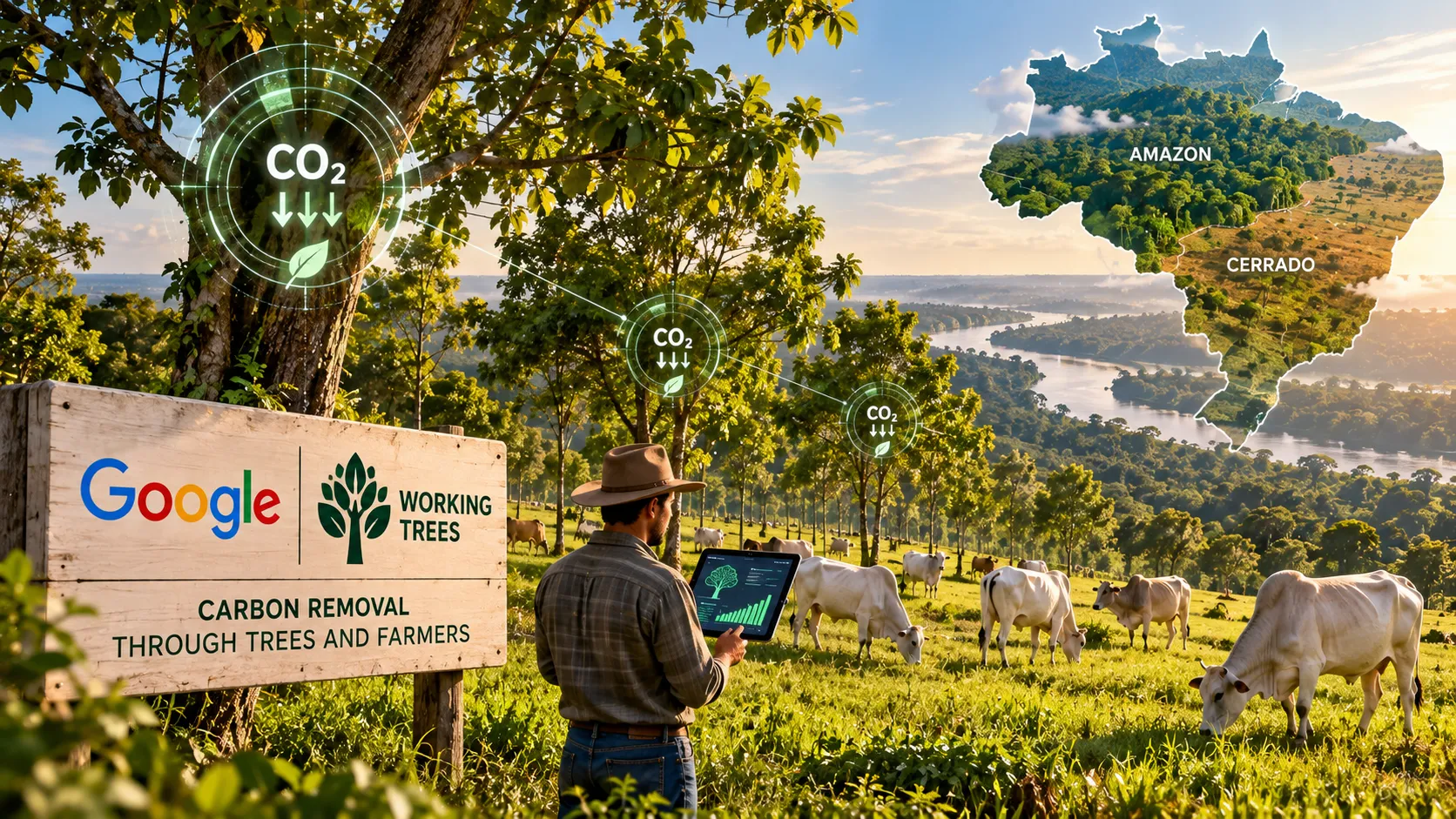
Google has agreed to purchase 270,000 tonnes of carbon dioxide removal from Working Trees through the Symbiosis Coalition, supporting silvopasture projects that integrate trees into cattle pastures in Brazil's Amazon and Cerrado regions. The projects will use digital tracking of individual trees to verify carbon removal.

By Prathista Lazar · Author21 October 2026New
Google Signs Deal With Working Trees to Remove 270,000 Tonnes of CO2 Through Silvopasture in Brazil

Google has signed an agreement to purchase 270,000 tonnes of carbon dioxide removal from Working Trees, a company that helps farmers integrate trees into cattle pastures, in one of the latest moves by a technology giant to offset rising emissions through nature-based carbon removal.

The deal, announced this week, was struck through the Symbiosis Coalition, a group of buyers committed to purchasing high-quality nature-based carbon removal credits. The projects will be located in Brazil's Amazon and Cerrado regions and will use silvopasture, a farming practice that combines trees, forage and livestock on the same land.

Working Trees will use digital tracking of individual trees to monitor and verify the carbon removed, an approach designed to address long-standing concerns about the credibility of nature-based carbon credits.

What is silvopasture?

Silvopasture involves planting trees on land used for grazing cattle. The trees absorb carbon dioxide from the atmosphere as they grow, storing it in their wood, roots and the soil. At the same time, they provide shade for livestock, improve soil health and can create additional income for farmers through timber, fruit or nuts.

In Brazil, vast areas of former forest have been cleared for cattle ranching, contributing to deforestation in the Amazon and the Cerrado, a vast tropical savanna that is one of the world's most biodiverse regions. Silvopasture offers a way to restore tree cover on degraded pastures without taking land out of agricultural production, potentially easing pressure to clear more forest.

Supporters argue that the practice can align the interests of farmers, who gain more productive land and new revenue, with climate goals.

The Symbiosis Coalition

The Symbiosis Coalition was formed by large corporate buyers, including Google, Meta, Microsoft and Salesforce, to support high-quality nature-based carbon removal projects. Members have collectively pledged to contract for millions of tonnes of removal credits, with an emphasis on rigorous standards for measurement, permanence and benefits for local communities and ecosystems.

The coalition was created partly in response to scandals that damaged confidence in the voluntary carbon market. Investigations in recent years found that many forest-based carbon credits, particularly those based on avoided deforestation, overstated their climate benefits. By focusing on removal, actively taking carbon out of the atmosphere, and applying strict criteria, the coalition aims to restore trust.
de54b7a1-575d-4b56-bdc7-47adde346c55.png

Digital tree tracking

Working Trees' use of digital tracking for individual trees is central to its pitch. By monitoring each tree's growth, buyers can have greater confidence that the carbon removal claimed is real and measurable. Advances in remote sensing, satellite imagery, drones and data analytics have made it possible to monitor nature-based projects more accurately and at lower cost.

Accurate measurement is crucial for carbon markets. Without reliable data, buyers cannot be sure that credits represent genuine climate benefits, and the market risks losing credibility.

Big Tech's carbon challenge

Technology companies are under growing pressure to address their emissions, which have risen sharply as they build data centres to power artificial intelligence. AI requires vast amounts of electricity, and despite investment in renewable energy, the rapid expansion of computing capacity has pushed up emissions at several major technology companies.


“Carbon removal is only as credible as the evidence behind each tonne.”
— TIGI Impact Desk

Google has set a goal of reaching net-zero emissions across its operations and value chain by 2030. However, the company has reported that its emissions have increased in recent years, largely due to data centre energy use. Carbon removal is one of the tools the company is using alongside clean energy purchases and efficiency improvements.

Google has signed agreements across a range of carbon removal approaches, from nature-based solutions to technological methods such as direct air capture and enhanced rock weathering.

Concerns and criticism

Carbon removal through trees has critics. Trees can be lost to fire, drought, disease or illegal logging, releasing the carbon they stored. Ensuring permanence over decades is a major challenge. Some environmental groups argue that companies should prioritise cutting their own emissions rather than relying on offsets or removal credits.

The UN Environment Programme's latest Emissions Gap Report, released on October 21, underscored that the world is falling short on emissions cuts and that returning warming to 1.5°C after overshoot would depend heavily on large-scale carbon removal, whose feasibility at the required scale remains uncertain.

What it means for India

India has significant potential for nature-based carbon removal through agroforestry, which is similar to silvopasture and involves integrating trees into farmland. The government has promoted agroforestry as a way to increase farmer incomes, restore degraded land and meet climate goals, including its commitment to create an additional carbon sink of 2.5 to 3 billion tonnes of carbon dioxide equivalent through forest and tree cover by 2030.

India is also developing its domestic carbon market under the Carbon Credit Trading Scheme. Deals such as Google's demonstrate growing global demand for high-quality removal credits, which could create opportunities for Indian agroforestry projects, provided they meet rigorous standards for measurement and verification.

The growing carbon removal market

Demand for carbon removal has grown rapidly as companies set net-zero targets and recognise that they cannot eliminate all emissions through reductions alone. Technology companies, including Microsoft, Google, Meta and Amazon, have become the largest buyers, signing deals for millions of tonnes of removal across nature-based and engineered approaches.

Microsoft has been the most prolific buyer, contracting for tens of millions of tonnes from projects ranging from reforestation to bioenergy with carbon capture. Prices vary widely, from relatively cheap nature-based credits to expensive engineered removal such as direct air capture. Buyers increasingly favour projects with strong verification and durable storage, and are willing to pay premiums for quality.

Brazil has emerged as a major destination for nature-based carbon removal investment, given its vast areas of degraded land suitable for restoration.

What comes next

Google's deal with Working Trees adds to a growing pipeline of corporate carbon removal purchases. As demand rises, the industry will face pressure to scale up while maintaining credibility.

For the carbon removal market, the key test will be whether projects can deliver the promised tonnes over time. Digital tracking and strict standards offer a path to greater trust, but long-term monitoring will be essential. For Brazil, deals such as this one could also channel much-needed investment to rural landowners and help restore degraded landscapes.

TagsGoogleWorking Treescarbon removalCO2 removalSymbiosis CoalitionsilvopastureBrazilAmazonCerradonature-based solutionscarbon creditsreforestationagroforestrynet zeroclimate techBig Tech climateAI emissionsdata centresIndia carbon marketsustainability

Reader reviews

Sign in to rate and review this article.
Loading reviews…
