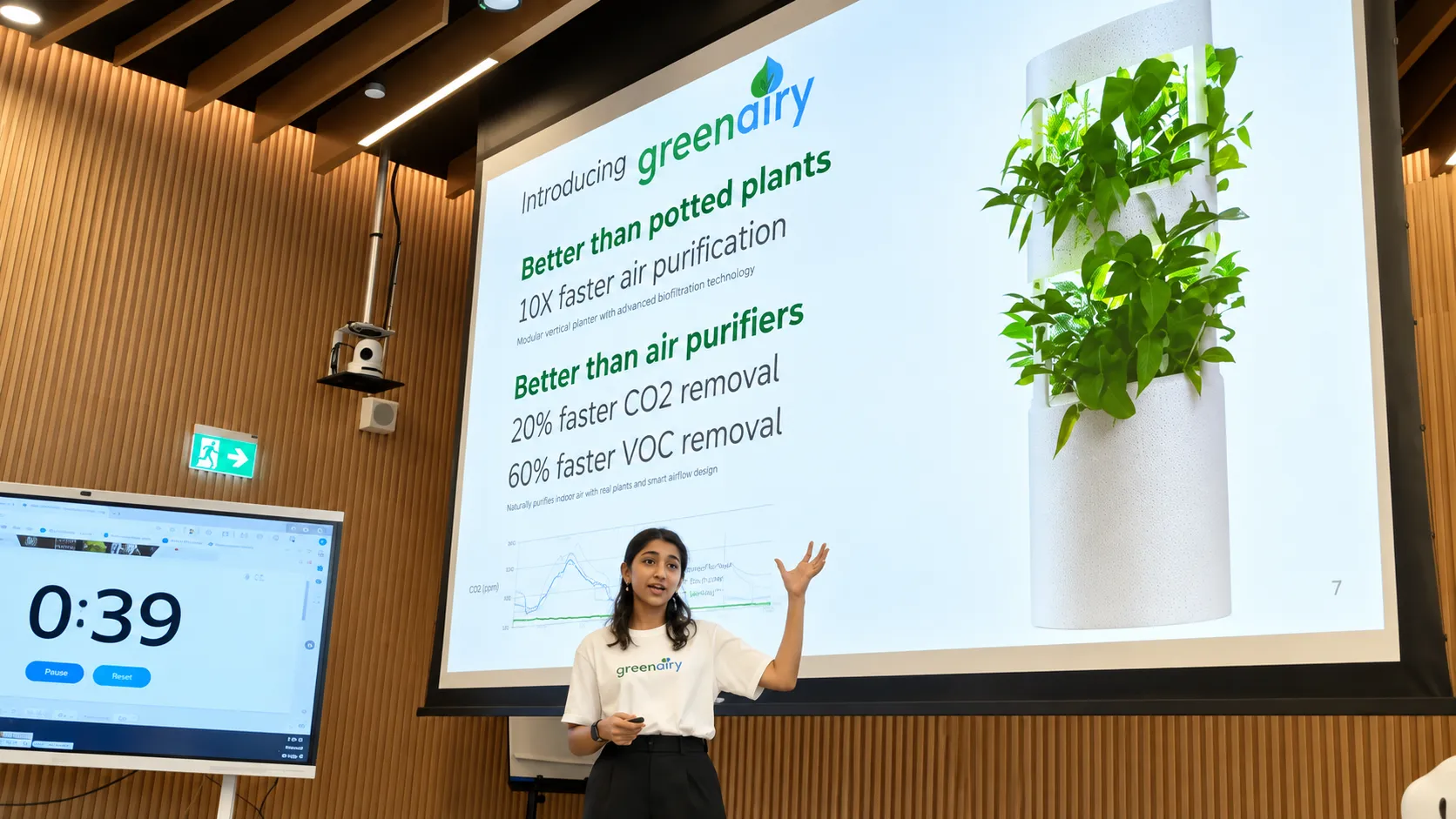
Greenairy, a start-up co-founded by engineer Tanvi Thombre, is building plant-based towers designed to remove harmful gases from office air, and says early testing in Singapore showed them cutting pollutant levels faster than a conventional air purifier.
The company, profiled by TechCrunch on 7 October, was started by Thombre and Lakshya Saraf while both were engineering students. Thombre is based in Singapore and Saraf in Berkeley, California, where Saraf is raising funds. TechCrunch did not report any funding amounts or investors.
Greenairy has been selected for TechCrunch's Startup Battlefield 200 and will appear at TechCrunch Disrupt in San Francisco from 13 to 15 October. The founders expect to begin installing their first mass-produced towers for customers in Singapore in the first half of 2027.
A health scare in the makerspace
The idea grew out of the founders' own experience. While working in a university makerspace, Thombre said she was “unknowingly exposed to toxic fumes from laser cutters, 3D printers, and soldering irons”. The issue became urgent when her best friend fainted and had to be taken to hospital.
“We began investigating indoor air pollution and realized it was an invisible but dangerous health risk,” Thombre told TechCrunch. The makerspace already had air purifiers, but those devices are designed mainly for particulate matter such as dust and pollen. They are less effective against gases such as carbon dioxide, formaldehyde and benzene, many of which belong to a group known as volatile organic compounds, or VOCs.
VOCs are released by everyday sources including paints, cleaning products, furniture and office equipment. Thombre pointed to links between these compounds and chronic disease as well as “sick building syndrome”, the term the US Environmental Protection Agency uses for situations in which occupants experience health effects linked to time spent in a building. She also cited Harvard research finding that better indoor air quality improved cognitive function and productivity.
Thombre has spent years on the problem. According to the Singapore University of Technology and Design, she completed a Master of Innovation by Design in 2022 with a thesis on developing a modular, internet-connected air-purifying plant tower named GreenAiry. A speaker profile for Singapore's AT ONE Impact Week describes her as trained in robotics and design engineering, with a master's focused on phytoremediation, the use of plants to clean air, and as a beVisioneers Singapore Fellow.
How the towers work, and what the pilot showed
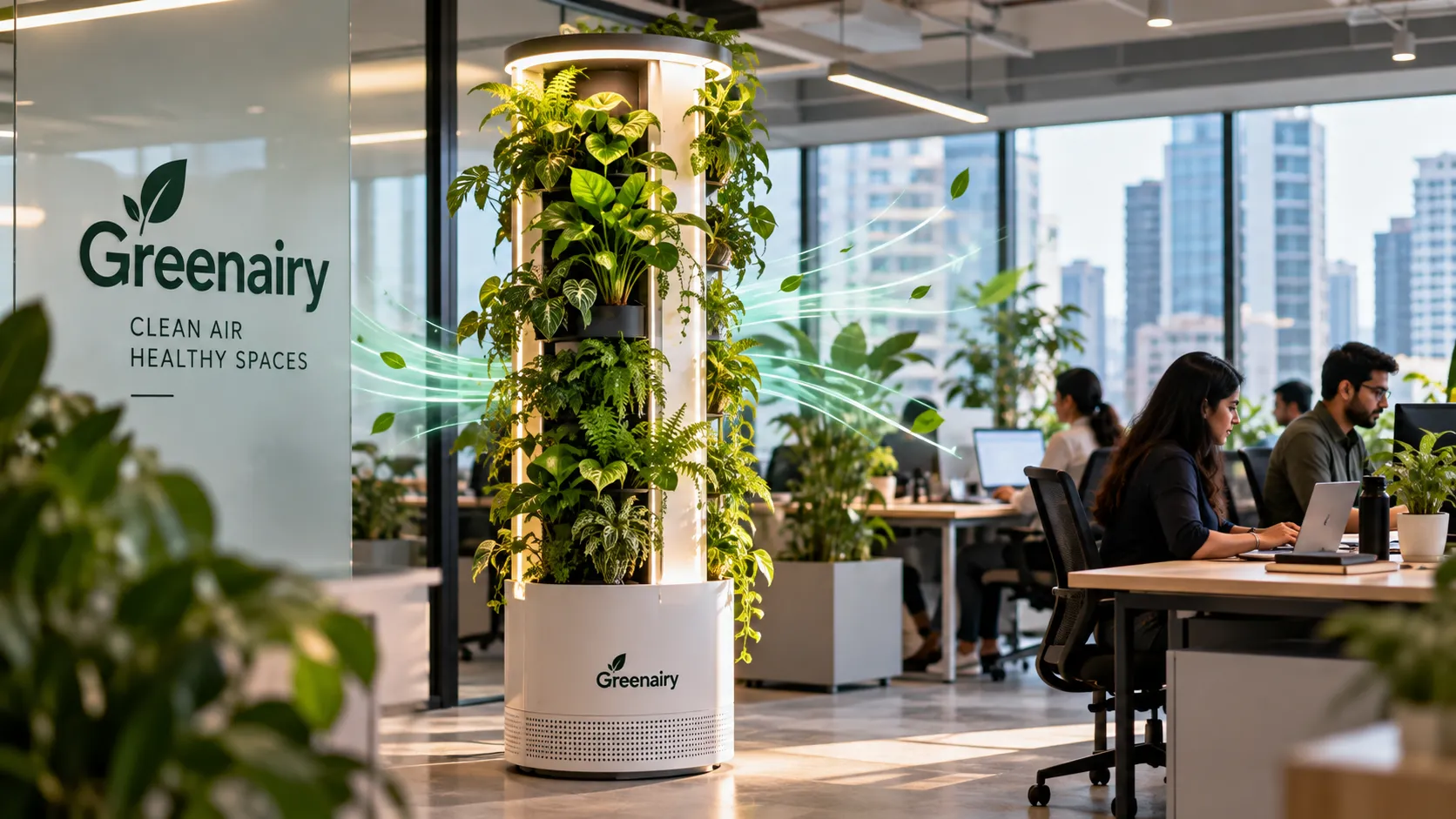
Greenairy's towers draw in room air, use plants and the microbes around them to break down toxic gases, and then release the cleaned air. “A plant in a pot cleans air slowly,” Saraf told TechCrunch, explaining that the company changes the conditions around the plant to speed up the process. The founders did not disclose the specific engineering involved.
Saraf argued that some air purifier filters remove only a narrow range of VOCs and need frequent replacement, whereas plants offer a natural approach that produces no harmful by-products and does not require new filters.
To test the idea, Greenairy compared three Singapore offices using RESET-certified air monitors: one with its towers, one with a medical-grade ioniser and one with a HEPA air purifier. “Our tower had the lowest VOC levels and removed VOCs the fastest,” Saraf said, adding that staff also liked the tower's fresh smell.
Thombre said VOC levels fell by 50%, measured both as a daily average and at their peak, with an immediate improvement during normal office hours. She expects further gains “as the plants and microbes mature and the gases are prevented from accumulating.” German testing company TÜV SÜD validated the results, according to Greenairy, which says it will publish them soon and shares them on request. The trial was short-term, and the findings have not yet been independently published.
Greenairy's own published figures vary. Its Catalyst Now profile claims a 60% reduction in toxic gas pollution with the Fresh tower, while the same page cites a 50% cut in total VOCs and a 20% cut in carbon dioxide. Those differences underline why the certified TÜV SÜD report will matter to potential customers.
From schools to offices, and the road to manufacturing
Greenairy operates as a social enterprise in Singapore, according to its profile on the Catalyst Now network. Alongside its office product, Greenairy Fresh, it runs Greenairy Supergreens, microgreen towers and a sustainability learning app that are being piloted in primary and secondary schools, as well as parent-child workshops. The company says it has tested air quality in more than 50 Singapore schools and offices and educated more than 250 students through farming workshops.
Large-scale manufacturing will start once the TÜV SÜD results are certified. “If things go to plan, both of us will be in Singapore by the first half of 2027,” Saraf said, setting out a timeline that ties the first mass-produced towers to the first customer installations in the city-state.
The two-continent set-up has a purpose. Singapore, where Thombre studied and where the pilots took place, is the launch market, while Saraf's base in Berkeley puts the company within reach of Bay Area investors. Selection for Startup Battlefield 200, which showcases early-stage companies at Disrupt, gives the founders a stage in front of those investors days from now.
The business is also designed to reach beyond offices. Greenairy lists quality education among its focus areas, and its school programme aims to turn students into what it calls sustainability changemakers through hands-on environmental lessons and urban farming. That dual model, selling clean-air hardware to companies while running education programmes for young people, reflects Thombre's stated interest, in her Impact Week profile, in getting the next generation to care for the planet.
Greenairy is not the only company betting on plants as air cleaners. In India, where indoor and outdoor air pollution is a persistent public health concern, Gurugram-based UBreathe sells plant-based purifiers that use a fan to boost phytoremediation, and secured ₹1.5 crore from Namita Thapar on Shark Tank India in 2023, The Better India reported. That gives Greenairy's approach a ready comparison in one of the world's largest markets for air purification.
The challenges are practical. Living systems need care, performance can vary with plant health and room conditions, and buyers will want independently published data before replacing proven filters. If the certified results hold up, Thombre and Saraf will have a product that brings both cleaner air and greenery into the workplace.