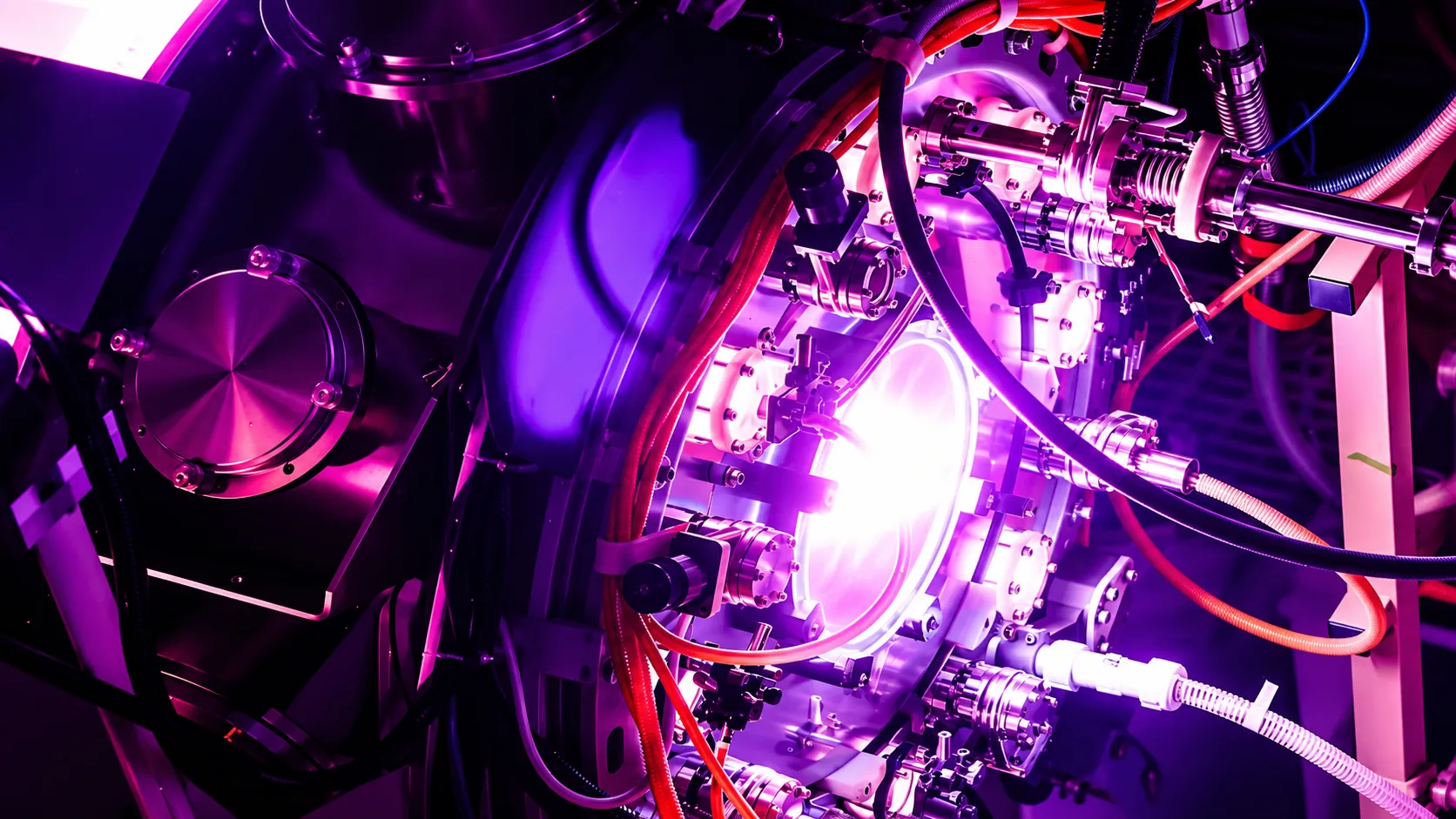
Helion Energy, one of the world's most closely watched fusion power companies, is turning to semiconductors in its quest to generate electricity from fusion, with new federal and private funding to build chips it says could dramatically improve the efficiency of its power plants.
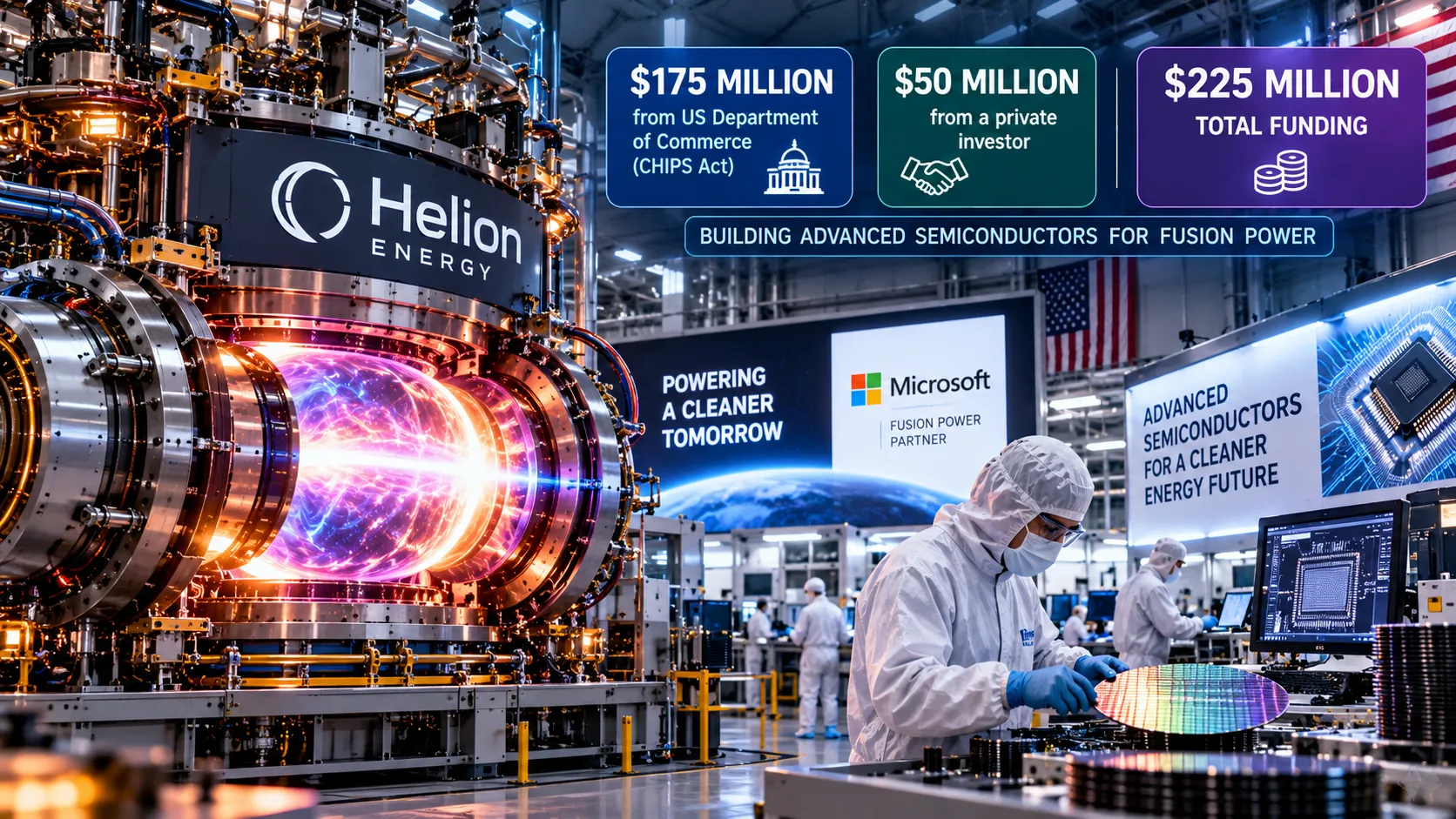
The company received a three-year, $175 million award from the US Department of Commerce under the CHIPS Act to fund research, development and manufacturing of advanced semiconductors and power electronics, TechCrunch reported on Thursday, October 22. Helion also announced a $50 million investment from an undisclosed private investor, bringing the total to $225 million.
Why fusion needs better chips
Helion's approach to fusion relies on pulses of enormous electrical power. Its machines use powerful magnetic fields to compress plasma to fusion conditions, then recapture electricity directly from the plasma's expansion. That process depends on high-voltage, pulsed semiconductors that switch and convert huge amounts of power extremely quickly.
Current devices lose about 5% to 10% of the electricity passing through them, chief executive David Kirtley said. Reducing those losses has an outsized effect on the plant's overall performance. "If we can cut that loss in half, that's actually twice the power output of the fusion system," he said.
The reason is that fusion plants must recirculate much of the energy they produce to sustain the reaction. Small efficiency gains in the power-handling equipment therefore translate into large gains in the net electricity a plant can deliver.
Building a US supply chain
Kirtley said no American companies currently make the kinds of semiconductors Helion needs. "There are no U.S. manufacturers right now that do it," he said. "This is absolutely enabling going from zero to 100 for advanced, high-voltage and pulsed semiconductors."
More than $100 million of the funding will go to semiconductor and advanced packaging research and development in Washington State, where Helion is based, and about $80 million will fund work in Vermont with chipmaker GlobalFoundries. Helion plans a new production line in Washington State, which TechCrunch described as the first in the US for this class of semiconductor. Such devices also have uses in manufacturing, wastewater treatment, medicine and defence.
Bill Frauenhofer of the Department of Commerce said the award would help "convert and deliver power to critical applications in defense, grid transmission, and advanced energy generation."
The Microsoft deadline
Helion is building Orion, its first power plant, and has a 2028 deadline to supply Microsoft with electricity from the grid, under an agreement that made it one of the first fusion companies to sign a commercial power deal. The new semiconductor capacity will help supply Orion's fusion machine.
However, Kirtley said the research would not reach Orion in time for its launch, since federal contracts take months to negotiate. He expects the improvements to benefit later plants.
Helion has raised more than $3.2 billion in total, making it the second-best-funded fusion startup, according to TechCrunch.
The fusion race
Fusion, the process that powers the sun, promises abundant, carbon-free electricity without the long-lived radioactive waste of conventional nuclear fission. After decades of research, private investment has surged, with companies such as Commonwealth Fusion Systems, TAE Technologies and Helion racing to build commercial plants.
Demand for clean, reliable power from AI data centres has added urgency. Technology companies are signing deals with nuclear, geothermal and fusion developers to secure future electricity supplies, as AI's energy needs strain grids.
Yet fusion remains unproven commercially. No company has yet demonstrated a plant that produces more electricity than it consumes on a sustained basis. Helion's 2028 target is among the most ambitious in the industry, and many experts are sceptical about whether it can be met.
Energy security and industrial policy
Kirtley framed the project in terms of national priorities. "Domestic energy supply, national security through energy dominance and energy security, that's our main focus," he said.
The award reflects how the CHIPS Act, designed to rebuild US semiconductor manufacturing, is being used to support specialised chips beyond mainstream computing, including power electronics critical to energy infrastructure.
What it means for India
India has a long-standing interest in fusion through its participation in ITER, the international fusion project in France, and research at the Institute for Plasma Research in Gandhinagar. As India seeks to meet rising electricity demand while cutting emissions, advanced nuclear technologies, including small modular reactors and eventually fusion, are part of its long-term energy planning.
Power electronics is also an area of growing importance for India, given the expansion of renewable energy, electric vehicles and grid infrastructure. India's semiconductor ambitions have focused largely on chip fabrication and design, but specialised power semiconductors represent another opportunity.
How Helion's approach differs
Most fusion research has focused on tokamaks, doughnut-shaped devices that use powerful magnets to confine plasma for long periods, an approach used by the international ITER project and companies like Commonwealth Fusion Systems. Helion uses a different design known as a field-reversed configuration, in which plasma is formed, accelerated and collided in a linear machine, then compressed with magnetic fields in rapid pulses.
A key feature of Helion's design is that it aims to recover electricity directly from the changing magnetic fields as the plasma expands, rather than using heat to drive turbines as in conventional power plants. This direct energy recovery could be more efficient, but it depends heavily on the performance of the power electronics that handle the electrical pulses, which is why the semiconductor work is so important.
Helion has built several prototype machines, and its seventh-generation device, Polaris, was designed to demonstrate electricity production from fusion.
What comes next
Helion's immediate focus is completing Orion and meeting its commitment to Microsoft. The semiconductor programme is a longer-term investment that could improve the economics of future plants.
If Helion succeeds, it could transform the global energy landscape. If it falls short, its investments in high-voltage semiconductors may still yield valuable technology for other industries. For investors and governments backing fusion, the semiconductor programme also highlights how breakthroughs in energy may depend on advances in adjacent technologies, from materials and magnets to power electronics. Progress in these supporting fields could benefit the wider energy industry well before fusion itself becomes commercial. Helion's progress over the next two years will be one of the most closely watched stories in clean energy.