
ImpactSustainability5 MIN READ

Sumitomo Takes 49% of Hero Future Energies' 500 MWp Hybrid Project as Japan Deepens Its Bet on India's Clean Power

Japan's Sumitomo Corporation will acquire 49% of a 500 MWp wind-solar-storage project being built by Hero Future Energies in Bidar, Karnataka, as foreign capital targets round-the-clock renewable power in India.

By Nisha Omkumar · Author6 October 2026New
Sumitomo Takes 49% of Hero Future Energies' 500 MWp Hybrid Project as Japan Deepens Its Bet on India's Clean Power

Japan's Sumitomo Corporation has agreed to partner with Hero Future Energies on a hybrid renewable energy project of about 500 megawatt-peak in Bidar, Karnataka, in a transaction that underscores the growing appetite of global strategic investors for India's next generation of clean power assets.

Under the arrangement announced on 6 October 2026, Sumitomo will acquire a 49% stake in the special purpose vehicle that owns the project, while Hero Future Energies, the renewable energy arm of the Hero Group, will retain 51%. Financial terms were not disclosed.

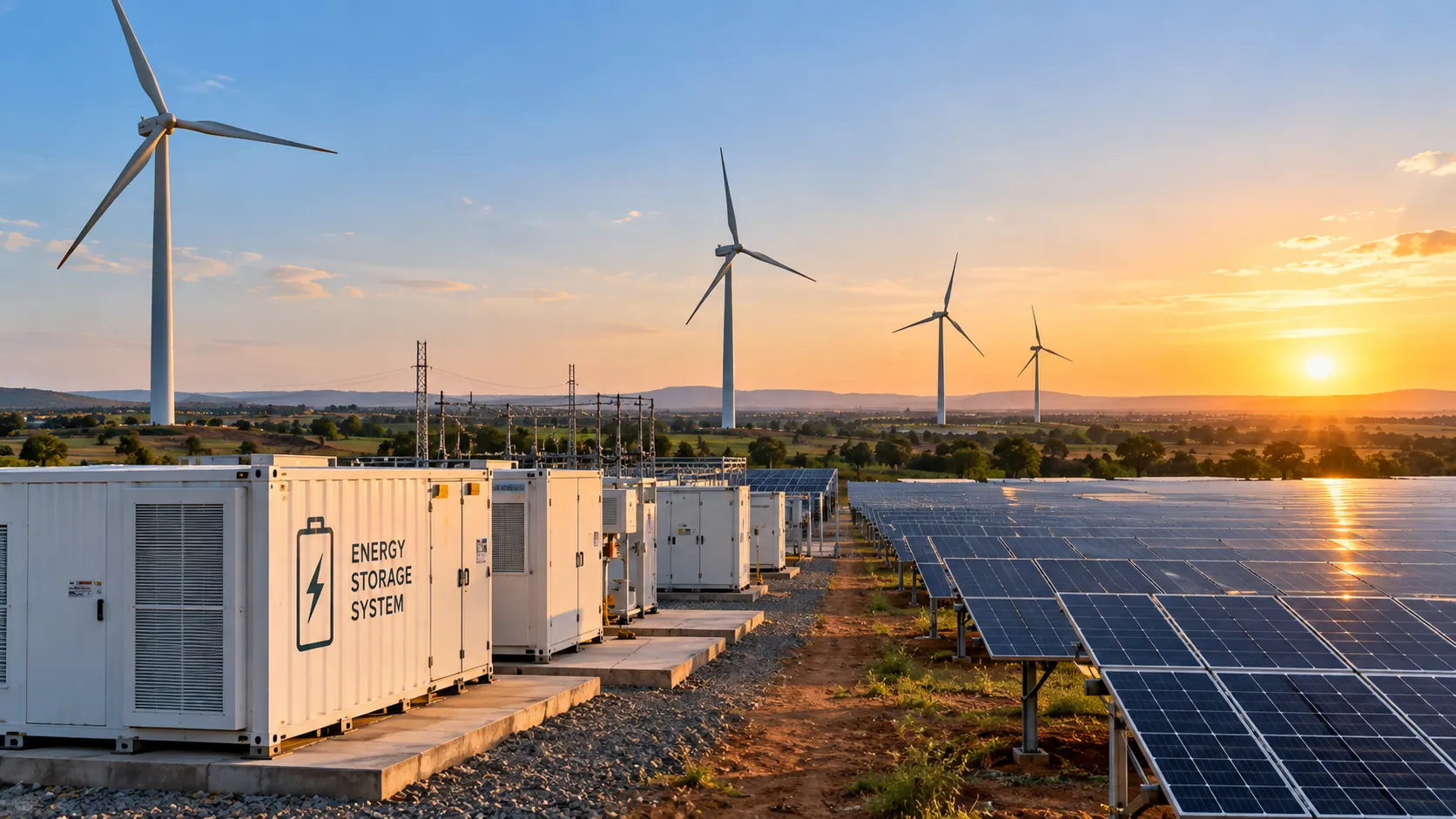
The project will combine wind and solar generation with large-scale battery energy storage, a configuration designed to deliver more reliable and flexible power to the grid than standalone solar or wind farms can provide.
c84d8552-3148-40ec-bf7a-bd146e934177.png

Why hybrid projects matter

India has added renewable capacity at a remarkable pace over the past decade, making it one of the world's largest markets for solar and wind power. That success has created a new challenge. Solar generation peaks in the middle of the day, when demand is often lower, and falls to zero in the evening, precisely when household consumption rises. Wind output varies by season and location. As the share of variable renewables on the grid grows, so do the difficulties of matching supply with demand.

The consequences are already visible. A recent report by global consultancy Kearney estimated that India curtailed more than 8 terawatt-hours of solar generation between April and June 2026, with grid congestion identified as a major factor. Curtailment means clean electricity that could have been generated was wasted, eroding project economics and slowing the displacement of coal.

Hybrid projects address that problem directly. By pairing solar, which generates during the day, with wind, which in many parts of southern India blows strongly in the evenings and during the monsoon, developers can produce a smoother output profile. Adding batteries allows surplus power to be stored and released when it is most valuable. Distribution companies and industrial buyers increasingly want exactly that kind of firm, dispatchable clean power.

The partners and their rationale

Rahul Munjal, founder and chairman of Hero Future Energies, said the partnership reflects confidence in the company's ability to execute projects and argued that strategic partnerships can combine capital and execution capabilities to accelerate clean energy adoption as India moves through its energy transition.

Srivatsan Iyer, the company's global chief executive, said Hero Future Energies has built expertise in complex renewable projects designed to supply dependable power to the grid. That experience in integrating multiple technologies on one site is increasingly important, as hybrid and storage-backed projects require more sophisticated engineering, grid interconnection and energy management than conventional solar parks.

For Sumitomo, one of Japan's largest trading houses, the investment strengthens its renewable energy platform in India. Jun Minase, general manager of the Overseas Energy Solution strategic business unit at Sumitomo Corporation, said the company sees significant potential in Hero Future Energies' growth plans as renewable energy accounts for a larger share of India's energy mix, and that the partnership creates opportunities to support a stable supply of renewable power.

A familiar pattern of Japanese capital

Sumitomo's move fits a broader trend. Japanese corporations, banks and development institutions have been among the most consistent foreign investors in Indian infrastructure, from metro rail systems financed by Japanese development assistance to stakes in power, logistics and industrial projects. Japan's trading houses, in particular, have been building portfolios of overseas renewable assets as they seek growth beyond their traditional businesses and respond to pressure from shareholders to decarbonise.


“India no longer needs only cheap solar megawatts; it needs power that arrives when the grid needs it, and that is what hybrid projects with storage promise.”
— TIGI Analysis

India offers those investors scale and long-term demand. Its electricity consumption is expected to keep rising strongly as the economy grows, cities expand and cooling demand increases. Government targets, including the goal of 500 gigawatts of non-fossil fuel capacity by 2030, provide a policy framework that reassures long-term capital, even if execution has at times lagged ambition.

Minority stakes in project-level vehicles have become a favoured structure. They allow foreign investors to gain exposure to operating or near-operational assets with contracted revenues, while the local developer retains control of construction and operations. For developers, selling a stake recycles capital that can be deployed into the next project.

Karnataka's role in the transition

Karnataka has long been among India's leading states for renewable energy, with strong solar resources and good wind sites. Bidar, in the state's north, has emerged as an attractive location for large projects thanks to available land and favourable resource conditions. Hybrid projects in the region can take advantage of both resources at a single site, reducing land and transmission costs relative to building separate facilities.

The state's industrial base, including Bengaluru's technology sector and its growing data centre capacity, is a significant source of demand for clean power. Large corporate buyers with net-zero commitments increasingly seek round-the-clock renewable supply rather than certificates or intermittent generation, and hybrid projects are well suited to meet that requirement.

A busy day for corporate clean power

The Sumitomo deal was not the only sign of corporate appetite for renewable assets this week. On the same day, Vardhman Textiles disclosed that it had agreed to acquire at least a 26% stake in a special purpose vehicle formed by Serentica Renewables to develop a 40-megawatt wind project in Karnataka and a solar project in Rajasthan, securing captive clean power for its manufacturing operations. Under India's captive power rules, industrial consumers that hold equity in a generating company can access renewable electricity on favourable terms, a structure that has driven a wave of similar investments.

Taken together, the transactions illustrate how financing for India's energy transition is diversifying. Developers are raising money not only from domestic banks and public markets but also from foreign strategic partners, global infrastructure funds and industrial customers who want a direct stake in the power they consume.

Challenges ahead

Hybrid and storage-backed projects are more complex than conventional solar farms, and they face real hurdles. Battery costs have fallen sharply but still add significantly to project budgets. Grid connectivity and transmission capacity remain bottlenecks in several states, and the curtailment data underline that generation alone is not enough without adequate network investment. Payment discipline among state distribution companies, while improved, remains a long-standing concern for investors.

Even so, the direction is clear. As India seeks to meet rising demand while reducing its reliance on coal, the value of renewable power increasingly depends on when and how reliably it can be delivered. Projects such as the Bidar hybrid, backed by a domestic developer and a global partner, represent the model that policymakers and investors expect to dominate the next phase of the country's energy transition. Sumitomo's 49% stake is a vote of confidence that the model can deliver both power and returns.

TagsHero Future EnergiesSumitomo CorporationRenewable EnergyHybrid PowerBattery StorageWind EnergySolar EnergyKarnatakaBidarEnergy TransitionJapan-IndiaSustainability

Reader reviews

Sign in to rate and review this article.
Loading reviews…