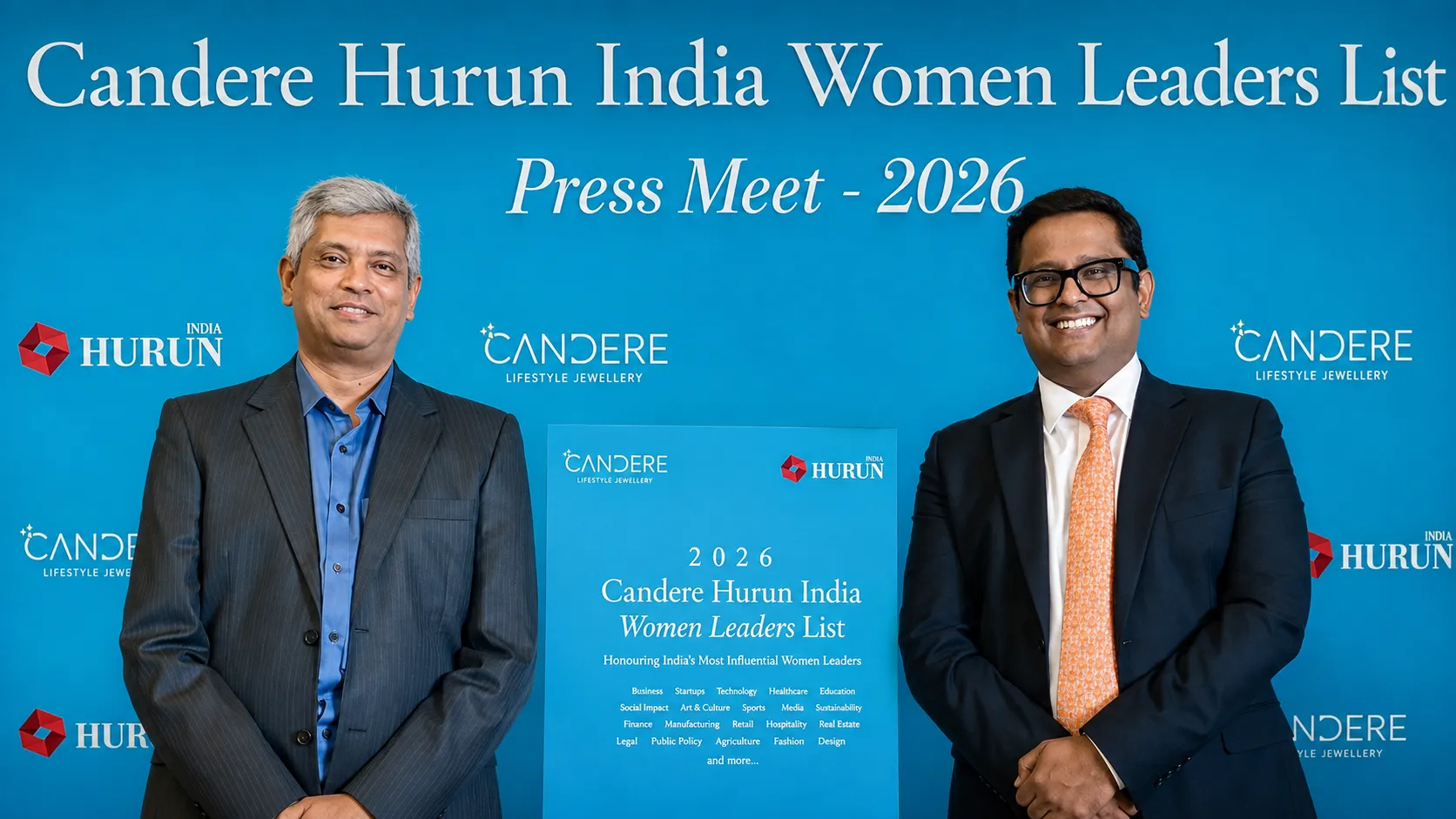
For most of its history, the business of ranking India's most influential women has been, implicitly, a business of ranking its most well-connected ones. Lists compiled by Indian and international media have tended to skew heavily toward women who inherited controlling stakes in family conglomerates, married into established business dynasties, or otherwise entered positions of corporate influence through channels that had comparatively little to do with independent achievement. The second edition of the Candere Hurun India Women Leaders List, published July 30, 2026, sets out to document a different reality — and its headline finding is difficult to dismiss as noise: of the 117 women recognised across 12 categories, 98, or 84%, are self-made, outnumbering those who inherited their wealth or leadership positions by more than five to one.
That statistic anchors a list that has grown considerably in both scale and scope since its inaugural 2025 edition, which recognised 97 women across nine categories. This year's cohort, together representing a combined enterprise value, market capitalisation and personal wealth of approximately ₹39 lakh crore — a sum roughly comparable to the entire GDP of Finland — spans seven decades of age, from 19-year-old para-archer Sheetal Devi to 86-year-old Cremica founder Rajni Bector, and reaches well beyond the traditional boardroom into sport, journalism, literature, entertainment and social-impact work.
The list's underlying methodology, developed jointly by Hurun India and jewellery retailer Candere by Kalyan Jewellers, organises its 117 honourees around five broader pillars: Wealth Creation, Value Creation, Impact, Culture and Startups. Culture accounts for the single largest share of the list, with 42 women, or 36% of the total, drawn from fields including sport, media, literature and entertainment — a deliberate structural choice that pulls the list away from a narrow focus on corporate and financial achievement alone. Startups follow with 28 women, or 24% of the cohort, reflecting the growing visibility of women founders across India's venture-backed technology sector. Value Creation, generally encompassing senior executives and professional managers rather than founders, accounts for 19 women, or 16%; Wealth Creation, the category most associated with the list's largest personal fortunes, comprises 18 women, or 15%; and Impact, spanning social enterprise and philanthropic leadership, rounds out the list with 10 women, representing 9% of the total.
Individual category leaders illustrate how deliberately the list's compilers sought to move beyond a single, narrow definition of influence. Priya Nair, who took over as CEO and Managing Director of Hindustan Unilever on August 1, 2026, tops the Professional CEOs category — a recognition of operating executive leadership at one of India's largest consumer goods companies. Roshni Nadar Malhotra, Chairperson of HCLTech, leads the Wealth Multipliers category with a net worth the report puts at ₹2,84,120 crore, reflecting both her family's original stake in the company and the value she has helped create as chairperson since 2020. Vaishali Nigam Sinha, co-founder of ReNew, ranks first in the New Economy category, a designation for leaders building India's clean energy, deep-tech and climate-technology sectors. Rajni Bector tops Heartland Founders, a category specifically designed to recognise entrepreneurs whose businesses originated and remain headquartered outside India's major metropolitan centres; Meena Bindra leads Indian Fashion and Lifestyle; Sudha Murty tops the Authors category on readership impact; para-shooter Avani Lekhara leads the Olympic and Paralympic Medallists category with three career medals; and Tushara Shankar, head of CSR at pharmaceutical company Lupin, ranks first among Social Change Makers on the basis of sustainability score.

Beyond individual category leaders, the report surfaces a series of granular statistics that collectively paint a picture of where and how India's influential women are concentrated. Kiran Mazumdar-Shaw, Executive Chairperson of biopharmaceutical company Biocon, holds the largest LinkedIn following among the list's honourees, with more than one million connections — a figure the report cites as evidence of her standing as arguably India's most globally recognised woman business leader. Independent journalist Faye D'Souza, at 44, is identified as the most-followed independent journalist among the cohort, with more than 2.2 million Instagram followers, a data point that speaks to the growing influence of independent, platform-native media figures relative to traditionally institution-affiliated journalists such as Barkha Dutt and Palki Sharma Upadhyay, both of whom also feature on the list. Geographically, Mumbai remains the dominant hub for the list's honourees, home to 26 of the 117 women recognised — a concentration that reflects the city's continued status as India's primary centre for both traditional business and media, even as the list's Startups and New Economy categories increasingly draw honourees from Bengaluru, Delhi-NCR and other emerging hubs.
The list's full roster of names reads, in aggregate, as something close to a cross-section of contemporary Indian public life: alongside Mazumdar-Shaw, Nadar Malhotra, Sinha, Bector, Bindra, Murty and Shankar sit names including Falguni Nayar, founder of beauty retailer Nykaa; Nisaba Godrej, Chairperson of Godrej Consumer Products; designer Anita Dongre; designer-entrepreneur Masaba Gupta; badminton champion P.V. Sindhu; boxer Mary Kom; shooter Manu Bhaker; weightlifter Mirabai Chanu; pharmaceutical entrepreneur Namita Thapar; and content creator Kusha Kapila. That breadth — spanning consumer goods, fashion, sport, pharmaceuticals and digital media within a single ranking — is, according to Hurun India's own framing, precisely the point: a deliberate rejection of the idea that a single sector, or a single kind of achievement, can adequately capture the range of ways Indian women are currently building influence.
Anas Rahman Junaid, Hurun India's Founder and Chief Researcher, was explicit about that ambition at the list's launch, framing this year's edition around reach rather than raw scale alone. 'What defines this year's list is not just its size, but its reach,' he said. 'Across 117 honourees and 12 categories, the 2026 edition spans seven decades of achievement and stretches well beyond the boardroom to include Olympic and Paralympic medallists, authors, independent journalists and social change makers.' He added that the underlying goal was to widen the definition of influence itself, moving away from measuring women's success 'only through a narrow lens' — an implicit critique of a prior generation of business rankings that, in India as elsewhere, tended to privilege inherited wealth and formal corporate title over independently built achievement in less conventionally 'businesslike' fields.
Sanjay Raghuraman, Managing Director of Candere by Kalyan Jewellers, framed the partnership's rationale in similar terms, describing the original goal of the collaboration with Hurun India as establishing 'an annual recognition celebrating women whose leadership, achievements and influence shape India in meaningful ways.' The year-on-year growth from 97 honourees across nine categories in the list's inaugural 2025 edition to 117 honourees across 12 categories in 2026 — a 21% increase in the size of the cohort alongside a one-third expansion in the number of recognised fields — suggests the list's organisers intend the ranking to keep broadening its definition of achievement in subsequent editions, rather than settling into a fixed, static format built around a narrow set of traditional business metrics.
For a country whose earlier rich lists and power rankings were, for decades, dominated overwhelmingly by men and, among the women who did appear, disproportionately by those born into existing business dynasties, the 2026 Hurun India Women Leaders List's central statistic — 84% self-made, outnumbering inheritors five to one — represents a genuinely notable shift in what Indian influence now looks like, and in who is now positioned to build it. Whether that shift reflects a durable structural change in India's economy and society, or simply a more deliberate methodological choice by this particular list's compilers, is a question likely to be tested by how the ranking's composition evolves over subsequent editions. For now, the underlying data speaks for itself: in 2026, the most reliable predictor of a woman's inclusion on India's most closely watched leadership list was not the family she was born into, but the enterprise, institution or body of work she built herself.