One of India's leading business schools is taking on a role that goes to the heart of how public welfare programmes are delivered. The Indian Institute of Management Bangalore (IIMB) has entered into two collaborations with the Ministry of Minority Affairs (MoMA) and the National Minorities Development & Finance Corporation (NMDFC) to strengthen skilling and entrepreneurship among minority communities.
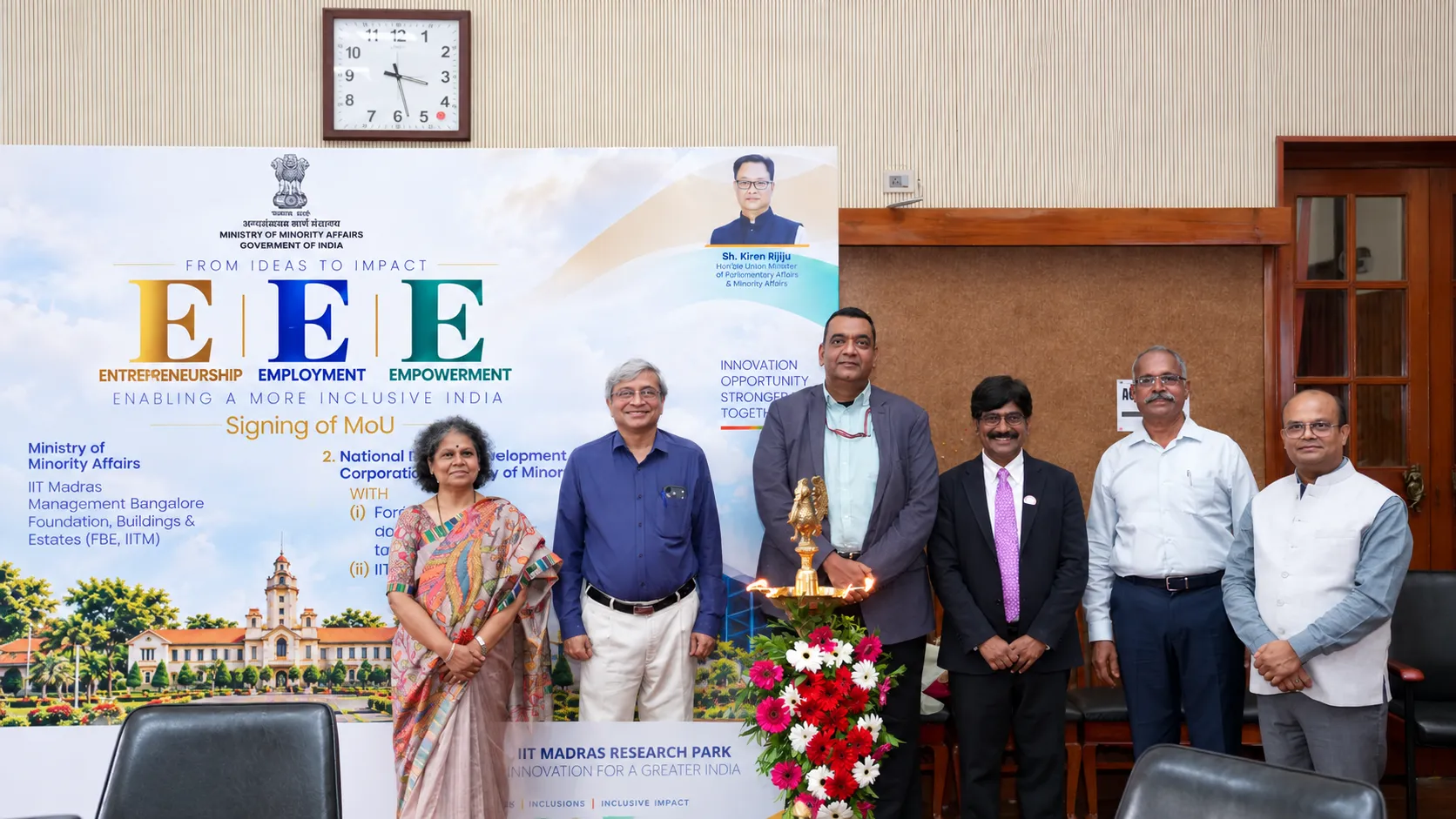
The agreements were signed in Bengaluru on September 25. They cover two distinct areas: independent monitoring of government-funded training centres, and support for minority entrepreneurs and start-ups through IIMB's incubation arm.
Independent eyes on skilling programmes
Under the first collaboration, IIMB's Centre for Public Policy will carry out independent field-level inspections and concurrent monitoring of 43 training centres run under the Pradhan Mantri Virasat Ka Samvardhan scheme, known as PM VIKAS. The centres are spread across Andhra Pradesh, Karnataka, Kerala, Tamil Nadu and Telangana.
The assessment will examine several dimensions of each centre's performance: how training is delivered, the quality of infrastructure, participation and attendance, certification and, crucially, placement outcomes.
PM VIKAS is the ministry's flagship scheme for the skilling, entrepreneurship and education of minority communities. It brought together several earlier programmes under one umbrella, with the aim of improving livelihoods through training in traditional crafts and modern trades, and by linking beneficiaries to jobs and credit.
Why concurrent monitoring matters
Large skilling programmes in India have often faced the same criticism: enrolment numbers look impressive, but it is harder to verify how many trainees complete courses, earn recognised certifications and find stable employment. Placement data reported by training providers is not always independently checked.
Concurrent monitoring, where an independent agency evaluates a programme while it is under way rather than after it ends, is designed to address that gap. It allows problems to be identified and corrected in real time, whether they relate to poor infrastructure, low attendance or weak links with employers.
Bringing in an institution such as IIMB adds credibility to the process. The Centre for Public Policy has a track record of research on governance and public service delivery, and its findings are likely to carry weight with policymakers.
Building an entrepreneurship pipeline
The second collaboration focuses on enterprise. IIMB Innovations' NSRCEL, the institute's start-up hub, will work with NMDFC to strengthen entrepreneurship and start-up support for minority communities.
The partnership covers skilling, incubation, mentoring, market access and investor linkages. In practice, that could help aspiring entrepreneurs move from an idea or small informal business to a structured venture with access to advice, networks and capital.
NMDFC is the government's principal channel for concessional finance to minority communities, providing loans for self-employment and small businesses through state agencies and other partners. Linking that financing capability with NSRCEL's experience in incubating start-ups could create a more complete pathway from training to enterprise.
NSRCEL has become one of India's most active university-based incubators, supporting early-stage ventures across sectors and running dedicated programmes for women entrepreneurs and social enterprises. Extending that expertise to minority entrepreneurs, many of whom run small businesses in crafts, trade and services, fits a broader push to make India's start-up ecosystem more inclusive.
Part of a wider push by the ministry
The IIMB agreements are part of a broader effort by the Ministry of Minority Affairs to draw on the expertise of premier academic institutions. The ministry has also signed agreements with the Indian Institute of Science (IISc) and IIT Madras, covering areas such as technical assessment of infrastructure projects under the Pradhan Mantri Jan Vikas Karyakram (PMJVK) and support for innovation and start-up incubation.
The approach reflects a recognition that government departments do not always have the in-house capacity to evaluate complex programmes rigorously. Partnering with leading institutions provides specialised expertise, independence and analytical depth.
The case for evidence-based welfare
India spends substantial sums on skilling and livelihood programmes across ministries. The challenge has long been measuring what works. Independent evaluations can reveal which training models lead to jobs and higher incomes, which centres are underperforming and where resources could be redirected.
For minority communities, the stakes are significant. Many beneficiaries of PM VIKAS belong to families that depend on traditional crafts or informal work. Effective training, recognised certification and access to markets can make a meaningful difference to household incomes.
The focus on placement outcomes in IIMB's mandate is particularly important. Skilling programmes succeed only if trainees are able to use their skills to earn a living, either through employment or self-employment. By measuring placement alongside attendance and infrastructure, the assessment will provide a more complete picture of each centre's impact.
Academia as a partner in governance
The agreements also illustrate a growing role for India's premier institutions in public policy. Business schools and technology institutes have long contributed research and training to government. Formal partnerships for programme monitoring and delivery take that relationship a step further, giving academics direct exposure to the realities of implementation on the ground.
For IIMB, the collaborations offer an opportunity to generate research on skilling and inclusive entrepreneurship, areas of growing importance as India seeks to create jobs for a large and young workforce. For students and faculty, they provide a practical link between classroom analysis and public service.
What to watch
The value of these partnerships will depend on follow-through. Key questions include how quickly IIMB's monitoring findings are shared with the ministry, whether they lead to corrective action at underperforming centres, and whether the results are published in a form that allows public scrutiny.
On the entrepreneurship side, success will be measured by the number of ventures supported, the funding they attract and the jobs they create. Linking NMDFC's credit programmes with NSRCEL's incubation expertise has clear potential, but it will require close coordination between a government finance corporation and a university start-up hub with very different ways of working.
A test of accountable welfare
The IIMB agreements are a modest but meaningful step toward more accountable and effective welfare delivery. By combining independent monitoring of skilling centres with support for minority entrepreneurs, they address two sides of the same challenge: making sure that public programmes translate into real economic opportunity.
If the approach proves successful in the five southern states covered by the monitoring mandate, it could provide a model for evaluating skilling programmes elsewhere in India, and for bringing more of the country's leading institutions into the work of inclusive growth.