The International Monetary Fund and World Bank wrapped up their 2026 annual meetings in Bangkok with a sobering message for governments: the global economy has shown resilience, but rising debt, persistent inflation, high energy and food prices, and the disruptive force of artificial intelligence demand urgent and difficult policy choices.
The meetings, the first held in Thailand since 1991, brought together finance ministers, central bankers, economists and business leaders from around the world. A summary of key takeaways published by The Nation on October 18 captures the main themes, from fiscal discipline and food security to the future of work.
Here are the most important messages for businesses and policymakers.
Asia is the world's growth engine
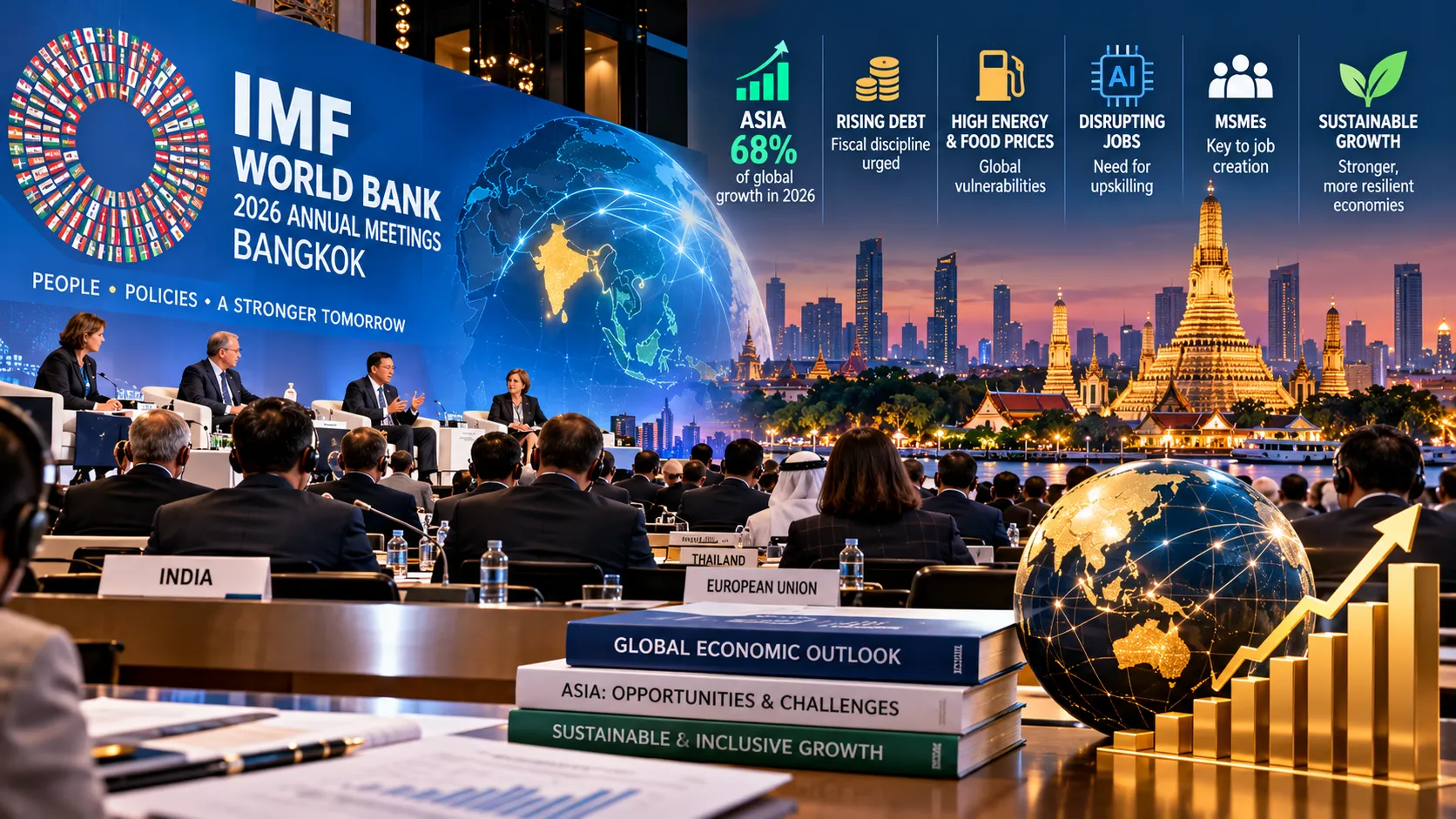
Asia has produced almost two-thirds of global economic growth since 1990, and a record 68% of global growth in 2026, according to an IMF report titled "Shaping the Future of Asia: Opportunities and Challenges." India and China remain the largest contributors, while Southeast Asian economies including Vietnam, Indonesia and the Philippines have also grown strongly.
Trade among developing countries has become a major driver. Such trade has roughly quadrupled over the past three to four decades, and about half of developing countries' trade is now with each other, World Bank officials noted. Intra-regional trade within ASEAN accounts for about 50% to 55% of the bloc's total. But officials warned that many of the roughly 100 trade agreements signed over the past decade have been weakly implemented.
The AI boom has also reshaped trade flows. From 2023 to 2025, world trade grew 8.3% cumulatively, but trade in AI-related goods rose 29%, while trade excluding those goods grew just 4.6%. Economies such as South Korea and Taiwan have been the main beneficiaries, with others like Thailand gaining indirectly through supply chains.
Fiscal discipline and targeted support
The IMF's World Economic Outlook, titled "Resilience Under Strain, Urgent Choices," urged governments to reduce deficits, end blanket cash handouts and set time limits on cost-of-living subsidies. Public debt remains above pre-pandemic levels in many countries.
On energy, the IMF advised replacing broad subsidies with targeted support for vulnerable households, summed up in the principle "protect people, not prices." Broad fuel subsidies are costly, tend to benefit wealthier households that consume more energy, and blunt the price signals that encourage conservation and investment in alternatives.
Energy dependence remains a vulnerability. Energy imports account for about 4% of GDP across the Asia-Pacific and about 7% in ASEAN, with nearly half of energy imported. Officials cited Middle East tensions, limited energy reserves and the risk of El Niño as major threats.
Officials also discussed the risk of "financial repression," in which governments keep their borrowing costs artificially low by pressing banks and other institutions to hold more government bonds, effectively shifting the burden onto savers.
Central banks should stay firm
Ten-year government bond yields have reached multi-decade highs, the highest since 2002 in the United States, since 2009 in Germany and since 1996 in Japan. IMF Managing Director Kristalina Georgieva backed the stances of the US Federal Reserve, the European Central Bank and the Bank of Japan, arguing that raising rates early is preferable to larger increases later. The IMF advised central banks to keep policy restrictive until inflation is clearly under control.


