India's startup boom is no longer confined to Bengaluru, Delhi and Mumbai, nor is it a predominantly male affair. New government figures show that nearly half of the country's recognised startups now have at least one woman in a leadership position, and almost as many come from smaller cities.
India now has more than 2.62 lakh, or 262,000, government-recognised startups, according to an official statement issued on Monday, November 9, and reported by IANS. The statement described India as the world's third-largest startup ecosystem.
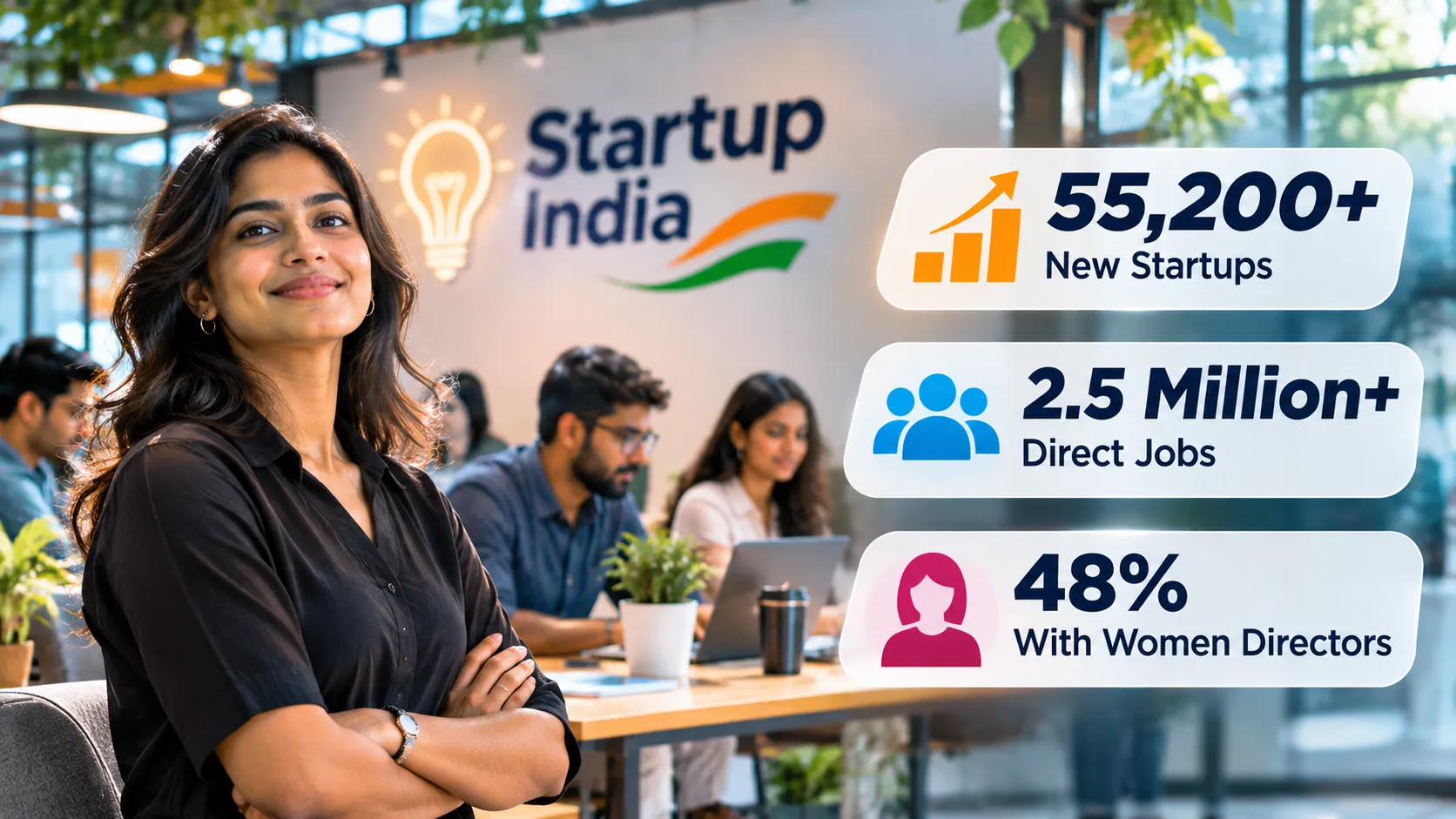
More than 1.07 lakh recognised startups, or about 48% of the total as of March 2026, have at least one woman director or partner, according to the statement.
November 9 is observed as National Entrepreneurship Day in India, marking the establishment of the Ministry of Skill Development and Entrepreneurship on November 9, 2014.
Record growth
The number of new recognitions has accelerated sharply. More than 55,200 startups were recognised in the 2025-26 financial year, the highest in any single year since the Startup India programme began in 2016, according to the statement. The number of recognised startups rose 51.6% year-on-year in 2025-26, and direct jobs created by startups rose 36.1%.
Startups have created more than 25 lakh, or 2.5 million, direct jobs up to October 2026, according to the statement.
"The shift from job seekers to job creators reflects India's growing entrepreneurial spirit," the statement said.
Beyond the metros
Nearly half of India's recognised startups come from Tier-II and Tier-III cities, according to the statement, and startups are present in all states and union territories. Maharashtra, Karnataka, Uttar Pradesh, Delhi and Gujarat lead in the number of recognised startups and direct employment, as of March 31, 2026.
The spread of startups to smaller cities reflects falling costs of starting a business, wider internet access, digital payments through UPI, and government support through schemes such as Startup India and state startup policies. Entrepreneurs in smaller cities are building businesses in agriculture, food processing, education, healthcare, local services and manufacturing, often serving markets that metropolitan startups overlook.
The women's leadership story
The figure of 48% of startups with at least one woman director or partner is striking, although it does not necessarily mean that women founded or lead all of these companies. A woman director may be a co-founder, an investor representative or a family member. Nonetheless, it indicates a significant presence of women in the governance of India's startups.
Women-led startups in India have achieved notable successes. Falguni Nayar founded Nykaa, which has become one of India's most valuable consumer internet companies and recently reported a tripling of quarterly profit. Upasana Taku co-founded fintech MobiKwik, Vineeta Singh co-founded Sugar Cosmetics, and Ghazal Alagh co-founded Mamaearth's parent Honasa Consumer, whose second-quarter profit rose 87%.
However, women-led startups continue to receive a small share of venture capital funding, according to industry data, and women founders often report greater difficulty in raising money and accessing networks. Closing this gap is a priority for policymakers, investors and advocacy groups.
Government support for women entrepreneurs
The government has introduced several measures to support women entrepreneurs, including funds of funds that reserve capital for women-led startups, credit guarantee schemes, and programmes run by state governments and incubators. Many states offer additional incentives for startups with women founders.
The Stand-Up India scheme provides bank loans to women and to entrepreneurs from Scheduled Castes and Scheduled Tribes for setting up new businesses, and the Mudra scheme has extended small loans to millions of women micro-entrepreneurs.
The demographic dividend
The statement noted that nearly 65% of India's population is under 35. Creating enough jobs for this young population is one of India's greatest economic challenges, and startups are increasingly seen as part of the solution, alongside manufacturing, services and government programmes.
While 25 lakh jobs is significant, it is small relative to the millions of young people entering India's workforce each year. Policymakers hope that startups will create more jobs as they scale, both directly and indirectly through their supply chains and the businesses that depend on their platforms.
Funding and listings
India's startup ecosystem has matured significantly. Many startups have reached profitability, and a growing number have listed on Indian stock exchanges. India now has more than 70 listed new-age technology companies, and 18 have debuted this year, according to Inc42. Large IPOs such as those of MakeMyTrip India and Razorpay are in the pipeline.
Venture capital funding has been more selective in recent years, with investors focusing on profitable growth and AI.
Challenges remain
Despite the growth, Indian startups face challenges, including access to funding outside the metros, regulatory complexity, infrastructure gaps in smaller cities and competition from large companies. Many recognised startups remain very small, and not all will survive or scale.
Recognition by the government offers benefits such as tax exemptions, easier compliance and access to government procurement, which encourages many new businesses to register as startups.
What it means for the diaspora
India's growing startup ecosystem offers opportunities for the global Indian diaspora as investors, mentors, partners and returning founders. Many successful Indian startups have been founded or backed by Indians who studied or worked abroad. As the ecosystem expands to smaller cities and more women take leadership roles, the diaspora can play an important role in providing capital, networks and expertise.
The role of incubators and states
State governments have played an increasingly important role in supporting startups. Many states have launched their own startup policies, offering grants, seed funding, incubation support and incentives for women entrepreneurs. Karnataka, Kerala, Telangana, Gujarat, Maharashtra and Tamil Nadu are among the states with active startup programmes, and incubators attached to universities, research institutions and corporate groups provide mentorship and infrastructure.
The Ministry of Skill Development and Entrepreneurship, whose founding is marked by National Entrepreneurship Day, works alongside programmes such as Startup India to build entrepreneurial skills, particularly among young people and in smaller towns.
The government's emphasis on recognised startups also reflects their role in innovation. Startups are working on solutions in areas such as agriculture technology, clean energy, healthcare, education, fintech and artificial intelligence, many designed for Indian conditions and affordable for Indian consumers.
What comes next
The government is expected to continue expanding support for startups, including through programmes focused on deep technology, manufacturing and women entrepreneurs. The next milestones will be measured not only in the number of startups, but in how many grow into sustainable businesses that create jobs and solve problems for India and the world.