ImpactSustainability5 MIN READ

India Bans Exports of Lithium-Ion Battery Black Mass With Immediate Effect to Keep Critical Minerals at Home

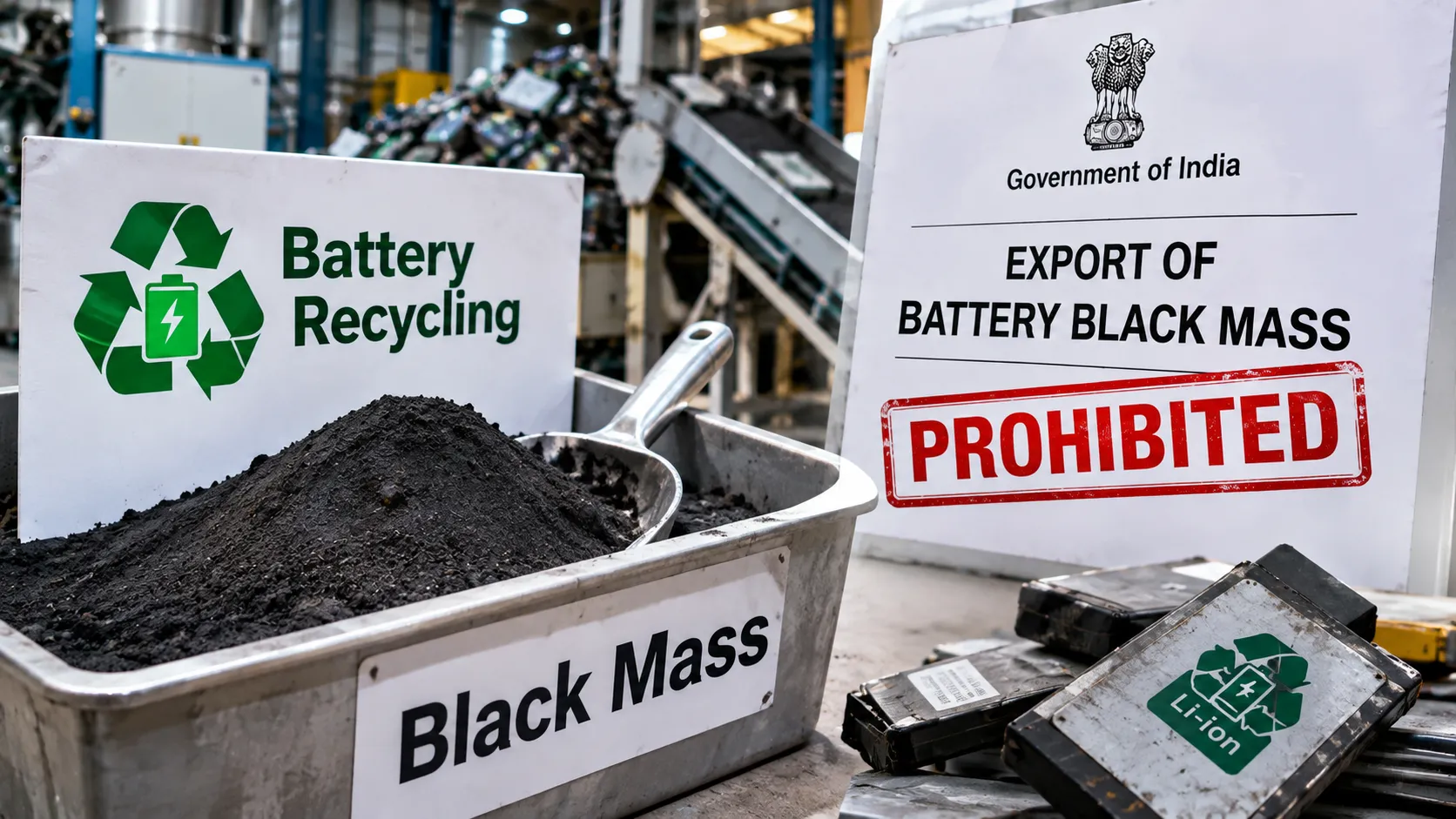
India's Directorate General of Foreign Trade on November 11 changed the export policy for lithium-ion battery black mass from "Free" to "Prohibited" with immediate effect. The powder, produced by shredding spent batteries, is rich in lithium, cobalt, nickel, manganese and graphite, and the move aims to keep critical minerals in the country and build a domestic battery recycling industry.

By Prathista Lazar · Author12 November 2026New
India Bans Exports of Lithium-Ion Battery Black Mass With Immediate Effect to Keep Critical Minerals at Home

India has banned the export of black mass, the mineral-rich powder produced when used lithium-ion batteries are shredded, in a move designed to keep valuable critical minerals in the country and accelerate the growth of a domestic battery recycling industry.

The Directorate General of Foreign Trade (DGFT), part of the Ministry of Commerce and Industry, issued a notification on Wednesday, November 11, amending the export policy for the material from "Free" to "Prohibited" with immediate effect, according to ANI. The policy was changed "with immediate effect, until further orders," the notification stated.

The ban covers products under ITC (HS) Code 85491400, which includes waste and scrap of primary cells, primary batteries and electric accumulators, including spent versions, according to ANI. It applies to unsorted material that does not contain lead, cadmium or mercury, a category identified as lithium-ion battery black mass. It is not a blanket ban on all battery-related exports.

The notification was issued under Section 3 read with Section 5 of the Foreign Trade (Development and Regulation) Act, 1992, and the Foreign Trade Policy, 2023.

What is black mass?

Black mass is a powder produced by dismantling, crushing and processing used lithium-ion batteries, such as those from smartphones, laptops and electric vehicles. It contains lithium, cobalt, nickel, manganese and graphite, which recyclers can recover through processes such as hydrometallurgy, in which chemicals are used to extract and purify the metals, according to ANI.

These minerals are essential for manufacturing new batteries. Recovering them from used batteries reduces the need for new mining, lowers costs and reduces dependence on imports. Black mass is therefore an intermediate product: it holds most of the value of a spent battery, but the minerals must still be extracted and refined.

Why India acted

Black mass "is rich in lithium, cobalt and nickel, which can be recovered and reused, reducing costs and foreign dependence," Inc42 noted. India has very limited domestic reserves of lithium, cobalt and nickel, and imports nearly all the critical minerals and battery cells it uses. As electric vehicle adoption grows, demand for these minerals will rise sharply.

Until now, many Indian recyclers have shredded batteries into black mass and exported it to countries with established refining capacity, particularly in East Asia, where the minerals are extracted and often used to make new battery materials. This meant India was exporting the most valuable part of its battery waste, only to import battery materials and cells later.

By banning exports, the government aims to ensure that the minerals in black mass are recovered domestically, supporting the development of refining and processing capacity. However, India's capacity for black mass extraction and refining is still limited, so capabilities must be built to capture its full value, according to Inc42.

Previous attempts to curb exports

The ban follows earlier efforts to restrict black mass exports. EV Reporter, an industry publication, has reported on government moves to tighten curbs on black mass exports and on allegations that some recyclers were finding ways to continue exporting the material. A full prohibition under a specific customs code is intended to close such gaps.

A global race for battery minerals

India's move reflects a global trend. Countries are increasingly treating black mass as a strategic resource. The United States has imposed restrictions on the export of black mass from recycling lithium-ion batteries, according to law firm Beveridge & Diamond, and China has adjusted its policies on imports of recycled battery materials.

“Every tonne of black mass that leaves India is a tonne of critical minerals the country will one day have to buy back.”
— TIGI Sustainability Desk

As governments seek to secure supply chains for electric vehicles and energy storage, control over battery recycling has become part of broader competition for critical minerals, which is dominated by China. China controls most of the world's refining capacity for lithium, cobalt and graphite, giving it significant leverage over global battery supply chains.

India's battery recycling industry

India has a growing battery recycling sector, including companies such as Attero, Lohum, Recyclekaro, BatX Energies and Exigo Recycling, many of which are investing in hydrometallurgical refining capacity to recover battery-grade materials. The ban could benefit companies that have invested in full recovery, by ensuring a steady domestic supply of black mass.

However, recyclers that have relied on exporting black mass may face challenges, at least in the short term, if domestic refining capacity is not sufficient to absorb all the material. Prices for black mass in India could fall if supply exceeds domestic demand, affecting the economics of collection and shredding.

India's Battery Waste Management Rules require producers to ensure the collection and recycling of batteries they sell, under an extended producer responsibility framework, and set targets for the recovery of materials. The export ban complements these rules by keeping recovered materials in the country.

fda26bce-6c26-4d25-96c7-12f9b1e9ca18.png

The electric vehicle connection

India's electric vehicle market is growing rapidly, led by two-wheelers and three-wheelers, with electric cars and buses also gaining ground. As the first generation of EV batteries reaches the end of its life, the volume of battery waste will increase significantly over the next decade. Building recycling capacity now will help India manage that waste and recover materials for new batteries.

The government's production-linked incentive scheme for advanced chemistry cell batteries aims to build domestic battery manufacturing. A domestic supply of recycled minerals could support these manufacturers and reduce their dependence on imports.

Environmental benefits

Battery recycling has significant environmental benefits. It reduces the need for mining, which can cause habitat destruction, water pollution and high carbon emissions. It also prevents batteries from ending up in landfills, where they can leak toxic substances or cause fires.

However, recycling itself must be done safely. Hydrometallurgical processes use chemicals that must be handled and disposed of carefully, and informal recycling of batteries can expose workers to hazardous materials. Strong regulation and investment in formal recycling facilities are essential.

Challenges ahead

Building a domestic refining industry will require investment, technology and skilled workers. Refining battery minerals to the purity required for new batteries is technically demanding, and companies must compete with established refiners in China and elsewhere. The government may need to support the industry with incentives, standards and infrastructure.

Industry participants will also seek clarity on how the ban will be enforced and whether sorted or processed materials will be treated differently from unsorted black mass.

What comes next

Recyclers, battery makers and investors will watch how quickly India's refining capacity expands to absorb domestic black mass, and whether the government introduces further measures to support the industry. The ban marks a clear signal that India intends to treat its battery waste as a strategic resource rather than a commodity to be shipped abroad.

Tagsblack masslithium-ion batteriesbattery recyclingDGFTexport bancritical mineralslithiumcobaltnickelgraphiteelectric vehiclescircular economye-wastebattery waste management ruleshydrometallurgyMake in Indiaenergy transitionsupply chainssustainabilityinvestors

Reader reviews

Sign in to rate and review this article.
Loading reviews…

