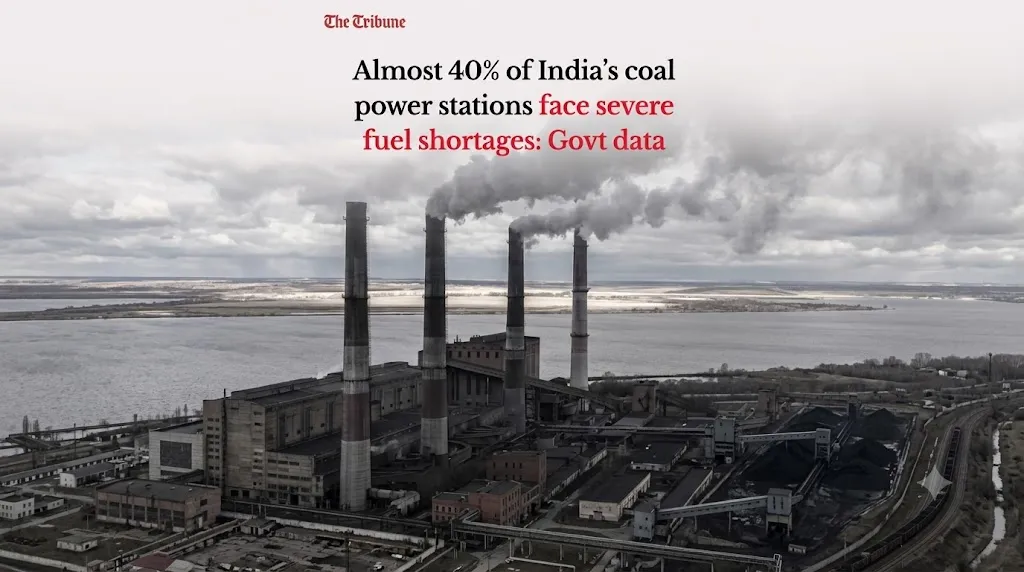
India's power system is heading into the festive season with thinner coal buffers than planners would like. As of 26 September, 77 of the country's 190 thermal power plants were holding critically low coal stocks, according to data reported by Business Standard. Total inventory at plants had fallen to 21.98 million tonnes, a decline of roughly 24 per cent from about 29 million tonnes at the end of August. That is enough to keep the fleet running for around seven days, and it represents just 37 per cent of the stock levels that plants are required to maintain.
Around half of India's thermal plants now hold less than a quarter of their required reserves. Two days earlier, on 24 September, the count of plants in the critical category stood at 80, so the position has stabilised slightly, but the aggregate cover remains uncomfortably low for a grid that relies on coal for the bulk of its electricity.
Why stocks are falling
The squeeze is the product of strong demand meeting weaker support from other sources. Peak electricity demand reached 269 gigawatts on 10 September, the highest September reading on record, close to the annual peak of 270 GW set in May. Night-time shortfalls, when solar output drops away, exceeded 7 GW at points during the month.
At the same time, a weak monsoon has cut into hydropower. Generation from hydro plants fell 12 per cent year-on-year in early September, a direct consequence of an El Niño-affected rainy season that left reservoirs lower than usual. With less water and no sun after dark, the grid has leaned harder on coal. Coal-fired generation rose 18 per cent in September and is up 11 per cent for the year to date.
The result is a familiar pattern: plants burn coal faster than it arrives. India's problem is rarely coal in the ground. Coal India and captive miners have raised output substantially over the past five years. The pinch point is usually getting the fuel from pitheads to power stations quickly enough, which depends on railway rakes, loading capacity, and the stocking decisions of generators and distribution companies trying to manage working capital.
Government invokes emergency powers
The Centre has moved to add supply to the grid. It has invoked Section 11 of the Electricity Act, which allows the government to direct generating companies to operate in a specified manner in extraordinary circumstances. Under the order, around 112 captive coal-fired power plants with capacity of 50 megawatts or more must run at maximum capacity from 1 October to 31 December.
Captive plants are typically owned by industrial companies such as steel, aluminium and cement producers to power their own operations. Requiring them to generate at full capacity, and to supply surplus power to the grid, frees up capacity at a time when utility-scale plants are managing tight inventories. The approach has been used before, most notably during the 2021 and 2022 supply crunches, and it signals that policymakers want a margin of safety through the festive and post-monsoon period.
A logistics issue, analysts say
Not everyone reads the numbers as a warning of an imminent crisis. Anujesh Dwivedi of Deloitte India described the situation as "more of a temporary logistics and inventory problem" than a structural supply shortfall. History supports that interpretation to a degree. In October 2023, stocks fell to about 7.5 days of cover before recovering, and in September 2021 they dropped to just four days amid wider supply disruptions, prompting emergency measures and scattered outages in several states.