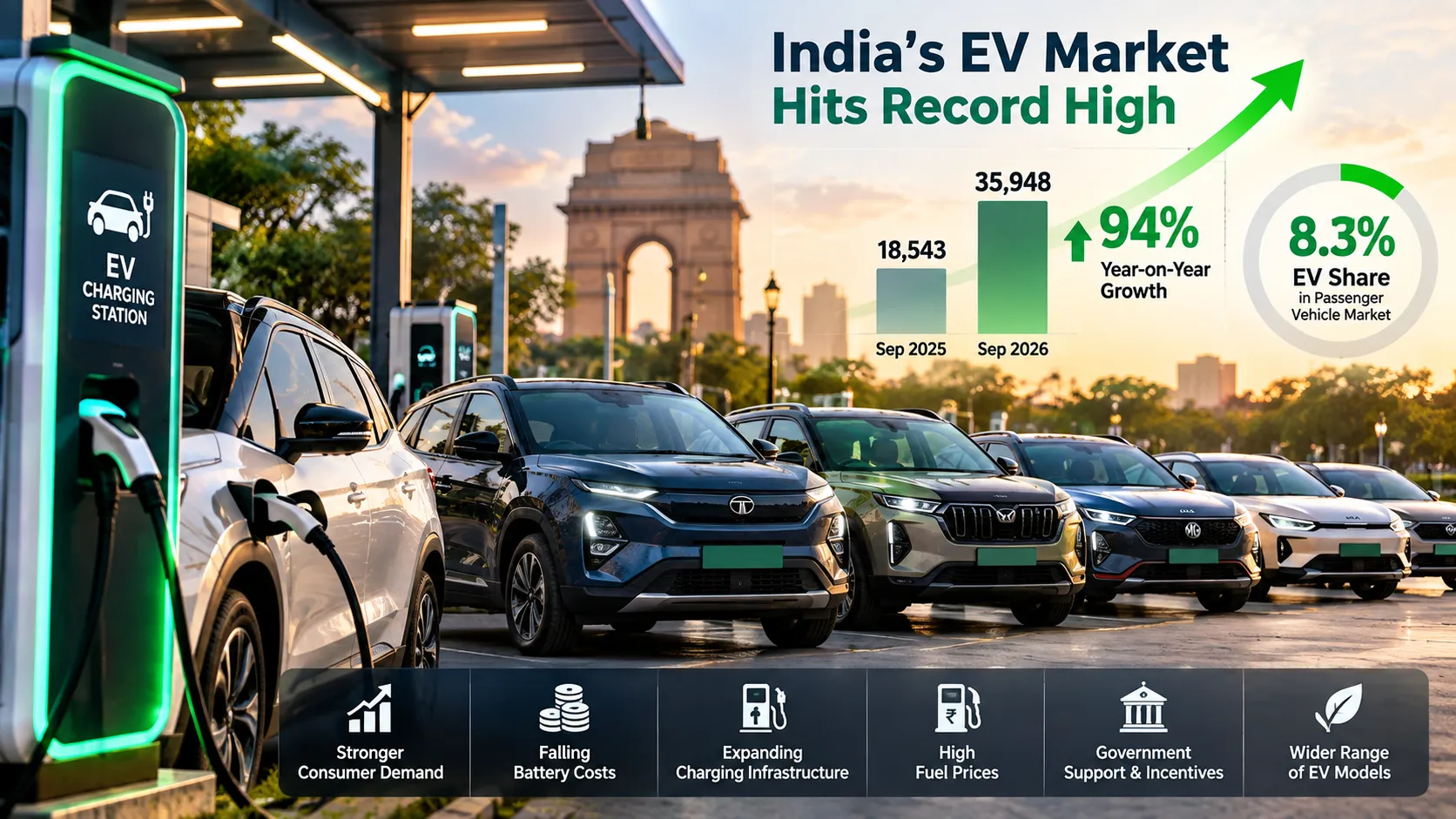
India's electric car market posted its strongest month on record in September, with registrations nearly doubling from a year earlier and battery-powered models accounting for a larger slice of new passenger vehicles than ever before.
Electric passenger vehicle registrations rose 94% year on year to 35,948 units in September 2026, according to government Vahan data compiled by brokerage Nuvama and reported on 2 October. That took EV penetration to 8.3% of the passenger vehicle market, up from 7.6% in August. Put simply, roughly one in every 12 passenger vehicles registered in the country last month was electric.
September registrations were also 11% higher than August's 32,433 units. Industry tallies differ slightly depending on cut-off dates and methodology; retail data cited by Autocar India put the September total at 35,995 units, describing it as the fourth straight month above 30,000.
For the first half of the fiscal year, April to September, electric car registrations reached 1,91,751 units, an 89% increase from 1,01,546 a year earlier.
Tata extends its lead, Mahindra closes the gap
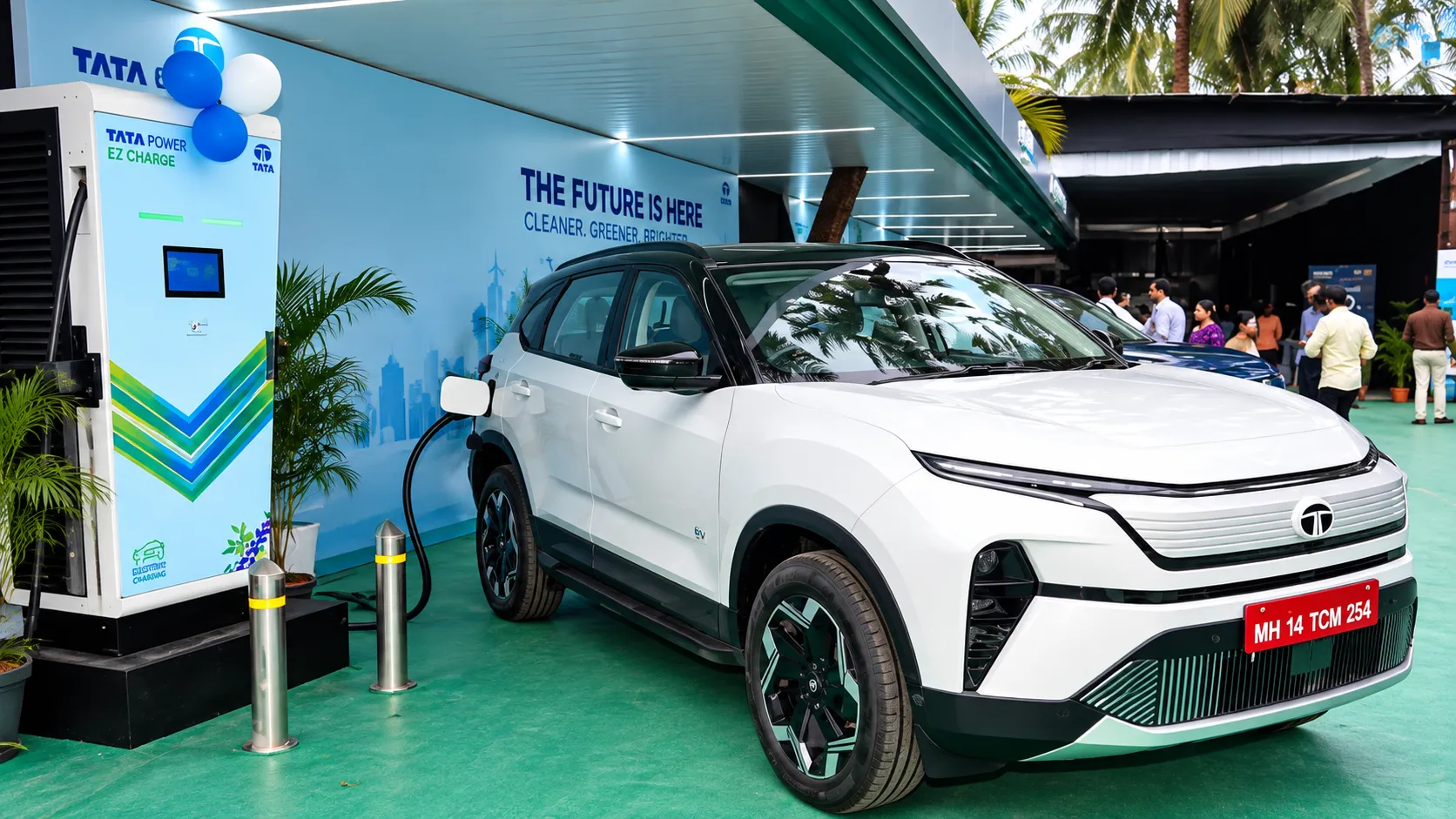
Tata Motors remained the clear market leader. It registered 14,722 electric passenger vehicles in September, double its volume a year ago and 7% higher than August, according to the Vahan-based data. Its market share stood at about 41%, slightly lower than the 42.6% it held in August but above the 39.7% it held in September 2025.
The company has been refreshing its electric line-up throughout the year. It launched a facelifted Punch EV in January, the Sierra EV in June, an updated Tiago EV in August and the Aeris EV in September. In the first half of the fiscal year, Tata registered 76,580 electric passenger vehicles, up 102%.
Mahindra & Mahindra was the strongest challenger. It registered 7,741 electric vehicles in September, up 116% year on year and 14% higher than August. Its first-half registrations climbed 120% to 43,677 units, lifting its share of the electric segment to 22.8% from 19.5% a year ago. Together, Tata and Mahindra accounted for nearly 63% of electric passenger vehicle registrations in the month.
JSW MG Motor India, which had built a strong position with the Windsor EV, remained a significant player but grew more slowly than the two domestic leaders. Kia moved into fifth place, overtaking Maruti Suzuki, after its electric sales more than doubled from a year earlier.
New entrants reshape the premium end
The month also highlighted how quickly new brands are building a presence. Vietnamese automaker VinFast registered 2,960 vehicles in September, compared with just six units a year earlier, according to one industry tally. In the luxury segment, Tesla moved ahead of Mercedes-Benz in electric sales, a sign that the American company's entry into India is beginning to register in the numbers even though its volumes remain small relative to the mass market.
The wider EV picture
The passenger car figures are part of a broader surge. Total electric vehicle registrations across all segments reached an all-time high of about 3.3 lakh units in September, the fourth consecutive month above the 3 lakh mark. Electric two-wheelers remain the backbone of the market by volume, while electric three-wheeler registrations rebounded to more than 86,000 units.
The two-wheeler segment has its own competitive story. Industry data released at the start of October showed electric two-wheeler registrations recovering month on month in September, with legacy manufacturers such as TVS Motor, Bajaj Auto and Hero MotoCorp gaining ground while startup players Ather Energy and Ola Electric lost market share.
What is driving demand
Several forces appear to be working together. Manufacturers have widened their electric line-ups across price points, giving buyers more choice than at any time in the past. Battery costs have come down over recent years, narrowing the price gap with petrol and diesel models. Charging infrastructure, while still patchy outside large cities, has expanded steadily.
Fuel prices have also played a role. India has faced an expensive year for oil, with global crude prices pushed higher by disruptions linked to the West Asia conflict. Higher running costs for conventional vehicles strengthen the economic case for EVs, particularly for buyers who drive long distances or use vehicles commercially.
The festive season provides an additional lift. September and October are traditionally strong months for vehicle purchases in India, and automakers typically time launches and promotions to coincide with Navratri and Diwali. ## Policy signals behind the shift
Government policy has nudged the market along without relying on large purchase subsidies for private cars. The PM E-DRIVE scheme, which succeeded the earlier FAME programme in 2024, focuses incentives on electric two-wheelers, three-wheelers, buses and public charging infrastructure. A production-linked incentive scheme for advanced chemistry cell batteries aims to localise the most expensive component of an EV, and a separate scheme allows global carmakers that commit to manufacturing investment in India to import a limited number of electric cars at lower duty.
States have added their own measures, including road tax waivers and registration fee exemptions in several large markets. The combined effect is to lower the total cost of ownership for buyers while encouraging manufacturers to build supply chains locally. Analysts expect the competitive pressure from new entrants to push automakers to localise more components, which over time should bring prices down further and widen the pool of buyers beyond early adopters in big cities. Used-car and fleet markets are also starting to take electric vehicles more seriously. Ride-hailing and corporate fleet operators have expanded electric fleets in several cities, attracted by lower running costs, and a growing pool of second-hand EVs is beginning to give budget-conscious buyers a cheaper entry point.
The road ahead
At 8.3%, India's electric share of passenger vehicles remains well below that of China and several European markets, but the trajectory has changed decisively. A market that was a niche for early adopters only a few years ago is now posting consistent monthly volumes above 30,000 units, and growth is outpacing the overall car market by a wide margin.
The question for the industry is whether this momentum can be sustained beyond the festive season and broaden beyond the large metros. Wider charging access on highways and in smaller cities, clearer long-term policy on incentives, and affordable financing will all matter. So will battery supply, given that much of India's cell requirement is still imported, even as domestic cell manufacturing capacity is being built under government incentive schemes.
For now, the September data offers manufacturers, investors and policymakers a clear signal: Indian consumers are moving to electric cars faster than many forecasts anticipated, and the competitive battle for that growing market is intensifying.