India's transition to electric two-wheelers reached a new high in October, as festive demand pushed registrations of electric scooters and motorcycles to a record. But the month also highlighted a dramatic reshaping of the market, with established manufacturers pulling ahead of the startups that pioneered the segment.
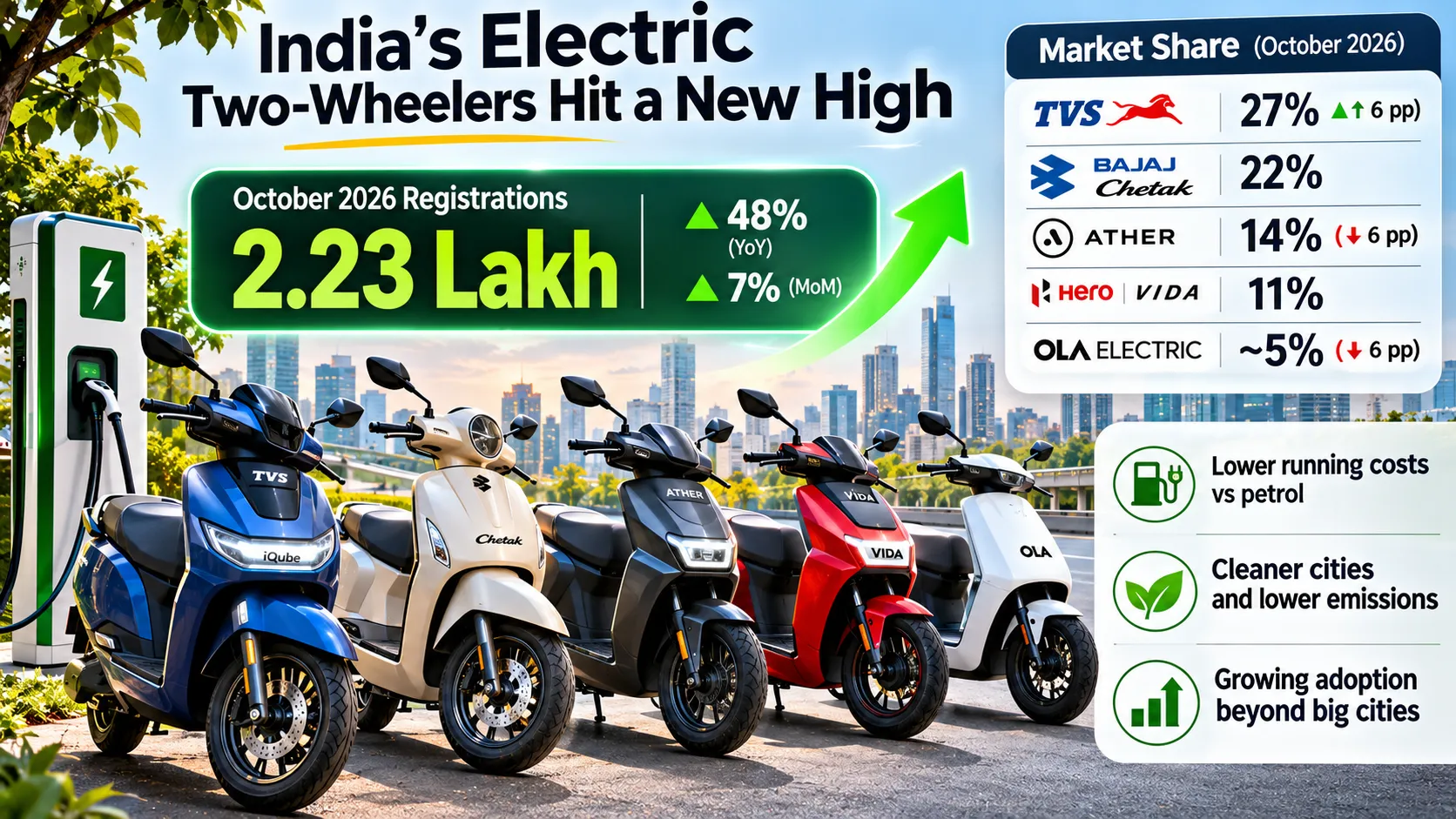
Electric two-wheeler registrations reached a record 2.23 lakh units in October 2026, up 48% from a year earlier and 7% from September, according to Autocar India on Sunday, November 1.
TVS takes a commanding lead
TVS Motor Company led the market with 60,429 units, up 94% from a year earlier, giving it a market share of 27%, up six percentage points, according to Autocar India. Its iQube electric scooter has become one of the best-selling EVs in the country, supported by TVS's extensive dealer network and reputation for reliability.
Bajaj Auto's Chetak was second with 49,067 units, up 51%, and a 22% market share. Ather Energy, the Bengaluru-based electric scooter pioneer, was third with 31,796 units, up 5%, though its market share fell to 14% from 20%. Hero MotoCorp's Vida brand was fourth with 29,901 units, up 81%, and an 11% share.
Ola's decline
Ola Electric, which was once the market leader, sold 12,096 units, down 26% from a year earlier, according to Autocar India. It was the only manufacturer among the top ten to record a decline, and its market share fell by six percentage points.
Ola Electric has faced a difficult period, with customer complaints about service and product quality, regulatory scrutiny and intense competition from established manufacturers. The company recently completed a ₹1,000 crore rights issue to strengthen its finances, and SoftBank has reduced its stake. Its shares have been volatile, reflecting investor uncertainty about its turnaround.
Incumbents strike back
The rise of TVS, Bajaj and Hero in electric two-wheelers represents a significant shift. When the electric scooter market began to take off, startups such as Ather and Ola led the way, attracting large venture capital investments and capturing early adopters. Established two-wheeler makers were initially slower to launch electric models.
Over the past two years, however, the incumbents have caught up, using their manufacturing scale, supply chains, dealer networks and brand trust to win customers. Buyers in smaller towns and cities, in particular, value the service networks and familiarity of established brands.
Ather's profitability milestone
Ather Energy, despite losing market share, recently reported its first quarterly profit, with scooter sales rising and revenue climbing strongly. The company has expanded beyond its southern Indian base into new markets and introduced more affordable models, including the Rizta family scooter. Its focus on technology, charging infrastructure and premium positioning has helped it maintain a loyal customer base.
The festive boost
October's record reflects the festive season, when Indians traditionally buy vehicles. Electric two-wheeler makers offered discounts and financing schemes to attract buyers, and rising petrol prices made the lower running costs of electric scooters more attractive. Petrol prices were raised by about ₹7.50 a litre in May.
Government support
The government's PM E-DRIVE scheme provides subsidies for electric two-wheelers, three-wheelers, buses and charging infrastructure. Subsidies have been reduced over time as the market has matured, and the industry has had to adjust to lower incentives. State governments also offer incentives, including road tax waivers.


