
India's microfinance industry, which provides small loans to millions of low-income households, most of them headed or run by women, is going through its most difficult period in years. Funding pressures, tighter regulation and the lingering effects of a wave of defaults are shrinking the sector, and industry leaders warn there may be no quick recovery.
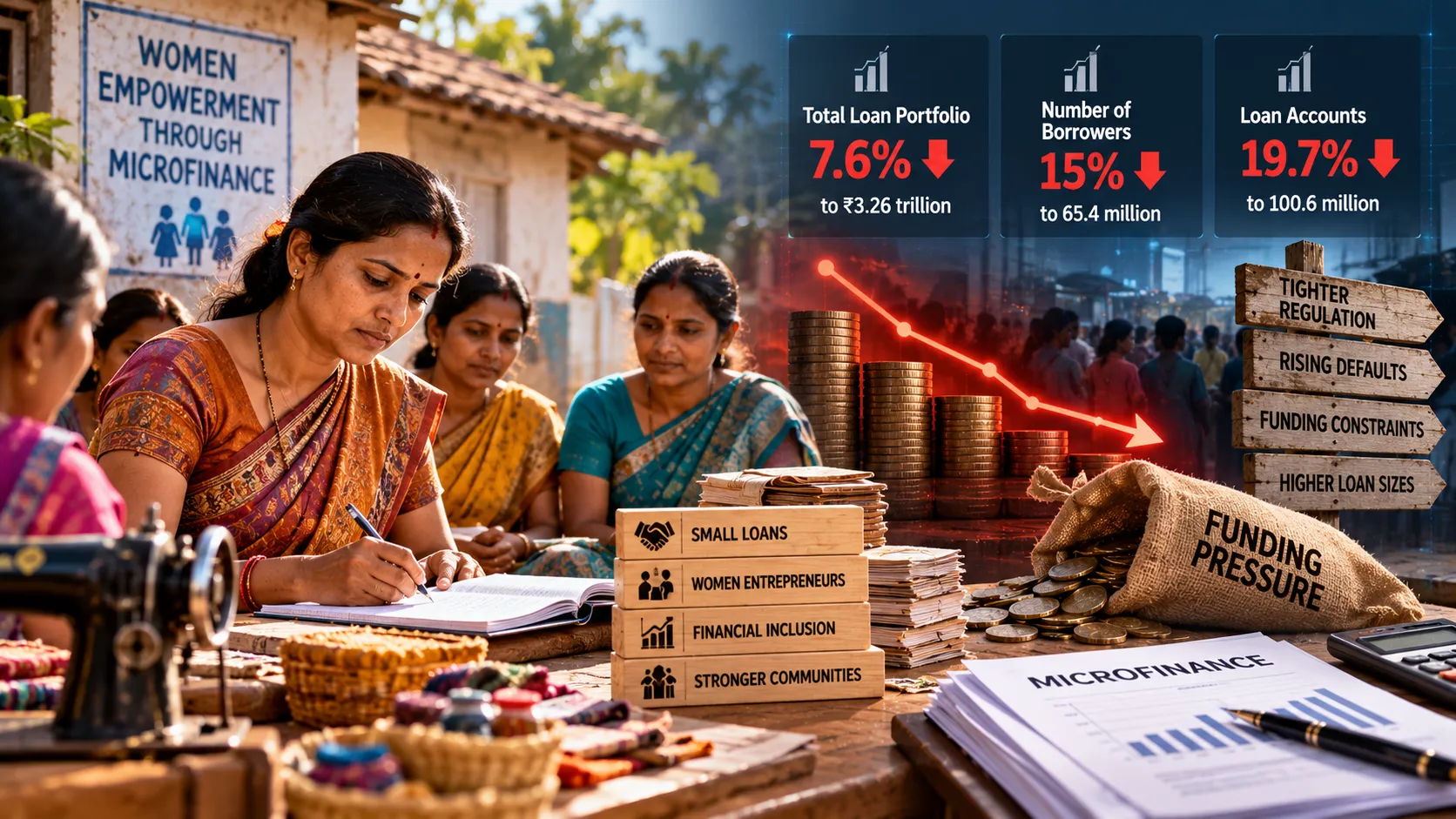
According to data from Sa-Dhan, the self-regulatory organisation for the microfinance industry, the industry's total loan portfolio fell 7.6% year on year to ₹3.26 trillion at the end of June 2026. The number of borrowers fell 15% to 65.4 million, and the number of loan accounts dropped 19.7% to 100.6 million. A Business Standard report on October 18 described lenders as having to "grin and bear" the situation for some time.
The decline matters far beyond the balance sheets of lenders. Microfinance has been one of India's most important tools for financial inclusion, and its borrowers are overwhelmingly women, who use small loans to run tailoring units, small shops, dairy and poultry businesses and other micro-enterprises that support their families.
Fewer borrowers, bigger loans
While the number of borrowers has fallen, the average loan size has risen. The average ticket size increased 15% to ₹62,962, reflecting a shift towards larger loans to existing, creditworthy customers.
Part of that change stems from regulation. Guardrails in the sector now cap the number of lenders a microfinance borrower can have at three, a measure introduced to prevent over-indebtedness after many borrowers took loans from multiple lenders and struggled to repay. Wilfred Sigler, managing director of credit bureau Equifax India, said borrowers now want to meet all their funding needs within the three-lender limit, and lenders are phasing out the smallest loans of ₹25,000 to ₹50,000.
The result is that the smallest, newest and riskiest borrowers, often women seeking their first formal loan, are finding it harder to access credit.
Legacy defaults weigh on lenders
Asset quality remains a major concern. Loans overdue by more than 180 days rose 440 basis points to 17.4% of the portfolio. Industry officials say newer loans are performing better, but older defaulted loans remain on lenders' books.
The stress traces back to a period of rapid lending growth after the pandemic, when some borrowers took on more debt than they could manage. Repayment problems in several states led to rising defaults in 2024 and 2025, prompting lenders to tighten credit and regulators and industry bodies to impose stricter rules.
The pressure has been uneven across types of lenders. Banks' microfinance portfolios stood at ₹79,023 crore, a 29.8% share of the market. Small finance banks' portfolios fell 9.4% to ₹48,759 crore. Dedicated microfinance NBFCs grew 5.2% to ₹46,884 crore, suggesting specialised lenders are regaining some ground.
Funding dries up for smaller lenders
Small and mid-sized microfinance institutions say their biggest problem is access to funding. Manoj Kumar Nambiar, managing director of Arohan Financial Services, said funding to smaller MFIs has been subdued, as banks have become cautious about lending to the sector after the rise in defaults. He proposed solutions including funding through larger NBFCs, securitisation of loan portfolios and a credit guarantee scheme to restore banks' confidence.


