India's path to cleaner road transport is increasingly being framed not as a single-technology race toward electric vehicles, but as a deliberately multi-fuel strategy combining EVs with ethanol blending and biofuels — an approach industry body the Society of Indian Automobile Manufacturers reaffirmed at its sixth International Conference on climate action, convened around this year's World Environment Day theme, “Inspired by Nature. For Climate. For Our Future.”
The rationale, according to policy analysts and industry groups including the Indian Federation of Green Energy, rests on India's distinct starting conditions: electric vehicles represented roughly 4 percent of new passenger car sales in India in 2025, compared with nearly 55 percent in China, 27 percent in the European Union and 10 percent in the United States, according to the International Energy Agency's Global EV Outlook 2026 — a gap driven partly by charging infrastructure limitations and partly by the sheer scale and diversity of India's vehicle fleet, spanning everything from two-wheelers to heavy commercial trucks with very different electrification economics.
Ethanol, in this framework, functions less as a competitor to electrification and more as a transition fuel that can deliver emissions reductions across India's existing internal combustion vehicle fleet without requiring wholesale fleet replacement — a particularly relevant consideration given India's ambitious 20 percent ethanol-blending target for petrol. Two-wheelers and three-wheelers, by contrast, offer what analysts describe as the strongest near-term economic case for direct electrification, given shorter average travel distances, lower operating costs and steadily declining battery prices; sales data bears this out, with two-wheeler EV sales reaching an all-time monthly high of around 191,000 units in March 2026, covering close to 9.8 percent market share even as crude oil price volatility linked to conflict in West Asia added urgency to the broader push away from imported fossil fuels.
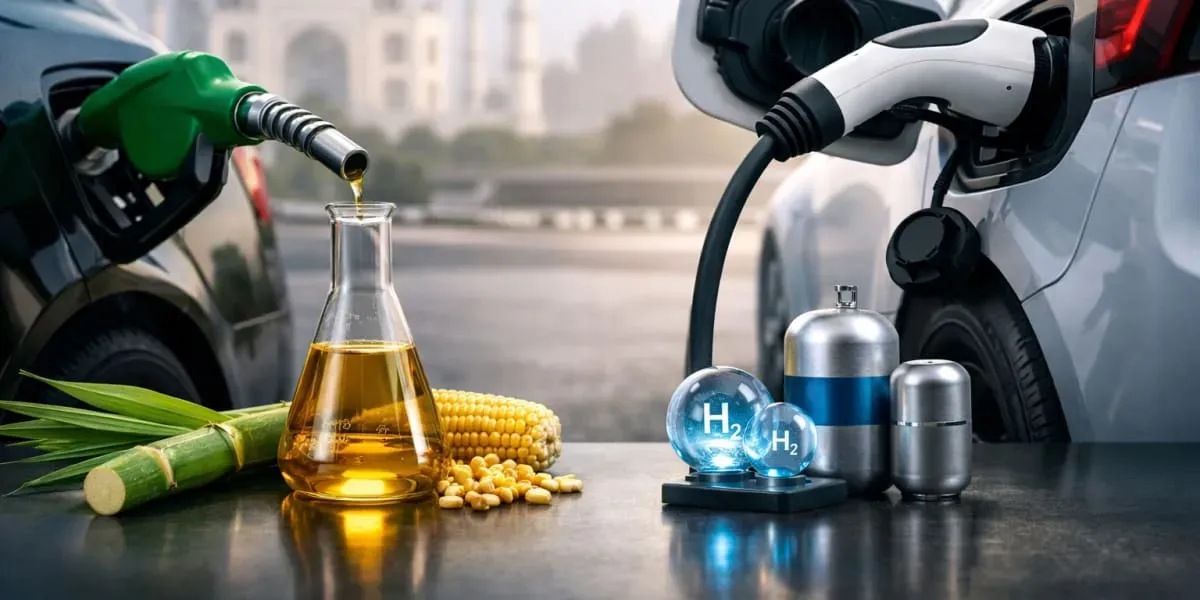
For heavier vehicle categories, the multi-fuel logic extends further: diesel is expected to remain dominant for buses and heavy goods vehicles for the remainder of this decade given the current economics of battery electric trucking, with biofuels offering an interim emissions reduction path, while green hydrogen is positioned as the longer-term solution for heavy-duty applications once production costs and refuelling infrastructure mature. India's EV market itself, valued at roughly $3.71 billion in 2025, is projected by industry analysts to expand to as much as $191 billion by 2034 as battery costs fall and charging infrastructure — already exceeding 27,000 public chargers nationally — continues to scale.
Government policy has moved to support the broader transition on multiple fronts simultaneously: a reduction in the goods and services tax on small cars from 28 percent to 18 percent is expected to boost affordable-segment demand generally, while forthcoming Corporate Average Fuel Efficiency standards for 2027-2032 and 2033-2037 are designed to tighten emissions requirements progressively rather than mandating a single compliance technology, explicitly preserving room for ethanol-blended, hybrid and electric pathways to coexist within the regulatory framework rather than picking a single technological winner.
For India's automotive sector, which accounts for roughly 7.1 percent of GDP and nearly half of manufacturing GDP, the multi-fuel approach reflects a pragmatic calculation: rather than importing a single-technology transition model designed for markets with very different vehicle fleets, charging infrastructure and manufacturing bases, India's policymakers and industry are betting that a diversified mix of ethanol, hybrid and electric pathways — layered across different vehicle categories according to where each technology's economics currently work best — offers a more realistic route to the country's 2070 net-zero commitment than a rigid, EV-only mandate would.