
ImpactStories5 MIN READ

India Post Crosses ₹4,000 Crore in Revenue for a Second Straight Quarter as Parcels Surge 71%

India Post earned ₹4,202 crore in the July-September quarter, up 25% from a year earlier, the first time in its history it has crossed ₹4,000 crore in two successive quarters, Communications Minister Jyotiraditya Scindia said. Parcel revenue grew 71%, life insurance 44% and international business 38%, while its expenditure coverage ratio improved to 62%.

By Prathista Lazar · Author23 October 2026New
India Post Crosses ₹4,000 Crore in Revenue for a Second Straight Quarter as Parcels Surge 71%

India Post, one of the world's largest postal networks and among the oldest public institutions in the country, is reinventing itself as a logistics and financial services business, and the numbers are beginning to show it.

The Department of Posts earned revenue of ₹4,202 crore in the July-September quarter, up 25% from ₹3,355 crore a year earlier and almost 5% higher than the previous quarter, Communications Minister Jyotiraditya Scindia said on Thursday, October 22, according to PTI.

"This is the first time in the history of India Post that we have breached the ₹4,000 crore mark for two successive quarters," Scindia said.

Parcels lead the growth

The strongest growth came from parcels, where revenue rose 71% from a year earlier. Postal Life Insurance and Rural Postal Life Insurance grew 44%, and international business rose 38%.

For the first half of the fiscal year, revenue grew to about ₹8,213 crore from roughly ₹6,500 crore a year earlier, an increase the minister described as almost 24%.

The department's expenditure coverage ratio, which measures how much of its costs are covered by revenue, excluding pensions, rose to 62% from 54% in the second quarter of last year, an improvement of almost eight percentage points. "Our measure of expenditure coverage ratio (ECR) has gone up to 62 per cent, excluding pension," Scindia said.

He singled out the Bihar, West Bengal and North East postal circles for exceeding expectations across the board.

A network like no other

India Post operates more than 1.5 lakh post offices, the vast majority of them in rural areas, making it one of the most extensive physical networks in the world. For many villages, the post office is the most accessible government institution, offering mail, savings accounts, insurance, pension payments and other services.

For decades, however, the department has run at a significant loss, with costs, including salaries and pensions for a large workforce, far exceeding revenue. The decline of traditional letter mail, as communication moved to phones and the internet, eroded a key revenue source.

The department's reform strategy has focused on turning that physical network into a competitive advantage in growing markets, particularly parcel delivery and financial services.

Riding the e-commerce wave

The surge in parcel revenue reflects India's e-commerce boom. Online shopping has spread rapidly beyond big cities to smaller towns and villages, creating demand for reliable delivery to remote areas that private logistics companies often find costly to serve.

India Post's reach gives it an advantage in last-mile delivery to these areas. The department has partnered with e-commerce companies, upgraded its parcel processing infrastructure and introduced new services aimed at businesses, including small sellers and exporters.

The growth of international business also reflects its role in cross-border shipping, including for small exporters using postal channels to send goods abroad.

Insurance and financial inclusion

Postal Life Insurance, established in 1884, is one of the oldest life insurance schemes in India, and Rural Postal Life Insurance extends coverage to rural populations. The 44% growth in this segment suggests the department is successfully using its network to sell insurance products.

India Post also plays a central role in financial inclusion through its savings schemes and India Post Payments Bank, which offers basic banking services through post offices and postal workers, including doorstep banking. These services are particularly important for rural households and those without easy access to commercial bank branches.
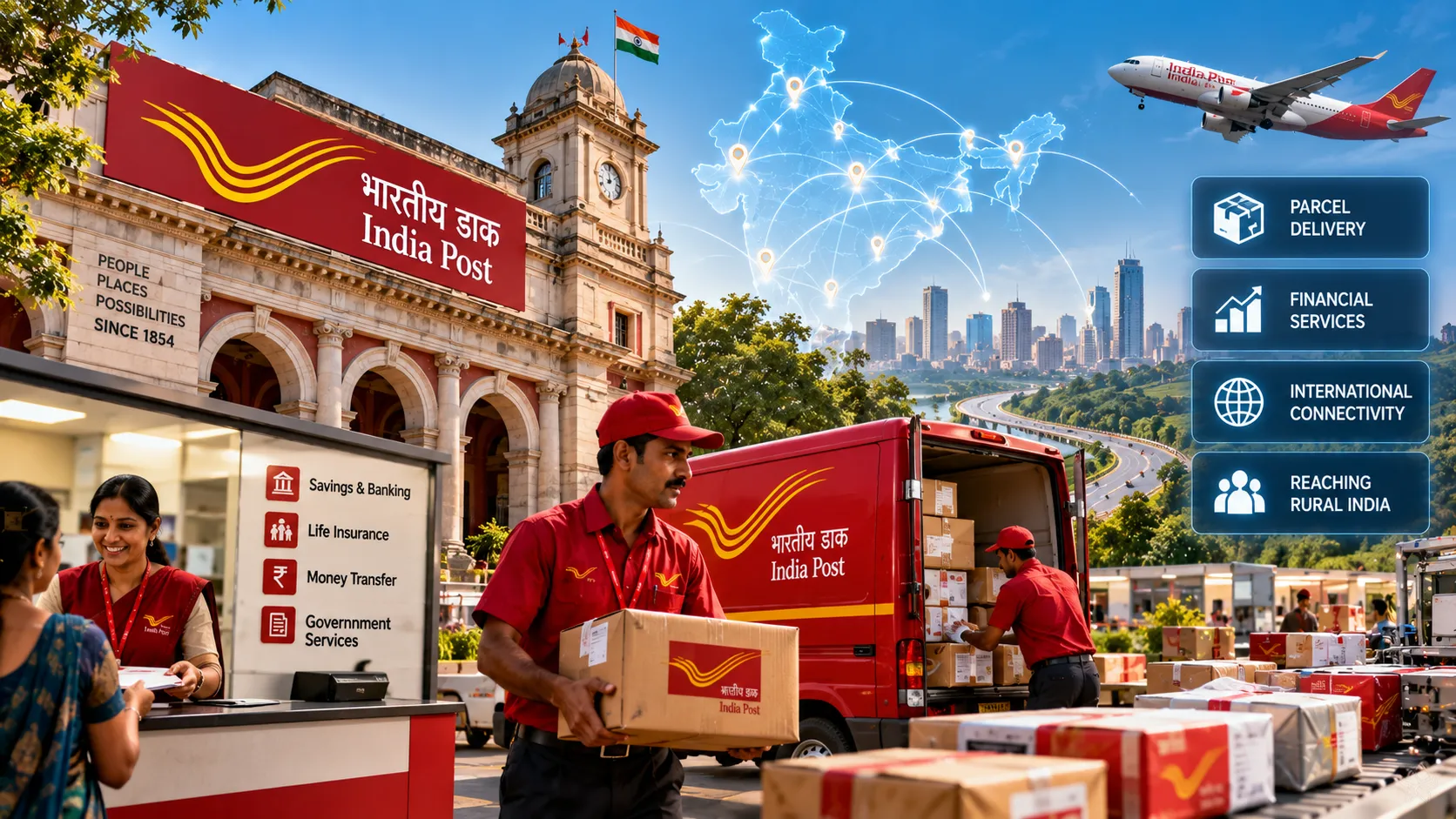

“This is the first time in the history of India Post that we have breached the ₹4,000 crore mark for two successive quarters.”
— Jyotiraditya Scindia, Union Communications Minister
dd55e88e-cd25-4779-83d3-c0502243a8e9.png

Why it matters for reform of public enterprises

India Post's turnaround efforts are being closely watched as an example of how government-run institutions can modernise. Unlike many state enterprises, the department is not being privatised but is instead being pushed to operate more commercially, using its assets to compete in growing markets.

The improvement in the expenditure coverage ratio is significant, as it shows the department is reducing its reliance on government support. However, at 62%, costs still significantly exceed revenue, and pension liabilities remain a major burden.

The competition

India Post faces strong competition in parcels from private logistics companies such as Delhivery, Blue Dart, Xpressbees and Shadowfax, as well as in-house logistics operations of e-commerce giants like Amazon and Flipkart. These companies have invested heavily in technology, automation and speed.

To compete, India Post needs to keep improving delivery times, tracking, customer service and digital integration with e-commerce platforms. The department has invested in technology, including digital tracking and automated sorting, but further modernisation will be needed.

A history spanning centuries

India Post traces its origins to the colonial era, with the modern postal system established in the 19th century. For much of its history, it was the primary means of long-distance communication for most Indians, delivering letters, money orders and telegrams to every corner of the country.

The department's money order service was once a lifeline for migrant workers sending money home to their families. Today, digital payments have largely replaced that function, but India Post has adapted by offering banking services through India Post Payments Bank, which uses postal workers to deliver financial services to doorsteps, including Aadhaar-enabled payments.

Digital transformation

The department has undertaken a large-scale technology modernisation programme, including core banking and insurance systems, digitised post offices and handheld devices for postal workers. These investments are intended to improve efficiency, enable real-time tracking and support new services.

India Post has also been designated to deliver various government services, from passport services at post office counters to distribution of government benefits. Its trusted presence makes it a natural channel for such services, particularly in rural areas.

What comes next

The government has signalled that it wants India Post to become a modern logistics and services organisation. Continued growth in parcels and financial services will be key to improving its finances further.

For rural India, a stronger India Post could mean better access to e-commerce, insurance and banking. For the government, it offers a model of how an old institution can find new relevance in a digital economy. Sustaining the current pace of growth will require continued investment in technology, logistics capacity and customer service. If the department can maintain double-digit revenue growth while controlling costs, it could further reduce its dependence on budgetary support, freeing public resources for other priorities. Its turnaround, if sustained, would rank among the more notable reforms of a public institution in India.

TagsIndia PostDepartment of PostsJyotiraditya Scindiaparcelslogisticse-commercePostal Life InsuranceRural Postal Life InsuranceIndia Post Payments Bankpublic sector reformrural Indiafinancial inclusiongovernment serviceslast-mile deliveryinternational mailBiharWest BengalNorth Eastpostal networkpublic enterprises

Reader reviews

Sign in to rate and review this article.
Loading reviews…