India is facing its most serious electricity squeeze in years, and it is happening after the sun goes down. A combination of weak hydropower output, low coal stocks, hot weather and a lack of storage for solar power has left several states struggling to meet evening demand, according to reports published by Business Standard on October 20.
India's power deficit reached 560 million kilowatt-hours in September 2026, the highest since August 2023, according to Reuters data cited by Business Standard. Rajasthan, Gujarat, Maharashtra, Tamil Nadu, Andhra Pradesh, West Bengal, Uttar Pradesh, Chhattisgarh and Delhi have asked the central government for additional power allocations to avoid cuts, especially at night.
The shortages highlight a structural challenge for India's energy transition: the country has added renewable capacity rapidly, but solar power disappears in the evening, when demand remains high.
States scramble for supply
Gujarat hit a record power demand of 29,822 megawatts on October 16, according to The Indian Express, and secured extra supply through central allocations and other sources. In Punjab, demand exceeded supply by about 800 to 1,000 MW during the paddy-growing season.
Tamil Nadu plans to buy about 1,500 MW of short-term power between October 15 and 31 at prices of up to ₹37 per unit during evening peak hours, because demand is high and wind generation has fallen short. Even Madhya Pradesh, normally a power-surplus state, arranged additional supply from Punjab and Uttar Pradesh.
The central government typically has about 14 to 15 gigawatts of coal and hydropower capacity available to allocate to states during shortages, but much of it had already been allocated by October, according to Reuters.
Why supply is falling short
Several factors have combined to create the crunch. Hydropower generation fell 20% year on year in September, as lower rainfall linked to the El Niño weather pattern reduced water in reservoirs, while coal-fired generation rose 13.3% to compensate.
Coal stocks are a major concern. About 47% of India's coal-fired plants had critically low fuel stocks, below a quarter of their mandated levels, according to Grid India data cited in the report. By mid-September, plants held about a week's worth of coal, half the level of a year earlier, according to a separate Business Standard analysis. Disruptions to coal mining and rail transport have added to the pressure.
Hotter-than-usual weather has sustained demand for cooling and irrigation, and plant maintenance has further reduced available capacity.
The evening problem
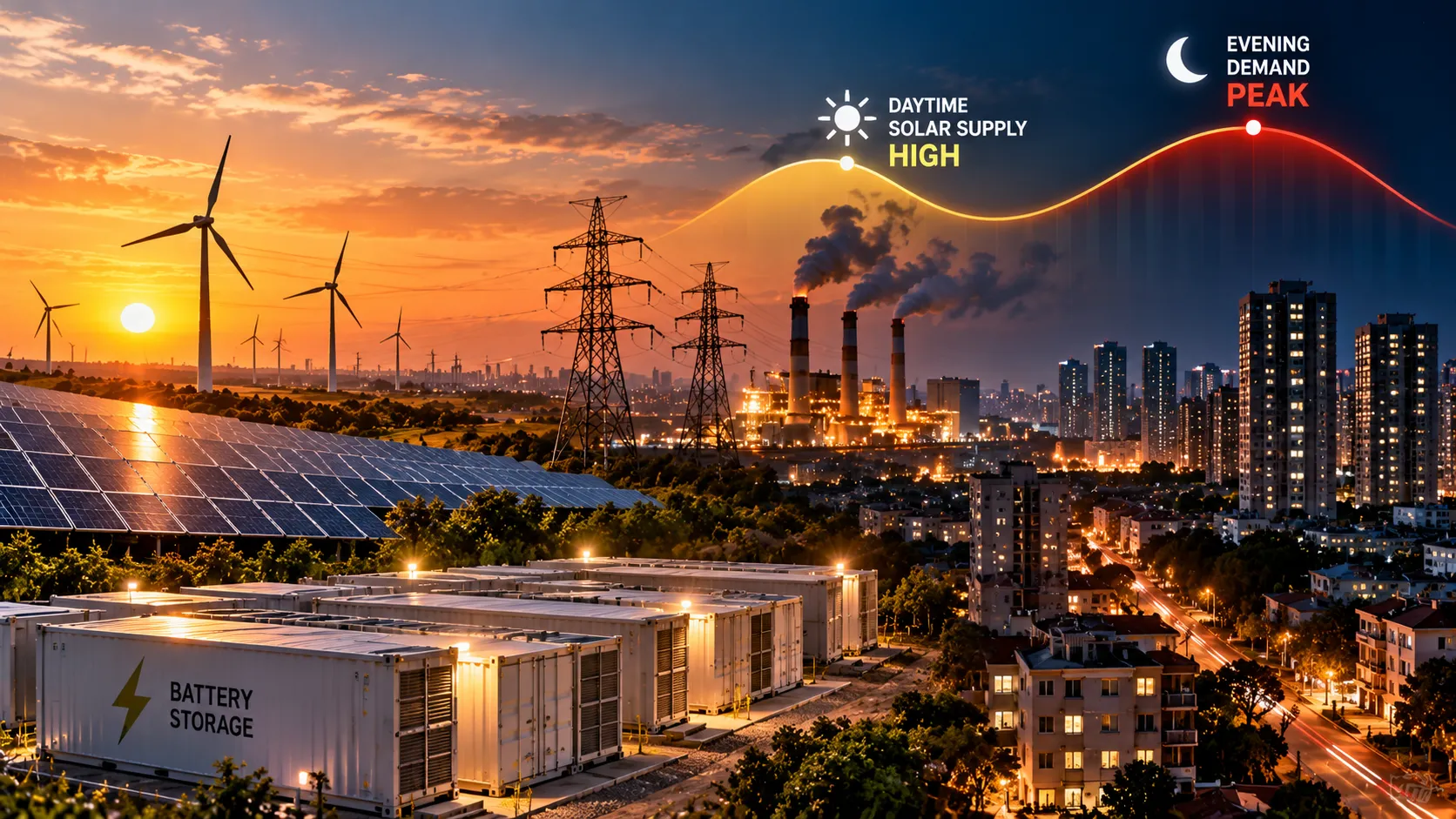
A deeper structural issue lies behind the immediate shortages. India's renewable energy capacity has grown from 13 GW in 2011 to more than 220 GW, transforming the country's power mix. But since 2016-17, demand has grown by about half, while total capacity has grown by about a third and non-intermittent capacity, from coal, gas, hydro and nuclear, by less than a fifth.
As a result, India's non-intermittent capacity per 100 MW of evening peak demand has fallen by about a quarter since 2016-17, back to its 2010-11 level, according to the analysis. During the day, abundant solar power meets much of the demand, but after sunset, the grid relies on coal and hydro plants that have not kept pace.
Battery storage, which could store daytime solar power for use in the evening, remains limited. The power ministry is pushing renewable energy producers to add batteries for use after sunset, but deployment is still in its early stages.
Distribution companies under strain
The analysis also points to weaknesses in power distribution. From 2020-21 to 2022-23, real investment in distribution stayed roughly flat while power sales rose about 50%. Investment has risen since 2023-24 but has not caught up. Only about a quarter of planned smart meters have been installed despite central funding.
Some states have shown what is possible. In Odisha, the share of power lost or unpaid fell from 31% to 18% within three years after a private operator took over distribution companies in 2020-21. Gujarat's four state-owned distribution companies rank among the ten best in the power ministry's latest ratings.
"The binding constraint is political economy, not technology," the analysis concludes, arguing that reforms to distribution, tariffs and market design are as important as building new capacity.
The government's response
The government has taken several steps. It shelved a proposed mandate to import coal because of high international prices and the weaker rupee, according to Bloomberg, and instead directed Coal India to increase domestic output and the Railways to improve coal transport to power plants.
Policymakers are also encouraging investment in storage and flexible generation. Pumped hydro storage and battery projects are being tendered across states, and regulators in Gujarat and elsewhere have issued rules for grid-connected battery storage.
Implications for growth and the AI boom
Reliable power is essential for India's economic ambitions. Manufacturing, data centres and electric vehicles all depend on a stable grid. India's data centre industry, expanding rapidly on the back of AI and cloud demand, could add significantly to electricity consumption in the coming years. Climate economist Nicholas Stern argued this week that data centre developers should be required to supply their own renewable power.
Renewables and the timing gap
India has added solar capacity at a rapid pace, but solar output peaks in the middle of the day and falls to zero after sunset. That leaves conventional power plants, mainly coal, to meet demand in the evening, when household consumption rises. Without enough battery storage or flexible generation, the grid struggles to cover the evening peak, even when total installed capacity appears ample.
What comes next
Relief may come as temperatures ease and demand moderates after the monsoon season, but the structural issues will remain. Investment in battery storage, pumped hydro, transmission and distribution, along with reforms to make the power market more efficient, will be needed to ensure that India's clean energy transition delivers reliable electricity around the clock.
For now, the evening power crunch is a reminder that adding solar panels is only half of the energy transition. The other half is making sure the lights stay on after the sun sets. Without faster progress on storage and grid flexibility, analysts warn that evening shortages could become a recurring feature of India's power system, even as installed capacity continues to grow. The issue is likely to feature prominently in policy discussions in the months ahead.