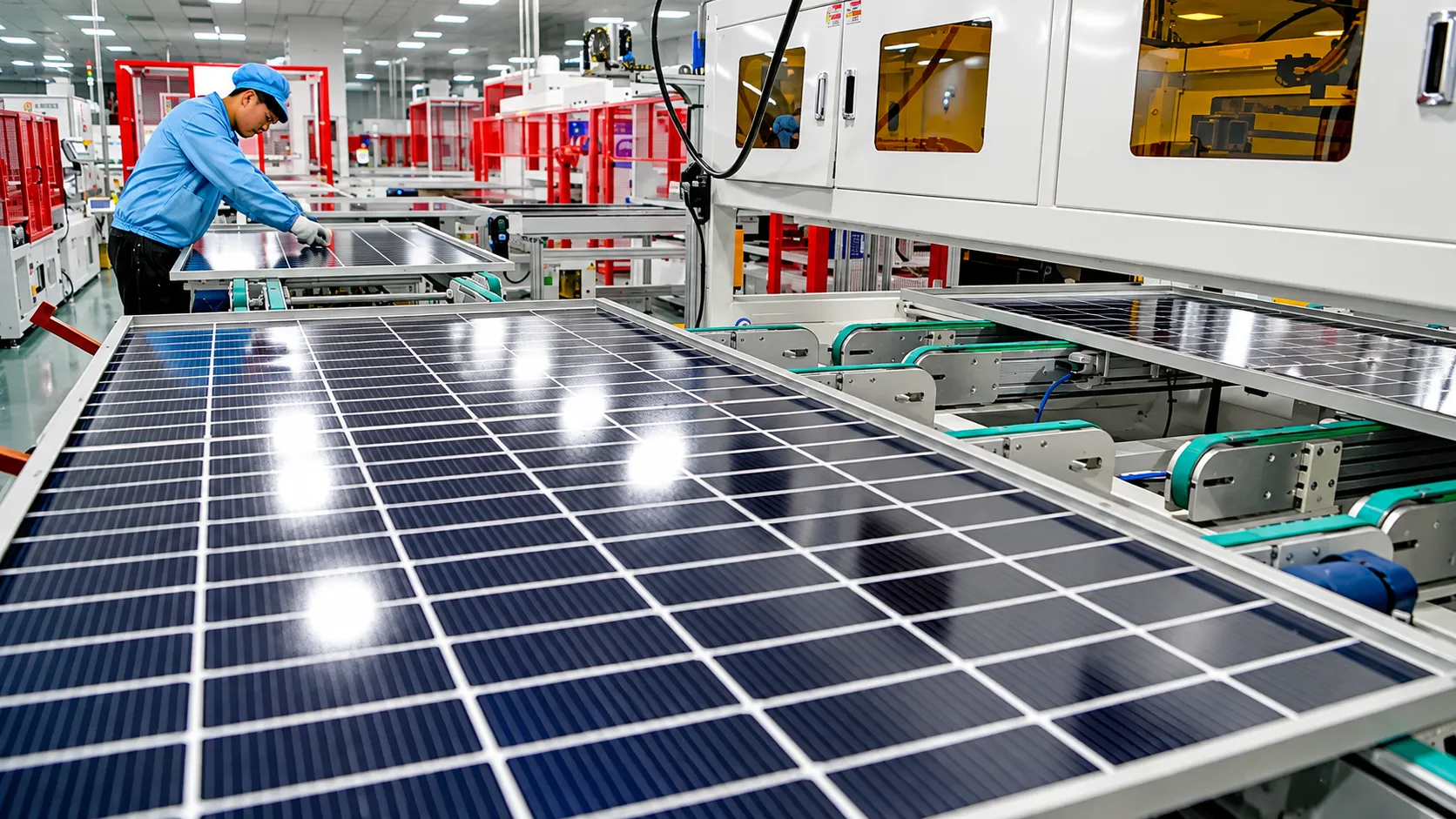
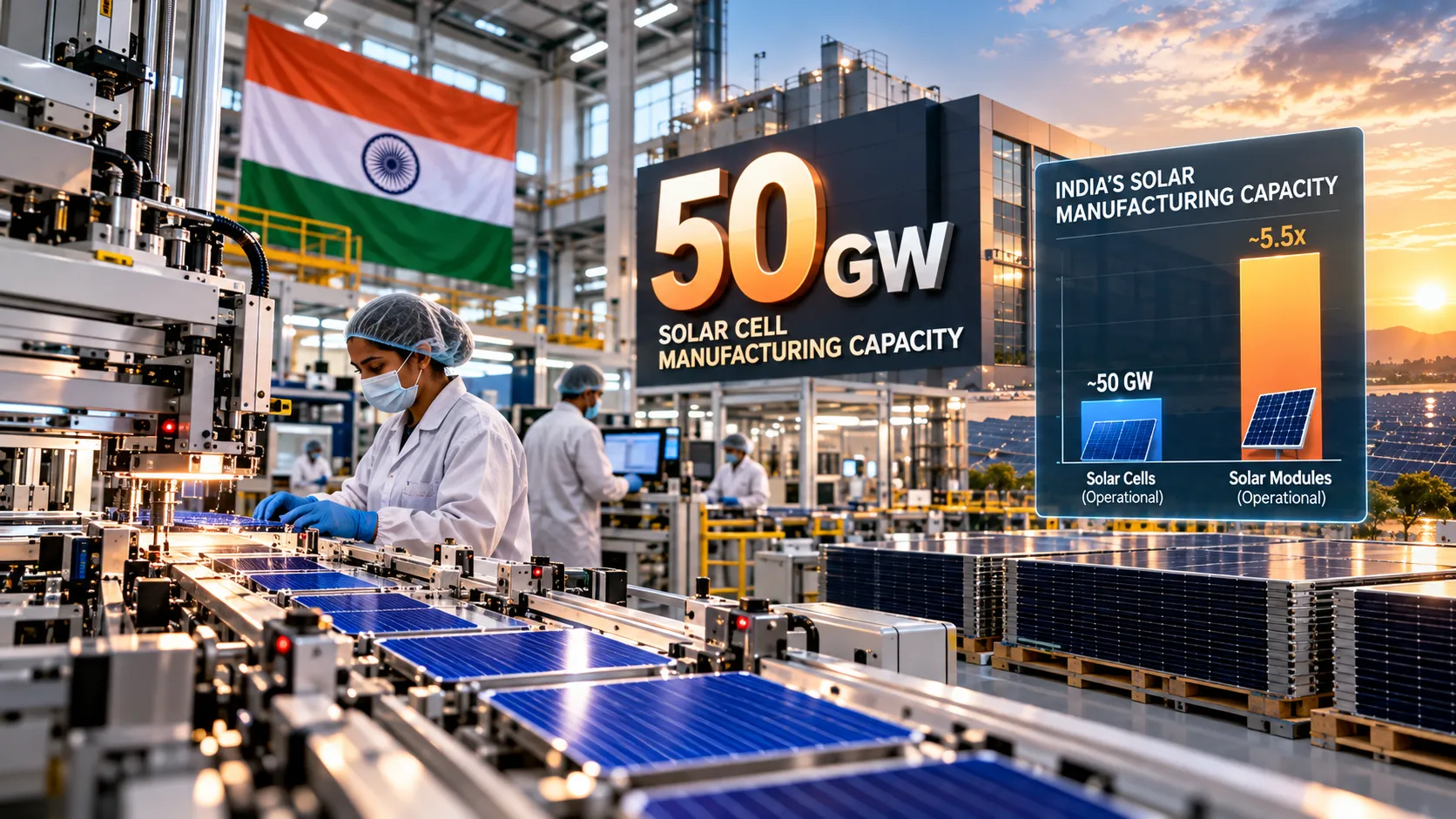
India's operational capacity to manufacture solar cells is approaching 50 gigawatts, according to Mercom India's PV Manufacturing Tracker. The milestone shows how quickly the country has moved to build the most technically demanding part of the solar module supply chain at home.
The figure, published by the research firm on October 13, represents a dramatic expansion. In 2024, India had just over 7 GW of cell-making capacity against roughly 80 GW of module assembly capacity, and module makers relied overwhelmingly on imported cells, most of them from China. Today, domestic cell lines are being commissioned at a pace few in the industry expected.
The same Mercom data, however, carries a reminder of the distance still to travel. Operational module manufacturing capacity is about 5.5 times larger than cell capacity. India can assemble far more panels than it can supply with domestically made cells, and the upstream stages of the chain, ingots, wafers and polysilicon, remain overwhelmingly imported.
Why cells matter
A solar module is essentially a frame of glass, backsheet and wiring wrapped around a set of solar cells, the components that convert sunlight into electricity. Module assembly is relatively simple and capital-light, which is why India's module capacity grew so quickly over the past decade. Cell manufacturing is a different proposition. It requires precise, high-volume semiconductor processes, expensive equipment and sophisticated process engineering.
That is why cells have long been the bottleneck in India's push for solar self-reliance. A country that assembles modules from imported cells captures only a small share of the value and remains exposed to supply shocks and price swings in the exporting country.
Policy as the catalyst
The surge in cell capacity has been driven largely by policy. The government's production-linked incentive scheme for high-efficiency solar modules rewarded companies that invested in integrated manufacturing, from cells upward. More decisively, the Ministry of New and Renewable Energy extended its Approved List of Models and Manufacturers, known as ALMM, to cells. Under ALMM List-II, which took effect from June 2026, solar projects covered by the mandate, including government-backed schemes and net-metered installations, must use modules built with domestically manufactured cells.
That requirement created a guaranteed market for Indian cell makers and gave manufacturers the confidence to commit capital. Large integrated players have commissioned cell lines alongside their module plants. Tata Power's solar manufacturing arm, for example, runs a 4.3 GW cell and module facility in Tirunelveli, Tamil Nadu. Smaller companies are also entering the segment. On the same day as the Mercom data, Shakti Energy Solutions, a subsidiary of Shakti Pumps, was reported to be building a 2.2 GW high-efficiency cell and module plant at Pithampur in Madhya Pradesh.
The upstream challenge
Cells, important as they are, are only one link in the chain. They are made from wafers, which are sliced from ingots, which in turn are grown from polysilicon. China dominates every one of these stages, controlling the vast majority of global capacity and setting prices for the industry worldwide.
India has only begun to build this upstream base. Several large groups have announced ingot and wafer projects. Tata Power Renewable Energy, for instance, has announced plans for a 10 GW ingot and wafer facility at Nellore in Andhra Pradesh. But these projects are capital-intensive, technically complex and will take years to reach scale. Until they do, Indian cell makers will remain dependent on imported wafers, exposed to the same supply risks the cell push was meant to reduce.
The 5.5-to-1 gap between module and cell capacity also raises the prospect of a shake-out. Module makers that do not integrate backwards into cells, or secure reliable access to domestic cells, may struggle to sell into the large share of the market now governed by domestic content rules. Industry consolidation is a likely outcome as the sector matures.
Policymakers have signalled that they intend to move further up the chain over time, extending domestic content requirements from cells to wafers once enough local capacity exists. Such a step would give wafer and ingot projects the same assured demand that ALMM List-II gave cell makers, but it would also raise costs for developers if introduced before supply is ready, a balance the government will need to manage carefully.
Export ambitions meet trade barriers
India's solar manufacturers have also looked abroad, particularly to the United States, where demand for non-Chinese supply has been strong. That opportunity has narrowed. In February 2026, Washington imposed steep duties on Indian solar imports, sharply reducing the attractiveness of the US market for Indian exporters and leaving more capacity to compete at home.
The domestic market is large enough to absorb much of it. India was the world's second-largest market for new solar and wind installations in 2025, according to BloombergNEF, and is expected to remain the second-largest solar market for the foreseeable future. Still, manufacturers will need to stay competitive on cost and technology, especially as global module prices remain under pressure from Chinese overcapacity.
Technology and quality
The pace of technological change in solar is another challenge for new capacity. Cell technology has shifted rapidly in recent years from older PERC designs to higher-efficiency architectures such as TOPCon and heterojunction. Manufacturers that invest in the latest processes can produce more efficient, more competitive cells. Those that lock in older technology risk being left with lines that are obsolete before they have paid for themselves.
Quality and bankability matter as well. Developers and lenders want assurance that modules made with Indian cells will perform reliably for 25 years or more in harsh conditions. Building that track record will be essential if Indian manufacturers are to command the trust of large project developers at home and customers abroad.
A milestone worth marking
None of these challenges diminishes the significance of nearing 50 GW. In roughly two years, India has gone from a marginal cell producer to one with capacity of global relevance, creating thousands of skilled manufacturing jobs and reducing the import dependence of a sector central to its climate goals.
The next phase will be harder. Closing the gap between modules and cells, building out wafers and polysilicon, keeping pace with technology and staying cost-competitive in a market shaped by Chinese scale will all require sustained investment and consistent policy. If India can manage that, it will have built not just a solar assembly industry but a genuine solar manufacturing base, one that strengthens both its energy security and its place in global clean-energy supply chains.