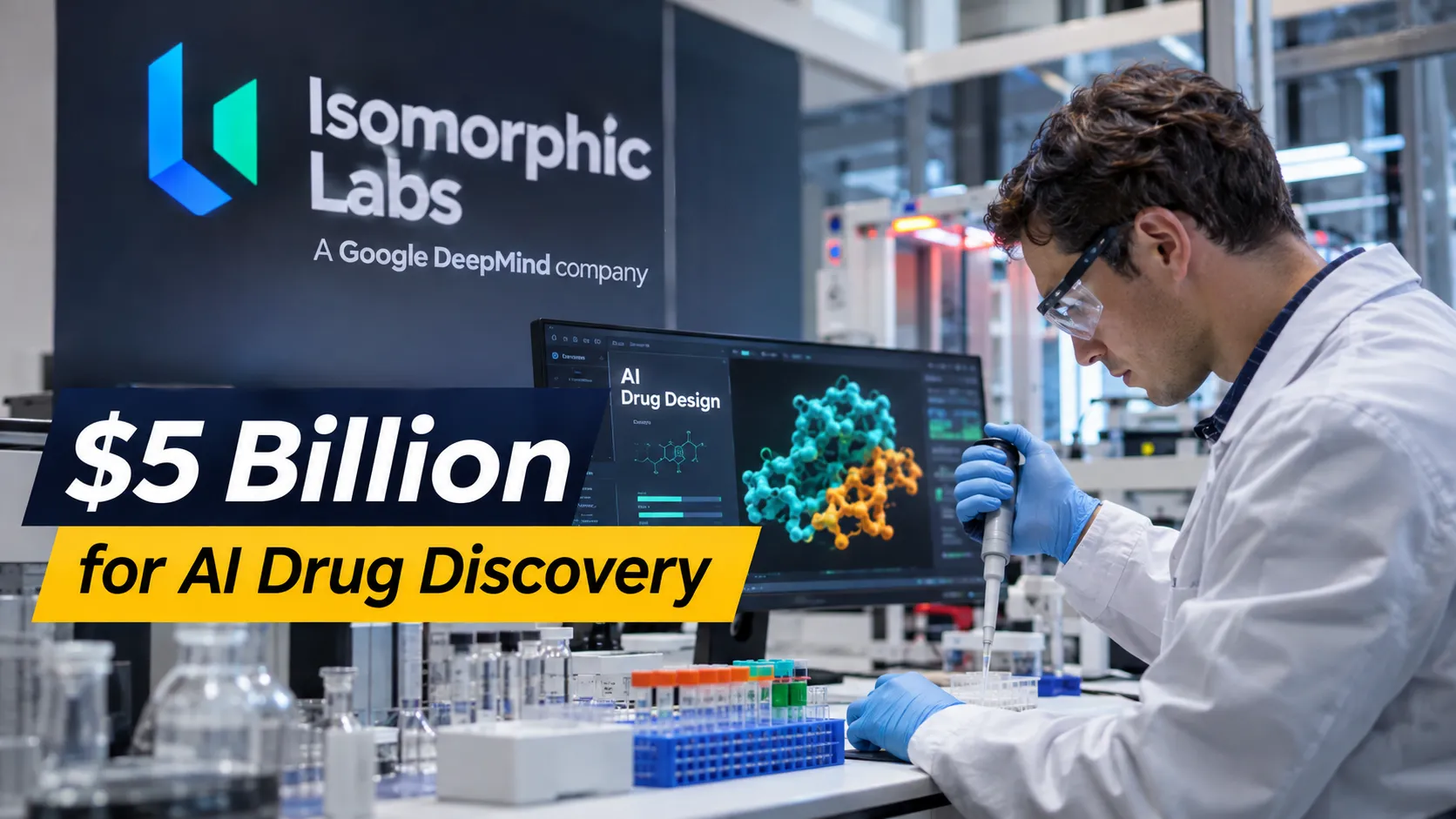
Six months after one of the largest funding rounds in biotech history, Isomorphic Labs has raised more than twice as much again.
Isomorphic Labs, the London-based AI drug discovery company spun out of Google DeepMind, announced a $5 billion Series C funding round on Tuesday, November 17, according to Tech Startups. The round was co-led by Greenoaks and Sequoia Capital.
Andreessen Horowitz and Alphabet also participated, along with existing investors Thrive Capital, MGX, GV, CapitalG, Temasek and the UK Sovereign AI Fund. The company did not disclose its valuation. Earlier reports by Dealroom and others had said Isomorphic was in talks to raise about $5 billion at a valuation of about $50 billion.
The round follows a $2.1 billion Series B in May 2026.
The DeepMind connection
Isomorphic Labs was founded in 2021 by Demis Hassabis, the co-founder and chief executive of Google DeepMind, who also leads Isomorphic. It was spun out of DeepMind to apply AI to drug discovery, building on the success of AlphaFold, the AI system that predicts the three-dimensional structures of proteins.
AlphaFold transformed biological research by predicting the structures of hundreds of millions of proteins, a task that previously required years of laboratory work for each protein. Hassabis and DeepMind colleague John Jumper shared the 2024 Nobel Prize in Chemistry for the work.
How Isomorphic designs drugs
Isomorphic's IsoDDE drug design system proposes and refines candidate molecules computationally before they move into laboratory development, according to Tech Startups. By predicting how molecules interact with biological targets, the system aims to identify promising drug candidates faster and more cheaply than traditional methods.
The company has partnerships with Eli Lilly, Novartis and Johnson & Johnson, and runs its own drug programmes in oncology and immunology. It reports encouraging preclinical results, although these do not establish safety or effectiveness in patients.
Why drug discovery is ripe for AI
Developing a new drug typically takes more than a decade and costs billions of dollars, with most candidates failing in clinical trials. Much of the cost comes from the trial-and-error process of finding molecules that bind to the right targets, are safe and can be manufactured.
AI promises to accelerate this process by predicting molecular properties, simulating interactions and prioritising the most promising candidates. If successful, it could reduce costs, shorten timelines and increase the success rate of drug development, potentially bringing new treatments to patients faster.
The scale of the bet
A $5 billion round is extraordinary for a company that has not yet tested a drug in humans. Trending Topics described the round as a mega-round without a single drug tested in humans. Investors are betting that Isomorphic's technology will produce a pipeline of drugs that justify the investment, either through its own programmes or partnerships with pharmaceutical companies.
The size of the round also reflects the enormous capital being raised by AI companies across sectors, as investors seek exposure to what they see as transformative technology. The funding will allow Isomorphic to expand its computing infrastructure, laboratory capabilities and team, and to advance drug candidates into clinical trials.
The UK angle
The participation of the UK Sovereign AI Fund underscores the importance the British government places on Isomorphic as a national AI champion. London has become one of the world's leading centres for AI research, anchored by DeepMind, and the government has sought to support homegrown AI companies.