
ImpactSustainability5 MIN READ

Global Standard-Setter ISSB Proposes Nature-Related Disclosure Rules, Building on the TNFD Framework

The International Sustainability Standards Board has released a draft of nature-related disclosure requirements to help investors understand companies' exposure to risks such as biodiversity loss, water scarcity and land degradation. The proposal, a non-mandatory Practice Statement drawing heavily on the TNFD framework, is open for comment until February 19, 2027.

By Prathista Lazar · Author23 October 2026New
Global Standard-Setter ISSB Proposes Nature-Related Disclosure Rules, Building on the TNFD Framework

The International Sustainability Standards Board, the body setting global standards for corporate sustainability reporting, has taken a major step towards making companies disclose how they depend on and affect the natural world.

The ISSB, part of the IFRS Foundation, released an exposure draft of proposed nature-related disclosure requirements on Thursday, October 22, ESG Today reported. The proposals aim to give investors consistent and comparable information about the risks and opportunities companies face from nature, such as biodiversity loss, water scarcity, soil degradation and pollution.

A Practice Statement, not a standard

The draft takes the form of a non-mandatory Practice Statement rather than a new standard. Companies would not be required to comply with it to claim compliance with ISSB standards, though individual jurisdictions could choose to make it mandatory. The ISSB will also seek feedback on whether nature content should instead become a mandatory standalone standard.

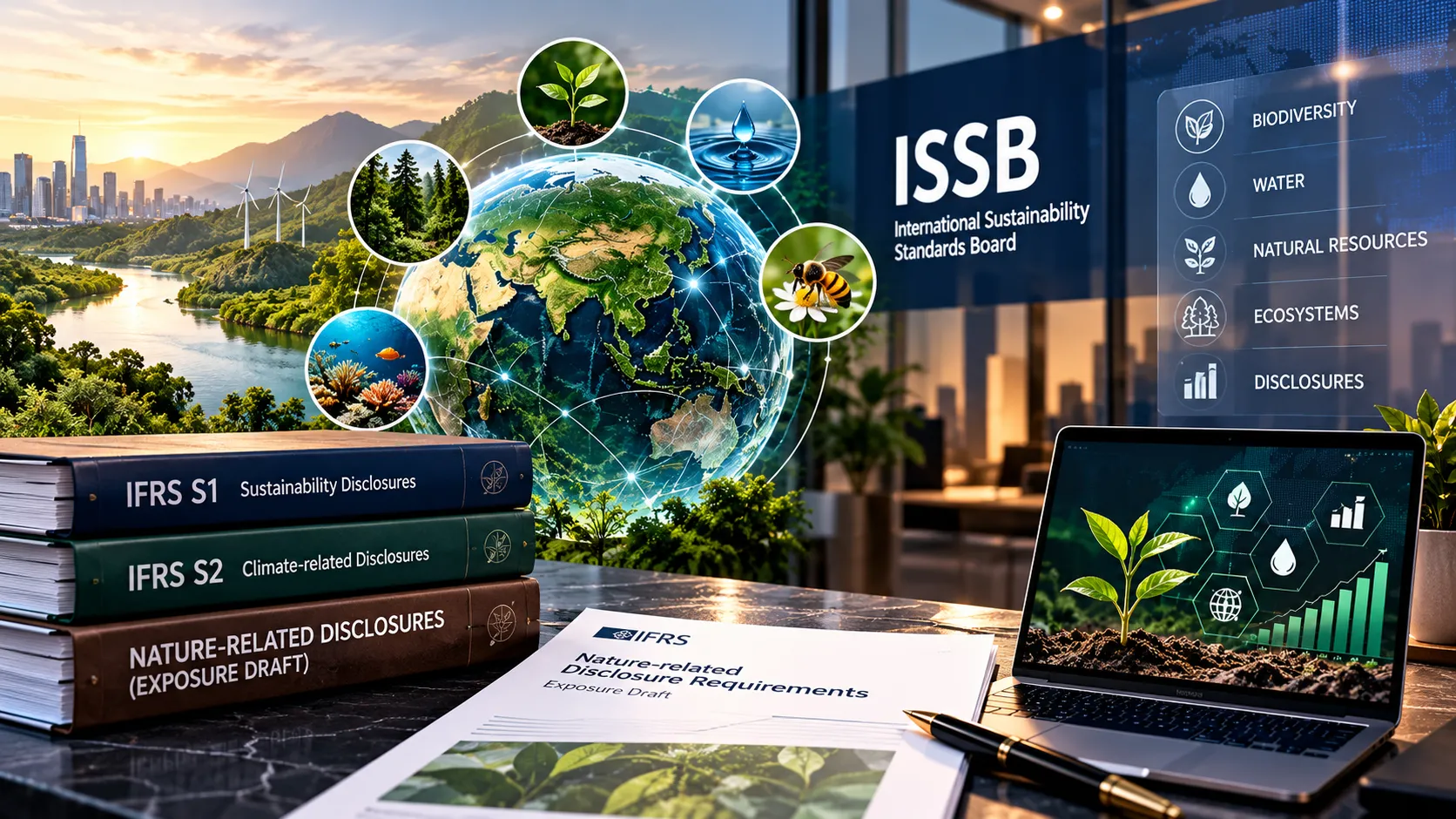
The board said it chose this format to limit disruption for companies that are already working to apply its first two standards, IFRS S1 on general sustainability disclosures and IFRS S2 on climate-related disclosures, which were released in June 2023.

"We recognise that companies are deeply engaged with applying IFRS S1 and IFRS S2 for the first time," said Sue Lloyd, the ISSB's vice-chair.

IFRS S1 already requires companies to disclose material nature-related sustainability risks and opportunities, but it does not include nature-specific requirements. The Practice Statement would provide that detail.
7348c79d-2167-4cde-9179-09d5b8ef0276.png

What companies would disclose

Under the proposals, companies would explain how they have responded, and plan to respond, to nature-related risks and opportunities in their strategy and decision-making. They would assess the resilience of their strategy and business model to nature-related uncertainties.

Companies would also disclose the amount and percentage of their assets or business activities vulnerable to nature-related risks, as well as those aligned with nature-related opportunities. They would report nature-related targets, including what each target covers, its location-specific aspects and objectives, and whether it was informed by law or regulation.

The emphasis on location is significant. Unlike carbon emissions, which have the same effect on the climate wherever they occur, nature-related impacts depend heavily on where activities take place. Drawing water in a water-stressed region, for example, carries very different risks from doing so where water is plentiful.

Building on the TNFD

The ISSB drew heavily on the framework developed by the Taskforce on Nature-related Financial Disclosures, a market-led initiative launched in 2021 that published its recommendations in 2023. After the ISSB announced its plans to work on nature last year, the TNFD ended its own technical work programme, effectively handing the baton to the ISSB.

The ISSB said companies already using the TNFD framework would be well placed to apply the Practice Statement. Hundreds of companies and financial institutions around the world have committed to reporting in line with TNFD recommendations.

ISSB chair Emmanuel Faber said that "companies that comply with an IFRS Sustainability Practice Statement on nature-related disclosures will be best placed" to meet investor needs. TNFD co-chair David Craig welcomed the publication of the exposure draft.

The ISSB also said companies applying other frameworks, such as the Global Reporting Initiative or the European Sustainability Reporting Standards, could apply the Practice Statement efficiently alongside them.


“We recognise that companies are deeply engaged with applying IFRS S1 and IFRS S2 for the first time.”
— Sue Lloyd, Vice-Chair, ISSB

Why nature matters to investors

More than half of global economic output depends moderately or highly on nature, according to estimates by the World Economic Forum. Agriculture, food and beverages, construction, pharmaceuticals and tourism, among other sectors, rely on ecosystem services such as clean water, pollination, fertile soil and stable climates.

As biodiversity declines and ecosystems degrade, these dependencies create financial risks. Investors want to understand which companies are most exposed and how they are managing those risks, just as they have increasingly sought information on climate risks.

Regulators and central banks have also begun considering nature-related financial risks, recognising that ecosystem degradation could affect financial stability.

What it means for India

India has been an early adopter of mandatory sustainability reporting. The Securities and Exchange Board of India requires the top 1,000 listed companies by market capitalisation to publish Business Responsibility and Sustainability Reports, which include environmental disclosures on energy, water, waste and biodiversity. The largest companies must also obtain assurance on key metrics.

Indian regulators have been considering how to align domestic requirements with ISSB standards. The Institute of Chartered Accountants of India has worked on sustainability reporting standards influenced by the global frameworks.

India is also one of the world's most biodiverse countries and faces significant nature-related pressures, from water stress and soil degradation to forest loss and pollution. Indian companies in agriculture, food processing, textiles, mining and infrastructure have significant dependencies and impacts on nature, making the ISSB proposals relevant to investors in those sectors.

The rise of sustainability reporting

The ISSB was created in 2021 in response to demand from investors for consistent sustainability information. Before its creation, companies reported under a patchwork of voluntary frameworks, making comparisons difficult. The ISSB consolidated several existing initiatives, including the Climate Disclosure Standards Board and the Value Reporting Foundation.

Since releasing IFRS S1 and S2, the ISSB has seen its standards adopted or used as the basis for requirements in a growing number of jurisdictions, including Australia, Japan, Singapore, Brazil and others. The European Union has its own European Sustainability Reporting Standards, which take a broader approach, while the United States has moved away from federal climate disclosure rules.

What comes next

The consultation runs until February 19, 2027. After reviewing feedback, the ISSB will decide whether to finalise the Practice Statement or develop a mandatory standard.

For companies, the proposals signal that nature is joining climate as a core area of sustainability reporting. Those that begin assessing their nature-related risks now will be better prepared as disclosure expectations grow. For Indian companies with international investors or operations, aligning early with the ISSB's nature-related disclosure framework could become a competitive advantage. Investors are increasingly asking how companies manage water, land use and biodiversity risks, particularly in supply chains linked to agriculture and raw materials, and clearer reporting standards will make those comparisons easier. Regulators in India may also look to the final framework when reviewing future disclosure requirements. Feedback from companies and investors during the consultation will shape the final outcome.

TagsISSBIFRS Foundationnature-related disclosuresbiodiversityTNFDsustainability reportingIFRS S1IFRS S2Emmanuel FaberSue LloydESGnature riskclimate disclosureinvestorsGRIESRSSEBI BRSRIndia ESGnatural capitalcorporate reporting

Reader reviews

Sign in to rate and review this article.
Loading reviews…