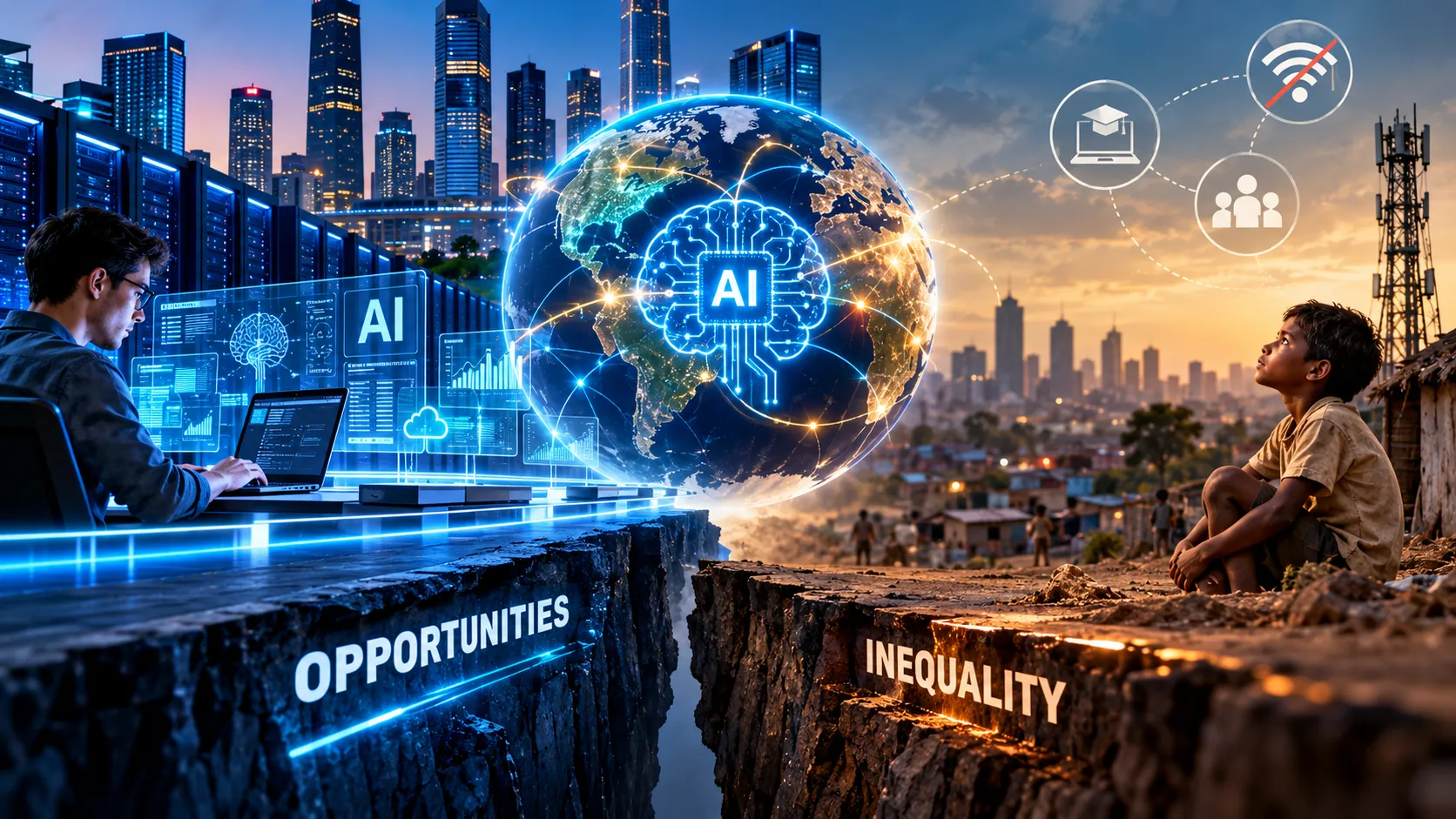
Artificial intelligence could widen the gap between rich and poor countries, creating a new form of inequality that goes beyond access to the internet, a senior United Nations official has warned.
Tomas Lamanauskas, deputy secretary-general of the International Telecommunication Union (ITU), the UN agency for information and communication technologies, told Al Jazeera on Sunday, October 25, that "the AI divide is really the big concern." He was speaking on the sidelines of the UN Conference on Trade and Development's World Investment Forum in Doha, Qatar.
"So a great divide could really mean an opportunity divide, and really could deepen the socioeconomic divide," Lamanauskas said.
Beyond the digital divide
For years, development experts have focused on the digital divide, the gap between people who have access to the internet and those who do not. Lamanauskas argued that AI adds a new and potentially deeper layer of inequality, because the benefits of AI depend not only on connectivity but on computing infrastructure, data, skills and the ability to shape the technology.
"So you clearly see still a rather big infrastructure divide," he said. "This actually affects your ability to be productive and to be part of job-market opportunities."
The numbers behind the divide
The figures cited in the discussion illustrate the scale of the challenge. About 2.2 billion people still lack internet access. Africa and Latin America together account for just 3.3% of global data centre capacity, meaning most of the computing power needed to run AI is concentrated in North America, Europe and Asia.
Closing the digital infrastructure gap would require an estimated $2.8 trillion of investment by 2030.
Adoption of AI tools is also uneven. About 29% of working-age people in developed countries use generative AI, compared with 16% in developing nations. Only 7% of African languages are represented in AI translation tools, limiting the usefulness of AI for hundreds of millions of people.
Jobs at stake
AI is expected to transform labour markets. Estimates cited in the discussion suggest AI could displace 90 million jobs while creating 170 million new ones, and that about 40% of workplace skills could change by 2030.
The 2026 International AI Safety Report, published in February, estimated that about one billion people use AI and that roughly 60% of jobs in advanced economies and 40% in emerging economies could be exposed to AI-related impacts, though it noted that concrete data is limited.
Fazl Barez of the University of Oxford told Al Jazeera that "the fears are real," but urged distinguishing between AI automating tasks and replacing entire jobs. He noted that routine cognitive work is particularly exposed, though the scale of impact remains uncertain.
AI cannot be stopped
Lamanauskas said he did not believe AI's advance could be halted. "AI is here to stay, and AI is here to transform our lives," he said. "AI is not a technology that can be controlled by one person or organisation or one company."
Instead, he called for greater investment in digital infrastructure, education and regulation, so that developing countries can not only use AI but help shape it. "The way forward is really to invest to make sure that the AI benefits everyone," he said.
Progress on national strategies
There are some signs of progress. According to figures cited in the report, 104 countries now have national AI strategies, compared with just four a decade ago. Governments are increasingly recognising the importance of AI for economic development and national competitiveness.
A December 2025 report by the UN Development Programme warned that AI could trigger a new era of inequality between nations, with countries that have unreliable power, limited connectivity and few technological skills at risk of missing out on its economic gains.
What it means for India
India occupies a distinctive position in the AI divide. It has a large and growing technology industry, a deep pool of engineering talent and a successful track record in building digital public infrastructure such as Aadhaar and UPI. The government's IndiaAI Mission aims to build national computing capacity and support Indian AI models, including models for Indian languages.
At the same time, India faces many of the challenges Lamanauskas described. Hundreds of millions of Indians have limited digital skills, internet access is uneven between urban and rural areas, and AI tools often perform poorly in Indian languages. India has positioned itself as a voice for the Global South on AI governance, and its experience with digital public infrastructure offers a model that other developing countries are studying.
Investment as the answer
The World Investment Forum, which brings together governments, investors and international organisations, is focused on mobilising investment for development. The scale of investment needed to close the digital divide, estimated at $2.8 trillion by 2030, far exceeds what governments in developing countries can provide alone, making private investment essential.
Data centres, undersea cables, mobile networks and power infrastructure are among the areas where investment is needed.
Building local AI capacity
Experts argue that developing countries need more than access to AI tools built elsewhere. Building local capacity, including data centres, research institutions, skilled workforces and datasets in local languages, allows countries to adapt AI to their own needs and capture more of its economic value. Without such capacity, countries risk becoming consumers of foreign AI services, with value and data flowing abroad.
Initiatives to develop AI models for underrepresented languages, including African and Indian languages, are one response. Open-source AI models, which can be freely downloaded and adapted, also lower barriers for developers in countries with limited resources.
What comes next
The ITU and other UN agencies are working on initiatives to expand connectivity, build AI skills and support developing countries in shaping AI governance. The success of these efforts will depend on mobilising investment and on whether wealthy countries and technology companies share the benefits of AI more broadly.
As AI reshapes economies, the risk is that countries left behind will find it ever harder to catch up. Lamanauskas's warning is a call to act before the opportunity divide becomes entrenched. The World Investment Forum, which runs from October 25 to 27, also brings together ministers and investors to discuss sustainable development financing, climate investment and the role of private capital in closing infrastructure gaps across developing economies.